






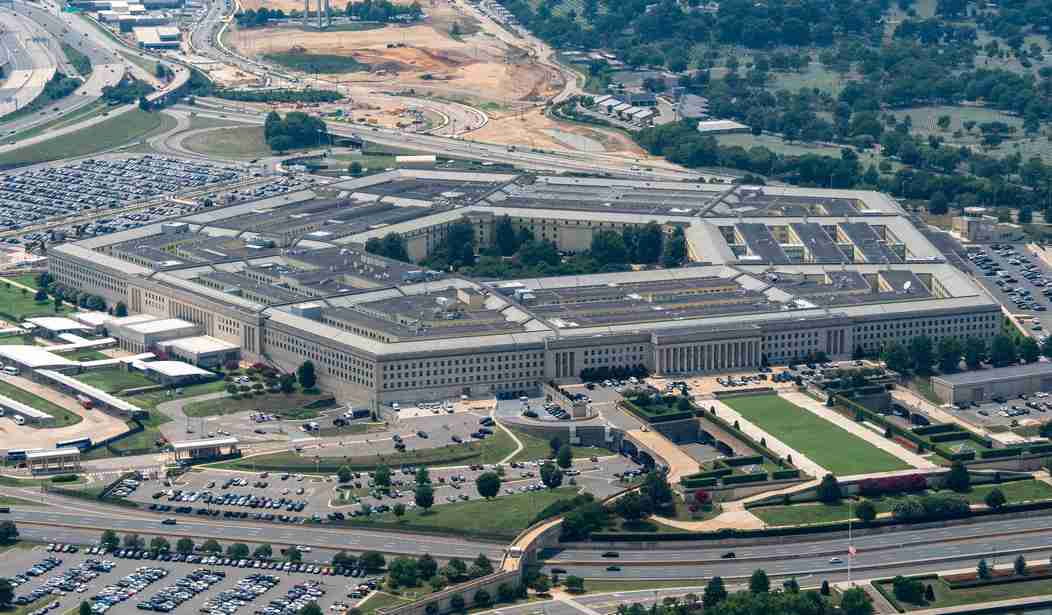
We're getting some big court decisions out of D.C. on Friday, including one that allows the Pentagon to continue excluding Anthropic's Claude from its supply chain after the artificial intelligence company refused to allow the military to use its technology for all lawful purposes, a divided federal appeals court ruled.
In Anthropic PBC v. Department of War, the D.C. Circuit on Friday denied Anthropic's challenges to its designation as a supply-chain risk, handing the Trump administration a significant win in a dispute that raises some thorny questions about how much control an AI company can retain over its product once the military puts it to work.
Judge Gregory Katsas (Trump) wrote the 2-1 decision, joined by Judge Neomi Rao (Trump). Judge Karen LeCraft Henderson (Bush 41) dissented.
Anthropic hasn't refused to allow the military to use Claude — far from it. The company has permitted the AI system to be used for weapons development, foreign-intelligence analysis, and offensive cyber operations, among other things.
But it has drawn two lines: Anthropic won't allow Claude to be used for lethal autonomous weapons or mass domestic surveillance. The Department of War wanted something broader — permission to use Claude for “all lawful purposes.” Anthropic wouldn't agree.
The dispute came to a head after Anthropic raised concerns about Claude's use in a sensitive overseas military operation. Anthropic itself placed media reports in the record identifying that operation as the January capture of Venezuelan leader Nicolás Maduro. Defense officials subsequently questioned whether they could depend on Claude to function as expected during military operations.
In March, Secretary of War Pete Hegseth formally determined that Claude presented a supply-chain risk under the Federal Acquisition Supply Chain Security Act (FASCSA). The department ordered Claude removed from its systems and barred contractors from using Anthropic products for department work.
Anthropic challenged that decision, but the D.C. Circuit has now sided with the administration.
At the heart of the dispute is a surprisingly ordinary word: “manipulate.” FASCSA allows the government to address supply-chain risks involving technology whose design or operation may be manipulated in a way that denies, disrupts, or otherwise affects its function.
Anthropic argued that Congress was talking about something more nefarious — sabotage, malicious code, compromised foreign technology, and the like. Anthropic, by contrast, openly programs Claude to refuse certain tasks based on its safety policies.
But the majority wasn't persuaded that the distinction matters. Because Anthropic intentionally designs and trains Claude to refuse certain uses, Katsas concluded, it is deliberately manipulating how the technology functions. In fact, he noted, there's not simply a risk that Anthropic will do so; given the company's restrictions, it's a “certainty.”
That doesn't mean the court concluded Anthropic has sinister motives, though: “We have no reason to doubt that Anthropic manipulates Claude's function, use and operation with noble intentions,” Katsas wrote.
But under the statute, the majority concluded, what Anthropic does matters more than why it does it. That also explains an apparent contradiction with another recent Anthropic court victory. In August, a federal judge in California rejected a separate Pentagon designation of Anthropic as a supply-chain risk under a different federal law.
The D.C. Circuit says the two rulings can coexist: The statute involved in the California case focuses on an “adversary,” language carrying implications of malicious or subversive conduct. FASCSA, however, applies more broadly to “any person” and contains its own definition of supply-chain risk — without any requirement of bad motive.
Anthropic also contended that the Pentagon retaliated against it for its public advocacy regarding AI safety, pointing in part to Hegseth's criticism of the company's “sanctimonious rhetoric,” “virtue-signaling,” and “Silicon Valley ideology.”
The majority acknowledged that Anthropic's advocacy is protected by the First Amendment but found that the company's speech wasn't what caused its exclusion. The department acted, it concluded, because Anthropic refused to agree to the “all lawful purposes” provision.
Henderson, however, saw the statute quite differently. In dissent, she argued that the majority reads “manipulate” far too broadly and that, viewed in context, Congress was targeting subversive or deceptive interference with government technology — not a company openly enforcing known restrictions on its own product.
The disagreement ultimately boils down to two competing risks: Anthropic fears what could happen if increasingly powerful AI systems are given unfettered control over functions such as lethal targeting. The military fears what could happen if an AI system it relies upon during an operation unexpectedly refuses to perform.
The D.C. Circuit didn't decide which fear is more justified with this ruling. It decided that, under the statute Congress enacted, that call belongs to the President and Secretary of War — not Anthropic:
This case raises profoundly difficult questions about the appropriate military uses of an almost unimaginably powerful new technology. The Secretary raises the deeply sobering prospect of overly constrained AI models shutting down unexpectedly and thus causing important military operations to fail. Anthropic raises the deeply sobering prospect of unconstrained AI models hallucinating inappropriate targets for lethal military force. Both possibilities present obvious national-security concerns. But in our Republic, it is the President and the Secretary of War who must determine how best to balance the competing risks. In doing so here, the Secretary did not transgress any limits on his authority under the Supply Chain Security Act or the Constitution. Accordingly, we deny the petitions for review.
Now, as with so many of these rulings, it's important to note: It ain't over yet. Anthropic could still seek rehearing en banc (i.e., by the full circuit) and/or appeal the decision to the Supreme Court. But for now, the Pentagon may continue excluding Anthropic from its supply chain.
Editor's Note: Thanks to President Trump and War Secretary Pete Hegseth's leadership, the warrior ethos is coming back to America's military.
Help us continue to report on Trump and Hegseth's successes as they make our military great again. Join RedState VIP and use promo code FIGHT to receive 60% off your membership.

Join the Conversation
VIP members get the ability to comment on articles.