
I knew it was cold that night in Resolute near the top of Canada’s Northwest Territories. But not how cold.
I was wearing an Arctic parka with hood, Arctic pants and mittens, a scarf, thick boots, and a balaclava over my head and face.
It was a five-minute walk to the airplane hangar from the Quonset hut full of beds that passed for a hotel. I failed to realize a patch of cheek was exposed under my glasses. Frostbite. Soon, the skin turned black, painful, peeled off, and would become a repeated health problem years later.
It was 38 degrees below zero.
It could have been noon in the long darkness of that Arctic winter. But it was midnight, and I was about to put my life into the hands of Spike Sheret and three other crew members of his four-engine Hercules cargo craft.
Sheret was a veteran pilot for Pacific Western Airlines, a Herc Rat in those days flying outsized cargo all over Canada’s vast Arctic, which covers 40 percent of the country's four-million-square miles. Two weeks off, then two weeks of 12-hour flight “days” like that night.
''One time we flew a sailboat, caviar, and thousands of goldfish to some sheik in Oman,'' he recalled. But that night we flew 5,300 gallons of fuel, enough to run an oil rig for one day, from the steel tanks of Resolute to a rubber bladder far out on the Arctic Ocean ice at a drilling rig named Whitefish 254 miles northwest.
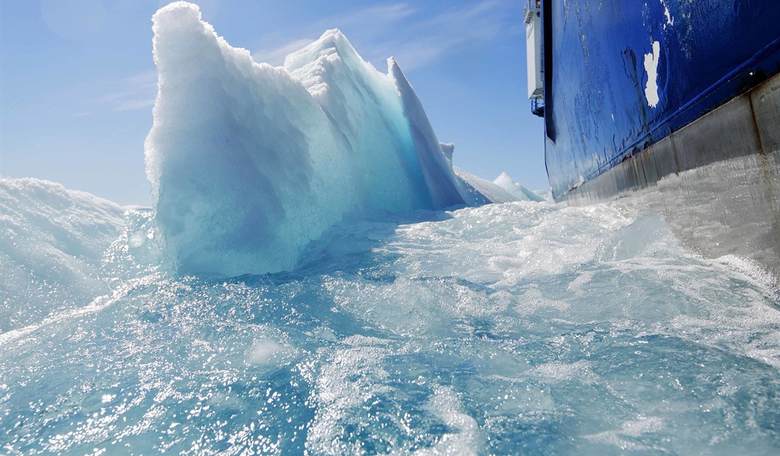
Quietly, Canada was constantly hunting its vast natural resources. The eight-month ocean drilling season is about to begin these days. Crews drill large holes in the ocean ice, then pump seawater up for days to spread out and freeze into upside-down ice domes.
The domes don’t hold up the drilling rigs. They float them, until next May or so, when the same Hercules planes that flew in the rigs haul the five million pounds of gear elsewhere in more than 120 loads. Sometimes they cut it a little too close, and the melting ice flows over the plane’s wheels as it taxis. “Those are interesting times,” Spike says, chewing on his unlit cigar.
“It's a bee-ooot-ifull night in the sky,” he added as we climbed out to 20,000 feet.
The Arctic sky was indeed beautiful that night. But absolutely empty, total black, no horizon, no lights below, just more stars than you ever imagined, like flying into a colossal inkwell.
In daylight, it can be tricky too — freezing clouds, fog, Arctic mirages. Altimeters are unreliable in the bitter cold. Compasses whirl uselessly so close to magnetic north.
“There’s Whitefish,” he said, pointing down to nothing visible in the dark. But the instruments said it was there. Then, a dim stream of lights appeared down below, and we descended at 140 miles an hour to a runway of ice lined with only 100-watt light bulbs in cans with blowing snow and a 35-mile-an-hour crosswind.
''Welcome to the Arctic Ocean,'' says Spike, ''Six feet under us is a couple thousand feet of water that'll kill you in one minute.''
In 35 minutes, loadmaster John Sproat would unload 42,612 pounds of volatile fuel and cargo, and Pacific Western Flight 383 would be climbing back out for two more loads going somewhere else before breakfast.
Spike looked at me with a smile. “Boring, isn’t it?”
When Margaret Squires goes grocery shopping, she doesn’t hold back: Ninety‐six rolls of toilet paper. Sixty pounds of flour. Four cases of Kool‐Aid. Three hundred pounds of meat. And a lot more.
That’s because Mrs. Squires goes grocery shopping for her family of five only once a year. And she does it all by mail from a remote area of Canada’s eastern Arctic.
When I met her, she lived with some 950 others in the remote community of Pangnirtung on Baffin Island a few miles below the Arctic Circle.
The name means “gathering place of the bull caribou” in Inuktitut, the language of the indigenous northern peoples. It was founded as a trading post in the early 1900s by the Hudson's Bay Company, an event that prompted the caribou to gather elsewhere.
Flying groceries in on the sometimes thrice-weekly plane is prohibitively expensive. So, in April she and her neighbors get a catalogue from the “local” store, which is 1,500 miles south in Montreal. She selects her family’s groceries for the entire year and mails in the order with a hefty check by late May.
Then – actually, around this time of year — “the ship” arrives with the town’s next year of food supplies.
She drives down to the landing to collect about 3,000 pounds of groceries.
“It's not really all that bad,” she told me, swinging open the door to a room that looked like a food warehouse. “You get used to it, and you come to gauge things pretty well.”
In Pangnirtung, you put food in the refrigerator to chill and out on the porch to freeze.
The town’s frozen-dirt airstrip has a sign: “Don’t Buzz Caribou.” I took my oldest son, Chris, on that trip.
We hired a local fisherman to take us 20 miles up the fjord to the Arctic Circle and Auyuittuq (eye-you-EE-tuck) National Park, an isolated 8,200-square-mile collection of rock and ice, which that year attracted 311 visitors total.
It was a 200-mile flight from Frobisher Bay, now called Iqaluit. At the time, the small airline with the little plane that ferried in people and freight, weather permitting, had upgraded its service to include a flight attendant.
Using two fingers, this was her entire safety spiel: “There are the emergency exits.”
Eric Hultgren was pretty secretive about what he does in his Connecticut basement 'til all hours of the night. Not a lot of noise from his house on Westport’s Clapboard Hill Road. The window had cardboard blocking the view.
“Who is it?” he called through the back basement door.
He was a 72-year-old widower who liked working with his hands. So much so that he did it all day most days as Cricket, his cat, observed nearby.
Eric had 48 good years of marriage with Shirley, then one bad year of her dying from cancer. He sat by her bed all day, even while she would sleep. But there’s only so much you can think about watching your life partner sleep.
So, Eric took to making wooden toys while he sat there with her. And sanding them – a lot. Everyone commented on how smooth his toys were. He’d sand the same truck or car for hours. He sanded the dickens out of every toy. Really hard.
He’d even sand after painting them the bright colors Shirley would choose.
When she passed, Eric and Cricket moved to the basement where he played big-band music as he worked. Every so often, neighbors would see him carrying armloads of 2x4s into the basement.
Then, occasionally they’d see their neighbor carrying numerous heavy shopping bags to his car and driving off. But Eric wasn’t into selling his very smooth toys.
"He shows up here every few weeks," said Dr. Tom Kennedy, head of the pediatric unit at Bridgeport Hospital.
"He walks in with shopping bags brimming with his wooden toys. Everybody knows him. He's Eric the Toyman. He goes room to room, handing one toy to each child. You should see their faces. He chats a while. In an hour, he's gone."
"Giving them away," says Mr. Hultgren. "Ah, that's the best part. I forget about all the work when I see those sick little faces light up. Everybody needs something sometime that's more powerful than medicine. It does my health real good, too. I get all charged up and hurry home to make more. I'm flexible. I'm alone."
Eric’s basement was littered with little trucks, planes, cars, and fire engines in various stages of construction. He even hand-carved every rung on the minute ladders. The vise on the cluttered workbench held each toy for lengthy sanding.
"Sanding's very important," Eric reminded me.
Turns out, he did so much sanding because sanding was when he thought of Shirley and their years together.
"She talks to others in my dreams," he said. "But she never talks to me. Still, I'm happy. So's she, I think."
This is the 44th in an ongoing series of personal memories. Links to all the others are below.
My American Family Tries to Decipher Life in Japan
Malcolm's Memories: They Don't Seem to Make July Fourths Like They Used To
Malcolm's Memories: The Joy of My Father's Joy
Malcolm's Memories: Me and Huck Down by the River
Malcolm's Memories: Making Oscars & Johnny's Toilet Paper Joke
Malcolm's Memories: She Loved Books So Much She Opened a Little Library
Malcolm's Memories: The Day Bill Buckley Asked My Help; Small Town Etiquette
Behind Johnny's Desk, Before Ford Was POTUS, and a Dog Makes Her Rounds
A Hooker in the House, Whistle War, and Ann Landers' Worst Mistake
More Neat People and a Nuclear Sub I've Met Along the Way
Malcolm's Memories: A Toddler's First Fourth
Malcolm's Memories: Train, Streetcars, and Grandma
The True Story of an Unusual Wolf, a Pioneer in the Wild
That Time I Wore $15K in Cash Into a War Zone
I Fell in Love With the South, Despite That One Scary Afternoon
More Memories: Neat People I've Met Along the Way
Unexpected Thanksgiving Memory, a Live Volcano, and a Moving Torch
The Horrors I Saw at the Three 9/11 Crash Sites Back Then
The Glorious Nights When I Had Paris All to Myself
Inside Political Conventions - at Least the Ones I Attended
Political Assassination Attempts I Have Known
The Story a Black Rock Told Me on a Montana Mountain
That Time I Sent a Message in a Bottle Across the Ocean...and Got a Reply!
As the RMS Titanic Sank, a Father Told His Little Boy, 'See You Later.' But Then...
Things My Father Said: 'Here, It's Not Loaded'
The Terrifyingly Wonderful Day I Drove an Indy Car
When I Went on Henry Kissinger's Honeymoon
When Grandma Arrived for That Holiday Visit
Practicing Journalism the Old-Fashioned Way
When Hal Holbrook Took a Day to Tutor a Teen on Art
The Night I Met Saturn That Changed My Life
High School Was Hard for Me, Until That One Evening
When Dad Died, He Left a Haunting Message That Reemerged Just Now
My Father's Sly Trick About Smoking That Saved My Life
His Name Was Edgar. Not Ed. Not Eddie. But Edgar.
My Encounters With Famous People and Someone Else
The July 4th I Saw More Fireworks Than Anyone Ever
How One Dad Taught His Little Boy the Alphabet Before TV - and What Happened Then
Muhammad Ali Was Naked When We Met