






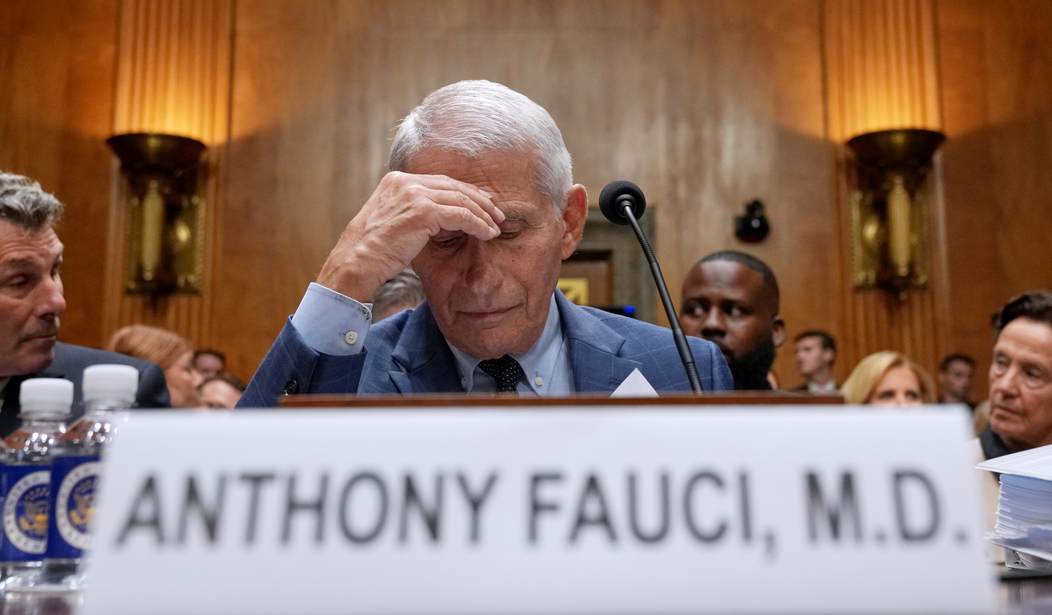
A “blinking red” email from Anthony Fauci's government account is raising another round of questions about what top federal health officials knew about potential COVID-19 vaccine side effects — and how far they may have gone to ignore them.
This time, the warning came from inside the FDA. In May 2021, acting FDA Commissioner Janet Woodcock wrote to Fauci and then-NIH Director Francis Collins about reports she was receiving from people experiencing unusual health problems following COVID vaccination.
According to the email released by Sens. Ron Johnson (R-WI) and Rand Paul (R-KY), some of those reports were coming directly from healthcare professionals.
And Woodcock wasn't simply passing along a few complaints. She was suggesting that the federal government actually study them. What a refreshing thought.
“The symptoms do not fit together into a distinctive syndrome and most are not easily quantifiable or evaluated with standard laboratory testing,” Woodcock wrote in the May 27, 2021 email. “Clearly during mass vaccination you will get a lot of psychological reactions and it is hard to sort these things out. But the peoples’ main complaint is that no one takes them seriously, no one knows how to treat them, and there is no effort to study this.”
She even anticipated that pharmaceutical companies would not be interested in funding research into adverse effects.
“I doubt the industry would support, for obvious reasons,” she wrote in the email. “But my experience is, that if you let a problem fester, then it will come back to bite you later and you are not prepared.”
It’s interesting that the “people before profits” narrative disappeared in the corporate media, which was flush with Big Pharma’s advertising dollars.
READ MORE: After Leaving NIH, Fauci Advised Italian Vaccine Institute That Landed $44M Grant
But Woodcock was hardly some longtime critic of the pharmaceutical industry. She spent 37 years at the FDA and had developed a reputation for maintaining close relationships with drug companies and industry-backed patient groups.
That makes the email all the more alarming. Even Woodcock apparently believed there was enough of a signal to warrant independent investigation.
She also warned that the government's existing vaccine-monitoring systems might not be equipped to identify the kinds of problems being reported.
“These problems are not the sort that a system like VAERS would be able to detect, or even a more sophisticated population-based active followup [sic] such as CDC has, or a medical record based system such as BEST [an FDA safety surveillance system],” she said.
So what happened next? Fauci, who, as director of the National Institute of Allergy and Infectious Diseases (NIAID), controlled an enormous research operation backed by roughly $5.5 billion in funding, forwarded Woodcock's concerns to Collins.
NEW FAUCI EMAIL: SYSTEM BLINKING RED @SenRonJohnson @SenRandPaul
— Catherine Herridge (@C__Herridge) August 16, 2026
Just months after the COVID-19 vaccine emergency authorization, the Acting FDA Commissioner flagged "adverse events...(from all three of the current vaccines.)
The main complaint is that “no one takes them… pic.twitter.com/xxeAYjnXEr
And Fauci clearly understood that the message couldn't simply be brushed aside.
“Janet [Woodcock] asks what we think of this? We cannot ignore her. We should probably bring in CDC and see what Rochelle [Walensky] thinks,” Fauci wrote.
What an interesting phrase: “We cannot ignore her.” So, was that the gut response?
But according to Johnson's office, it remains unclear whether then-CDC Director Rochelle Walensky was ever brought into that conversation — or whether the kind of dedicated study Woodcock was requesting was ever launched.
The nation's acting FDA commissioner was explicitly asking for research into adverse events being reported after vaccination, warning that existing surveillance systems might miss them and cautioning that ignoring the issue could allow it to “fester.”
Yet more than five years later, investigators apparently still haven't identified the comprehensive study Woodcock was asking Fauci and Collins to undertake.
And this wasn't the only internal discussion raising questions about how federal health officials handled vaccine safety signals.
An investigation released by Johnson in April revealed that Peter Marks, then director of the FDA's Center for Biologics Evaluation and Research, had been warned by a safety-data expert that FDA surveillance systems might not be sensitive enough to detect statistically significant adverse events.
Marks expressed concern that the analysis could “create erroneous conflicts that feed in to anti-vaccination rhetoric,” according to Johnson's report.
Scientific analysis requires critical feedback. This is not optional, but a critical aspect of the scientific method.
That accountability mechanism was broken during the pandemic because of mass censorship, broken surveillance systems, data manipulation, and biased reporting.
Now, years later, researchers are still investigating some of the symptoms Woodcock was hearing about in 2021.
A Yale-led research team, for example, has studied what it calls "post-vaccination syndrome," or PVS, among a small group of people reporting persistent symptoms after COVID vaccination.
Those symptoms included excessive fatigue, brain fog, difficulty concentrating, exercise intolerance, muscle aches, numbness, sleep problems, and tinnitus.
The researchers examined 42 people identified as having PVS and found several biological differences worth investigating further. Among the most striking was the detection of higher circulating levels of SARS-CoV-2 spike protein in some PVS participants compared with controls.
“This suggested that prolonged antigen persistence might be associated with PVS in a subgroup of patients,” the study states.
The researchers also explored possible differences involving T-cell exhaustion, antibodies, and reactivation of Epstein-Barr virus.
The research was released as a preprint rather than a peer-reviewed journal article, involved a small sample, and did not establish that persistent spike protein causes the symptoms. The researchers themselves described the findings as hypothesis-generating and called for additional work.
That's why Woodcock's email to Fauci matters. She warned that these reported side effects needed to be studied.
But it looks like Big Pharma and the NIH weren’t too curious about looking into the gravely serious matter.
Disturbingly, the researchers behind the later Yale work acknowledged that patients reporting PVS had often struggled to get attention for their symptoms, describing the subject as politically and scientifically “radioactive.”
Fauci’s email perfectly encapsulates the biomedical industry’s hostility to governmental accountability.
It’s something the American people can no longer afford to “ignore.”
Editor's Note: The mainstream media continues to deflect, gaslight, spin, and lie about President Trump, his administration, and conservatives.
Help us continue to expose their left-wing bias by reading news you can trust. Join RedState VIP and use promo code FIGHT to receive 60% off your membership.



Join the Conversation
VIP members get the ability to comment on articles.