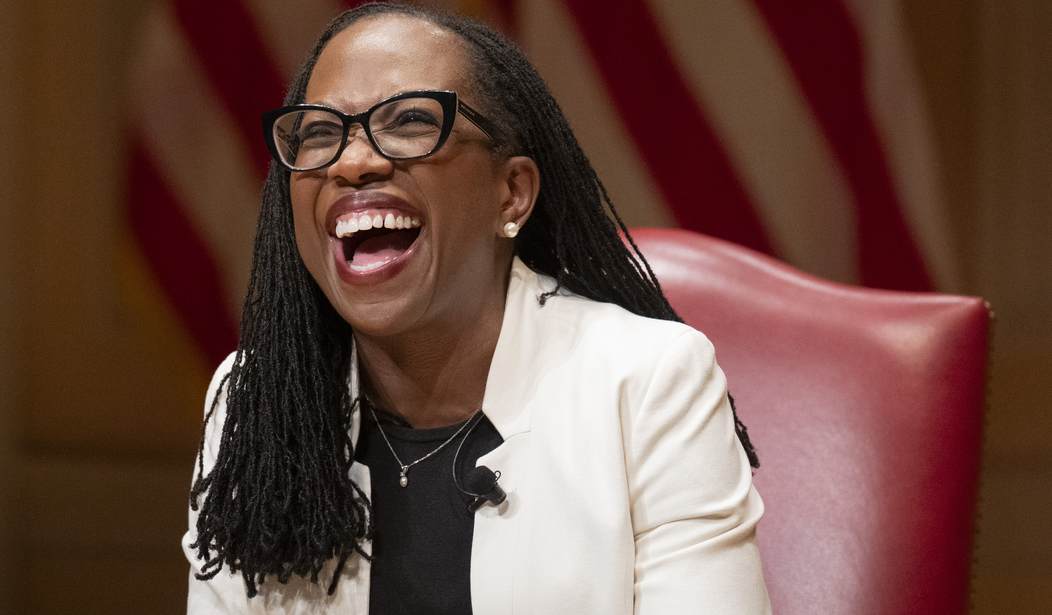

Supreme Court Justice Ketanji Brown Jackson has declined President Trump's request for an immediate administrative stay in his appeal to the Supreme Court to reinstate key parts of his executive order on mail-in ballots.
The radical justice gave a temporary procedural win to fellow Democrat-appointed judge Indira Talwani, an Obama appointee who first blocked the election integrity initiative.
Jackson declined the Trump administration’s request for immediate administrative stay and gave the White House seven days to respond to the emergency application.
🚨 Justice Jackson declined the Trump administration's request for an immediate administrative stay.
— SCOTUS Wire (@scotus_wire) July 27, 2026
She gave plaintiff states 7 days to respond to the emergency application. https://t.co/qMbM04FjSH pic.twitter.com/SarUyJTSgx
SCOTUS Wire notes that Justice Jackson denied the administrative stay, not the full stay. Therefore, the full bench may rule on the matter, but it will take “at least a week.”
“For the application itself, she will almost certainly refer it to the whole bench,” the reporter noted.
Judge Talwani cited the Help America Vote Act (HAVA) as well as Congress' oversight of federal elections in her ruling:
The Help America Vote Act of 2002 (“HAVA”) was passed after the 2000 Presidential election and “aimed ‘to alleviate a significant problem voters experience’—eligible voters being turned away at the polls because their names were missing from voter registration lists.”
READ MORE: First Circuit Slaps Down DOJ Request in Mail-In Ballot Suit - Now It Could Be Heading to SCOTUS
USPS Scores Big Win, As Fed Appeals Court Stays Order on Vote by Mail Ballots
Justice Jackson’s order is consequential in light of an ongoing fight on Capitol Hill between President Trump and Republican Senate leadership over the matter of "nuking the filibuster" and passing the SAVE America Act with a bare majority.
Senate Majority Leader Thune (R-SD) continues to stall the legislation. He claimed on Hannity that there were 15 Republican senators who were a “nay” on nuking the filibuster.
🚨 NOW: Senate Majority Leader John Thune announces at least 15 REPUBLICAN SENATORS are a "NAY" on nuking the filibuster for the SAVE America Act
— Eric Daugherty (@EricLDaugh) July 28, 2026
NAME THEM!
THUNE: "We don't [have the votes]. They met with 20 Republican senators, 15 were a NO on getting rid of the filibuster.… pic.twitter.com/t2zR9xhpJr
Only a handful of Republican senators have agreed to cancel the slated Senate recess in order to stay in Washington, D.C. and get the job done, according to election activist Scott Presler.
Republican Senators up for re-election in 2028:
— ThePersistence (@ScottPresler) July 28, 2026
🟥 John Boozman (R-AR)
🟥 Katie Britt (R-AL)
🟥 Ted Budd (R-NC)
🟥 Mike Crapo (R-ID)
🟥 Chuck Grassley (R-IA)
🟥 John Hoeven (R-ND)
🟥 Jon Husted (R-OH)
🟥 Ron Johnson (R-WI)
🟥 John Kennedy (R-LA)
🟥 James Lankford (R-OK)
🟥 Mike…
President Trump’s mail-in ballot order was a workaround in lieu of the SAVE America Act’s passage in the Senate.
While it may seem on its face to be a legal "Hail Mary," the order appears to draw firmly on executive authority over the Post Office. Since it is against federal law for non-citizens to vote in federal elections, the president is duly authorized to manage executive branch agencies in a manner that enforces the law.
In March 2025, President Trump signed Executive Order 14248: Preserving and Protecting the Integrity of American Elections.
“Free, fair, and honest elections unmarred by fraud, errors, or suspicion are fundamental to maintaining our constitutional Republic. The right of American citizens to have their votes properly counted and tabulated, without illegal dilution, is vital to determining the rightful winner of an election,” the executive order stated.
“Under the Constitution, State governments must safeguard American elections in compliance with Federal laws that protect Americans’ voting rights and guard against dilution by illegal voting, discrimination, fraud, and other forms of malfeasance and error,” the order said.
“Yet the United States has not adequately enforced Federal election requirements that, for example, prohibit States from counting ballots received after Election Day or prohibit non-citizens from registering to vote,” it continued.
“Several Federal laws, including 18 U.S.C. 1015 and 611, prohibit foreign nationals from registering to vote or voting in Federal elections,” it added.
In June, the Department of Homeland Security disclosed the agency intended to move forward with an initiative that allows states to verify voter citizenship and enhance oversight of mail-in ballot systems nationwide.
Under the plan, state election officials would be able to compare voter registration records against the SAVE database, as well as records maintained by the Social Security Administration, the State Department, and U.S. Citizenship and Immigration Services.
The initiative would better equip states to verify whether registered voters are U.S. citizens.
In addition, the U.S. Postal Service was tasked with monitoring mail-in ballot activity. The USPS was instructed to identify unusual voting patterns and generate investigative leads related to potential election fraud.
As expected, the election integrity measures drew immediate legal challenges.
A coalition of 23 states, led by California (of course), argues that Trump lacks the authority to impose federal rules on elections that are administered by state and local officials.
“We look forward to filing our response to the government’s application in the U.S. Supreme Court by the deadline set by Justice Jackson,” Walter Garcia, a spokesperson for California Attorney General Rob Bonta, said in a statement.
However, a separate federal appeals court ruling lifted a broader injunction against the Postal Service rule, which would clear the way to a measure of federal oversight over the midterm elections.
The three-judge panel in the D.C. Court of Appeals put a hold on a lower court ruling that had blocked the Postal Service from implementing the measures, giving the Trump administration a temporary victory.
Dozens of blue states have been fighting tooth-and-nail to prevent federal oversight over elections, particularly when it comes to stopping illegal voting.
The left-wing activist Democracy Docket reported on the latest regarding a lawsuit against 30 states and Washington, D.C. to get access to voter rolls in order to screen them for deceased, non-resident, and non-citizen voters:
Since last September, President Donald Trump’s Department of Justice (DOJ) has sued 30 states and Washington, D.C. as part of its nationwide crusade to obtain state voter rolls. It has said the lawsuits are needed when a state won’t willingly hand over rolls, so that DOJ can assess compliance with federal voting law.
Democracy Docket, after its mendacious article excusing dirty voter rolls, crowed the DOJ had “lost all 17 voter roll cases decided by district courts and its first appeal. No judge has ordered a state to provide an unredacted statewide voter list.”
America is in serious trouble if it can get neither the SAVE America Act passed, nor any federal oversight over mail-in ballots and dirty voter rolls.
Election integrity would be dead on arrival. The foundation of our representative government rests on feet of clay.
Every election would continue to be a suspect, partisan affair — defeating the entire purpose of having elections to begin with.