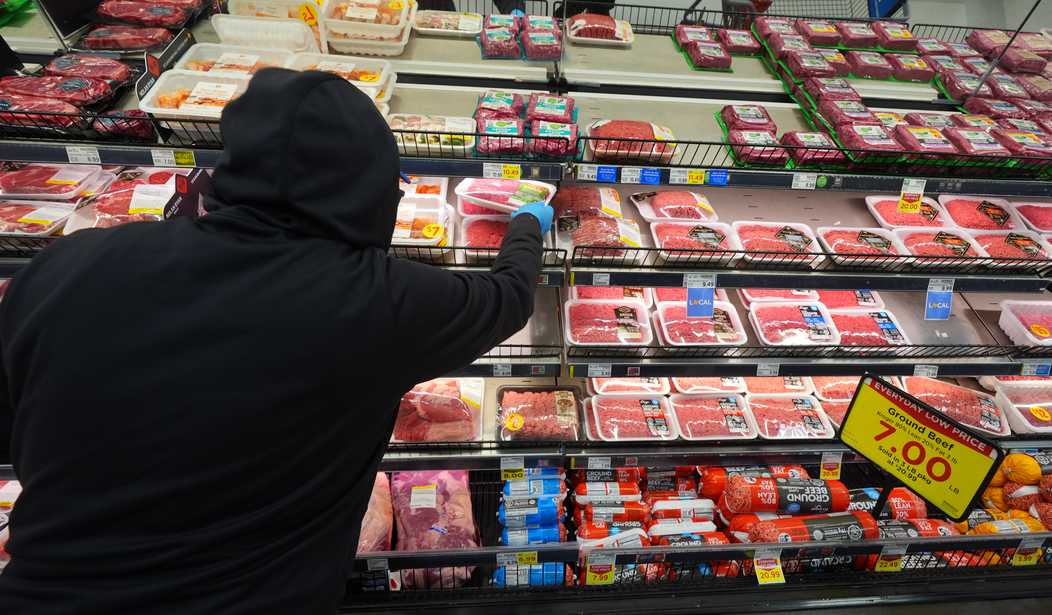

Consumers and ranchers received some good news this week regarding the U.S. Department of Agriculture making significant moves to rein in the price of beef. My RedState colleague Ward Clark reported on the Truth Social post where President Donald Trump announced he would be breaking up central control of beef production by allowing smaller concerns to process their own cattle for sale to consumers.
While this is not a snap-of-the-fingers instantaneous change, it is a big step in the right direction. Our friend and occasional RedState columnist Shipwreckedcrew laid it out well in this X post, explaining why President Trump's response transcends what has occurred under previous presidencies and is actionable, rather than theoretical.
Pres. Trump's announcement this morning that he's going to make changes to USDA regulations that require USDA meat inspections in a manner that precludes state and local meat processing and direct sale to consumers is exactly the kind of purpose-driven decision-making that is a…
— Shipwreckedcrew (@shipwreckedcrew) August 28, 2026
Pres. Trump's announcement this morning that he's going to make changes to USDA regulations that require USDA meat inspections in a manner that precludes state and local meat processing and direct sale to consumers is exactly the kind of purpose-driven decision-making that is a huge reason for his political support.
This issue arose in an interview with Glenn Beck earlier this week when Beck -- who owns a cattle operation in Texas -- asked him to look at the market monopoly of Big 4 meat processing companies who have purchased dozens of smaller processors for the purpose of shutting them down, knowing that the barriers to entry into the market for new processing companies were such that their consolidation would allow them to dictate both what they paid ranchers, and what they charged for processed beef to distributors.
Almost every prior President would have paused while the political implications of this change -- via lobbying against it by the Big 4 processors -- had an opportunity to jump in and strangle it.
Trump dealt with it like a CEO of a family owned business -- he looked into like he said he would, didn't like what he was told, so he said "Change it."
That's why he's a "One of One" President.
Here is a snippet of that Glenn Beck interview.
WATCH:
Somebody finally said it to the President's face.
— SAVE BEEF 🇺🇸 BeefMaps.com (@BeefMaps) August 30, 2026
Four companies process American beef. Two aren't even American.
The rancher called it a cartel.
The President asked who writes the rules that keep everyone else out.
It's the USDA.
That's the whole damn problem right there. pic.twitter.com/PDWoi9Qc7B
Clark felt the president's wording in his post wasn't as clear as it should have been.
There's one thing that's not completely clear. Mind you, no orders or actions have yet been drafted that we know of. But here's the thing: President Trump writes that his documents, in whatever form they take, will "allow farmers and ranchers to be given the right to process their own food." It's not clear what is meant by that. Does he mean to process their own stock for personal consumption? Because that is what that sentence appears to say. Does he mean to process their own stock for sale? That would be a much bigger deal; that would decentralize the process and take at least some of the processing out of the hands of, as the president puts it, the nasty monopoly of big processors.
But it seems cattlemen and graziers understood fully. Unlike the other Truth Social post the president made days prior, where he announced an increase in the import numbers for beef trimmings, they are cheering this one on.
"Trump wants to remove some of the red tape and costs associated with setting up USDA inspected facilities for small producers or areas of the country that don’t have USDA processors to be able to sell their protein to consumers in a legal way," grazier Derek Lange told Just The News last week.
"Consumers want to buy beef from ranchers and be a part of their story."
Right on. If the customers, particularly families, were able to buy their beef locally, it would change the game and help remove the collusion of big government and big beef to destroy smaller producers. As Clark further explained, that was how things used to be done, particularly in rural America.
However, a conglomerate of large cattle producers: Tyson, Cargill, JBS, and National Beef, made an alliance with the USDA for centralized control, and they now handle about 85 percent of U.S. fed-cattle slaughter. With that alliance comes regulations, which are always costly for smaller concerns.
Lange, who runs Citrus Cattle Company in California's Central Valley, spoke about the difficulties of dealing with red tape and getting the meat processed for the consumer.
One of the biggest challenges I had when trying to develop our direct-to-consumer beef business was finding a USDA processor for an operation my size," he said.
"We haul our finished beef two-and- half hours away in order to have our beef USDA processed per the current regulations. To have our beef USDA processed, it costs two and a half times what it would cost at a local custom butcher.
"The way we remove power from the 'Big 4' is to give US ranchers a way to be competitive in the marketplace, and I think Trump understands this.”
The Big 4 Beef producers are probably card-carrying members of the National Cattlemen's Beef Association (NCBA). This organization was quick to cast shade on the president's plan, calling it a "short-term political fix."
NCBA supports more competition, more opportunities for small & regional processors, and eliminating unnecessary regulations but weakening federal meat inspection & food safety standards isn’t the answer.
— National Cattlemen's Beef Association (@BeefUSA) August 28, 2026
America’s cattle producers have earned consumer trust in U.S. beef over…
NCBA supports more competition, more opportunities for small & regional processors, and eliminating unnecessary regulations but weakening federal meat inspection & food safety standards isn’t the answer.
America’s cattle producers have earned consumer trust in U.S. beef over generations. That trust, and the gold standard food safety system behind it, shouldn’t be put at risk for a short-term political fix.
Washington should focus on reducing legitimate regulatory burdens, lowering input costs, protecting the herd from foreign animal disease & expanding processing opportunities—not managing the cattle business.
This take kind of indicates that NCBA wants to control the competition, rather than see it increase. And having reported on many of the Trump administration USDA's initiatives, they are focusing on much of what NCBA claims they are not.
NCBA knows that it is increased competition which will dictate prices and keep them down. Competition also gives more control back to the consumer. As a person who eats large amounts of beef, I prefer to know how many hands touched the meat I ingest. A small producer can tell me that. Tyson and its processing mills? No one knows, and Tyson certainly doesn't care.
There's also the health aspect, not only in limiting foodborne illnesses, but there is a health benefit in feeding from the region where you live and thrive. Locally-sourced beef tastes better, reduces the need for extra additives to preserve length of use, and purchases from local ranchers and farmers add to the local economy, not corporate profits. The U.S. Small Business Administration did a study on the impact of shopping local. For every $100 spent at a local business, $68 stays in that region. As opposed to that same $100 being spent at a national chain or store, where only $43 stays in the area.
Boosting local economies and creating a network of trust between local ranchers, farmers, and the consumer is a winning strategy. Unleashing small producers to handle the means and methods of their own meat production can also assist them in not just expanding their own businesses, but helping create new ones.
If executed well, this could mean a resurgence for rural America that doesn't involve a data center and which has proven benefits for all Americans.