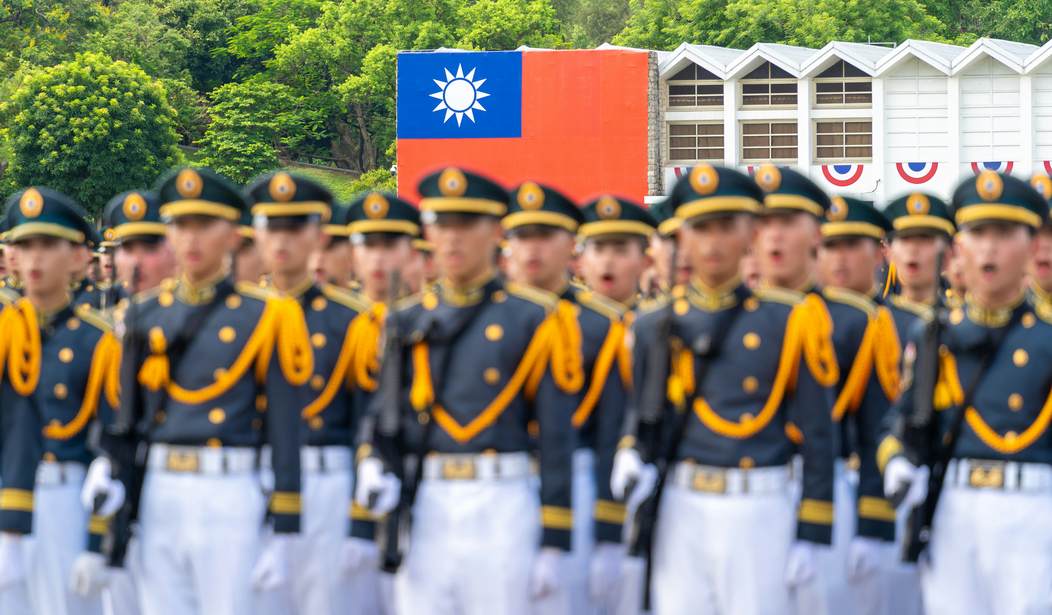

Following the Trump-Xi summit in Beijing this month, left-wing pundits and foreign affairs “experts” have been busy accusing President Trump of abandoning Taiwan. Yet what Trump and administration officials actually said during and after the summit tells a different story.
According to China’s readout of the meeting, Xi warned Trump that if the “Taiwan question” is handled improperly and without care, “the two countries will have clashes and even conflicts, putting the entire relationship in great jeopardy.” The U.S. readout, on the other hand, doesn’t mention anything about the self-governed island, implying that the Trump administration isn’t open to negotiating its status.
In a post-summit interview, Secretary of State Marco Rubio stated that Washington’s Taiwan policy remains unchanged and that, at the summit, each side expressed its own position on the matter — consistent with how Taiwan’s been discussed at previous meetings with Chinese officials. Simply acknowledging China’s position on Taiwan — which isn't rooted in reality or history — doesn’t mean that the U.S. government endorses it.
On the sidelines of the Shangri-La Dialogue in Singapore, Secretary of War Pete Hegseth reiterated that the U.S.’s “stance on Taiwan remains unchanged.”
President Trump’s statement about “not looking” for Taiwan to declare independence also drew backlash from the usual suspects.
However, his statement is consistent with Washington’s existing Taiwan policy, namely strategic ambiguity and the “One China” policy. The U.S. has never supported Taiwan independence. Rather, Washington continues to arm Taiwan with weapons of a defensive nature in order to preserve the cross-strait status quo.
The vast majority of Taiwanese support maintaining the status quo, and the current leadership in Taipei sees no need to formally declare independence, given that Taiwan already is an independent country.
RELATED: Taiwan Update: The Battle Over the Special Defense Budget Continues Despite US Pressure
President Trump also said he will speak directly with Taiwan President Lai Ching-te regarding a $14 billion arms package. He would be the first sitting U.S. president to speak with the leader of the self-governed island since 1979, when Washington formally recognized the People’s Republic of China.
But this isn’t the first time President Trump has broken with precedent in favor of Taiwan. In 2016, Trump accepted a congratulatory call from then-President Tsai Ing-wen. Beijing reacted by lodging a complaint.
If the phone call with Lai happens, which I hope it does, it would mark a major departure from Nixon’s China Policy. Strategic ambiguity and the “One China” policy are outdated and play into the Chinese government’s long-term territorial ambitions.
Even if the call doesn’t materialize, President Trump’s public statement about his willingness to engage directly with Taiwan’s president is a positive development — a tacit acknowledgement of the island’s sovereignty.
All the accusations that Trump is abandoning Taiwan beg the question: Why would he do so when his administration is working to secure some of the most critical chokepoints across the globe? From the Panama Canal to the Strait of Malacca, the administration’s actions suggest a strategy of constraining communist China's maritime influence, not accommodating it.
Nearly half of the world’s container fleet passes through the Taiwan Strait, and over 20 percent of global maritime trade transits this body of water. A shutdown of the Taiwan Strait would spell economic disaster, affecting supply chains and leading to a global stock market crash. A Taiwan contingency would likely impact the Luzon Strait as well.
Despite his “negotiating chip” comment, there’s little to suggest that Trump would actually treat arms sales to Taiwan as such. After all, Taiwan plays a critical role in the Pentagon’s deterrence by denial strategy in the Indo-Pacific.
ALSO SEE: What the Pentagon’s 2026 National Defense Strategy Really Says About China
The total dollar value of arms sales to Taiwan authorized by Trump exceeds that approved by any U.S. president. It was this administration that approved an $11 billion arms package for Taipei, the largest to date, weeks after last year's Trump-Xi summit in Busan, South Korea.
Trump has said that Xi told him Beijing won’t invade Taiwan while he is U.S. president. What Xi exactly said is unknown. But if Xi were to break his word, Trump wouldn’t take it lightly. That said, China’s campaign to weaken, pressure, and isolate Taiwan is already underway. A full-scale invasion is only one dimension of the challenge.