








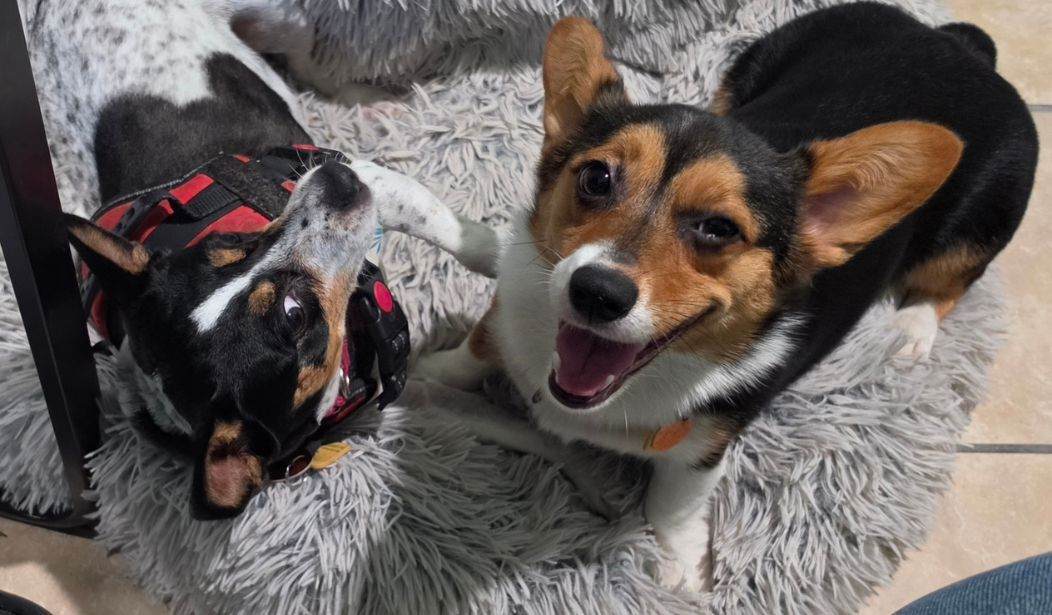
With a few exceptions — looking at you Becca Lower and Stacey Matthews — the majority of Team RedState have gone to the dogs, as you can tell by those of us who have revealed our joy and happiness, along with the trials and tribulations with our fur kiddos. In the crazy O'Connell family, we believe in the magic of three. In January, we had to transition our sweet Portuguese Pondego Ian (due to cancer), and after a period of mourning and readjustment, we adopted an adorable 9-month-old Welsh Corgi named Remi to create a new triad with our remaining senior pups: MaltiPoo, Puppet (16), and Rat Terrier, Minnie Mouse (8).
Dogs enrich our lives, there is no question about it. But science is finding empirical evidence on the whys, and the ways these critters are essential to our human health, longevity, and thriving. Now that I am officially a seasoned citizen, my interest in research and information on enhancing health and longevity as one ages has increased exponentially.
I follow a Johns Hopkins geriatric researcher named Neal K. Shah, and he outlined a study which shows dog ownership could be the key to preventing dementia. Shah detailed how dog owners are 40 percent less likely to develop dementia, and dog owners who walk their dogs have an additional 20 percent risk reduction. Sixty percent — I like those odds. The main reason is neurological. One of the problems with aging is that many older adults stop learning or shy away from the unexpected. Which means the forging of new neurological pathways comes to a near standstill. The daily routine of caring for dogs, and the spontaneous nature of their interactions with us, help to combat this.
It's quite fascinating.
WATCH:
A major study found dog owners are 40% less likely to develop dementia. And the reasons go deeper than just staying active.
Dogs force daily walking, which directly increases blood flow to the brain. They create social connection, one of the strongest predictors of cognitive health. They reduce cortisol levels consistently. They give owners a sense of purpose, which research links directly to slower brain aging.
But here's what most people miss: the protection is neurological. Dogs stimulate unpredictable, playful interaction that keeps the brain building new connections well into old age.
For family caregivers especially, this matters deeply. Isolation is one of the fastest accelerators of cognitive decline. A dog interrupts that pattern every single day without fail.
You don't need an expensive breed. You don't need a big house. You need the routine.
That is one of the reasons why my husband and I adopt more than one while we are still mobile and capable. They keep us on our toes, and also interact with each other in different ways than a single pet. Now we know that we're also helping to combat the deterioration of our brains. I call that, "Winning!"
Another fascinating study published Monday in iScience provides proof that dogs can read our facial expressions, emotions, and can empathize with our joy and our pain. In the study, scientists scanned the brains of eight dogs: six Border Collies, a Labrador Retriever, and a Golden Retriever, and explored how dogs process various human expressions, including happiness, sadness, anger, and fear.
The scans, carried out by a team from the University of Vienna, show how the animals’ brains respond differently depending on the expression that humans display.
Senior study author Laura Cuaya explained their findings in a press release published on the university’s website. “When we compare humans with primates, we are looking at abilities that may have come from a common ancestor,” she said.
“With dogs, the story is totally different. They followed a very different evolutionary path, yet through domestication, they developed the social abilities needed to understand and cooperate with us.”
No, duh. But it's nice to know that science is catching up to what dog lovers and owners have intuitively understood and embraced.
Non Political
— 🦅 Eagle Wings 🦅 (@CRRJA5) July 30, 2024
They are not just pets; they are friends, protectors, and family members.
Dogs are incredibly perceptive animals. They can read human body language and understand our emotions.
Dogs show us every day why they are truly our best friends.
🐾 ❤️🐾❤️🐾❤️🐾 pic.twitter.com/eT9ajFoXjE
Canine empathy, a remarkable phenomenon, denotes the ability of dogs to sense and respond to human emotions with an almost intuitive sensitivity. This ability is not merely a byproduct of domestication but a deeply ingrained trait that has evolved over centuries of cohabitation with humans. Dogs possess an acute awareness of human emotional states, often perceiving subtle cues through changes in facial expressions, body language, and even vocal tone.
This is also the secret sauce to why dogs can be trained as working, service, and emotional support animals for everything from veterans who suffer from PTSD to the detection and aid for people who suffer from neurological disorders like epilepsy.
The importance of understanding canine empathy extends beyond the realm of curiosity; it plays a significant role in the human-animal bond and contributes to our overall well-being. This intuitive connection fosters companionship and emotional support, providing comfort during times of stress or sadness. For instance, many dogs instinctively offer physical affection or stay close to their human companions when they detect distress, promoting a sense of security and emotional stability.
Studies like the one mentioned above help delve the depths of the canine-human relationship. The provision of this extended knowledge and enhancement of the human-canine bond can alter and transform life for the better.
Furthermore, recognizing the depth of canine empathy can enhance training and communication, as it underscores the importance of positive reinforcement and patience. By acknowledging and respecting a dog’s ability to empathize, owners can forge stronger, more harmonious relationships with their pets, ensuring a nurturing environment that benefits both parties.
It's nice to see science providing useful research and information that helps both humans and canines to thrive.
Editor's Note: At RedState, it's not all about politics and policy. We like to bring attention to what's good in the world, with columns like "Feel-Good Friday," "Start Your Weekend Right," and "Hoge's Heroes."
Support our work! Join RedState VIP and use the promo code FIGHT to get 60% off your VIP membership!



Join the Conversation
VIP members get the ability to comment on articles.