






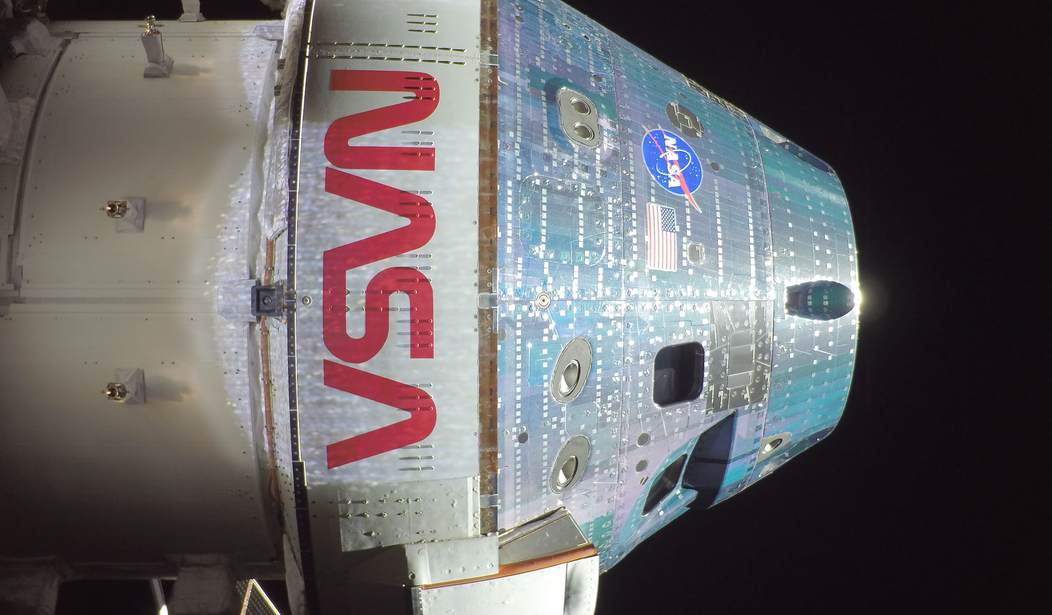
I’m betting that most of our readers will recognize this opening monologue:
Space: the final frontier. These are the voyages of the starship Enterprise. Its five-year mission: to explore strange new worlds; to seek out new life and new civilizations; to boldly go where no man has gone before!
Yep, it’s Star Trek, and those words were uttered by Captain James T. Kirk (William Shatner) in the legendary 1960s TV show.
And on Monday, four NASA astronauts did actually go where no man has gone before as the Artemis II mission took them to the farthest point away from our home planet in history.
It’s been decades since we’ve even attempted to attempt to enter deep-space, which is defined as beyond near-earth orbit:
A new milestone for humankind: The crew of Artemis II are now the farthest any human has ever travelled, reaching a maximum distance of 252,752 miles from Earth.
— NASA (@NASA) April 6, 2026
This surpasses the previous record set by Apollo 13 in 1970 by about 4,102 miles. pic.twitter.com/DbLFvvdEfT
As RedState reported Monday morning, the spacecraft is conducting a seven-hour flyby of the moon and will see its “dark side.” Many commenters on that story pointed out that the moon technically has no dark side — it has a far side, as it’s technically called, and is lit by the sun. We can’t see that side from Earth, however, which is why it’s still “dark” to us, and why many scientists, including NASA itself, sometimes refer to it as the Dark Side.
Let’s face it, it’s more poetic.
SPECTACULAR: Artemis II Releases Stunning Photos of Dark Side of Moon Never Seen Before by Human Eyes
Morning Minute: Proud to Be an American...
There were some touching moments as well, like when the crew came up with some very special dedications:
The Artemis II crew proposed new names for two lunar craters as they continued the flight that's taking them around the far side of the moon.
Speaking to mission controllers, Canadian astronaut Jeremy Hansen suggested naming one crater "Integrity," after the name of their Orion spacecraft.
And in an emotional tribute, he said they chose the name "Carroll" for another moon crater, after commander Reid Wiseman's wife, who died in 2020.
"Some times of the moon's transit around Earth we will be able to see this," he said of the crater. "... And it's a bright spot on the moon. And we would like to call it Carroll."
To commemorate the Artemis II mission, the astronauts announced their suggestion to rename certain features on the Moon to honor the Orion spacecraft, named Integrity, as well as commander Reid Wiseman's late wife, Carroll. pic.twitter.com/ejfhnItDo8
— NASA (@NASA) April 6, 2026
As their spacecraft broke the distance record, Canadian astronaut Jeremy Hansen had some inspiring words:
From the cabin of Integrity, as we surpass the furthest distance humans have ever traveled from planet Earth, we do so honoring the extraordinary efforts and feats of our predecessors in human space exploration.
We will continue our journey even further into space before Mother Earth pulls us back into everything that we hold dear.
He added, "We challenge this generation and the next to make sure this record is not long-lived."
Approaching the near side of the Moon.
— NASA Artemis (@NASAArtemis) April 6, 2026
The Artemis II astronauts have surpassed the record for the distance from Earth at 1:56 ET (1756 UTC). This record was previously set during the Apollo 13 mission when the astronauts traveled 248,655 miles from Earth. The Moon continues to… pic.twitter.com/OapAGgGMex
The Moon continues to grow larger and larger in the windows of the Orion spacecraft as the Artemis II mission gears up to observe the far side. The astronauts are predicted to make their closest approach of the Moon around 7:02pm ET (2302 UTC).
So far, the mission has been a major success, and President Donald Trump congratulated the administrator of NASA on Monday:
🚨 WOW! President Trump gave HUGE praise to NASA Administrator Jared Isaacman as Artemis II reaches the moon
— Nick Sortor (@nicksortor) April 6, 2026
“Jared's done a FANTASTIC job at NASA. He’s amazing! Everybody told me he was gonna be good. I didn't know he'd be THAT good.”
Proud to have been one of those people! 🇺🇸… pic.twitter.com/9IBIrgIqXq
We have indeed landed on the moon in the past and explored strange new worlds with interplanetary probes, but we have yet to find "new life and new civilizations." RedState’s Brandon Morse has thoughts on that:
My Crazy Theory on Why We Haven't Met Any Aliens
Artemis II is scheduled to return to Earth on Friday, April 10, 2026, with splashdown in the Pacific Ocean off the coast of San Diego targeted for 8:06–8:07 p.m. EDT. Between now and then, expect more amazing photographs and discoveries.
Editor's Note: President Trump is leading America into the "Golden Age" as Democrats try desperately to stop it.
Help us continue to report on President Trump's successes. Join RedState VIP and use promo code FIGHT to get 60% off your membership.



Join the Conversation
VIP members get the ability to comment on articles.