






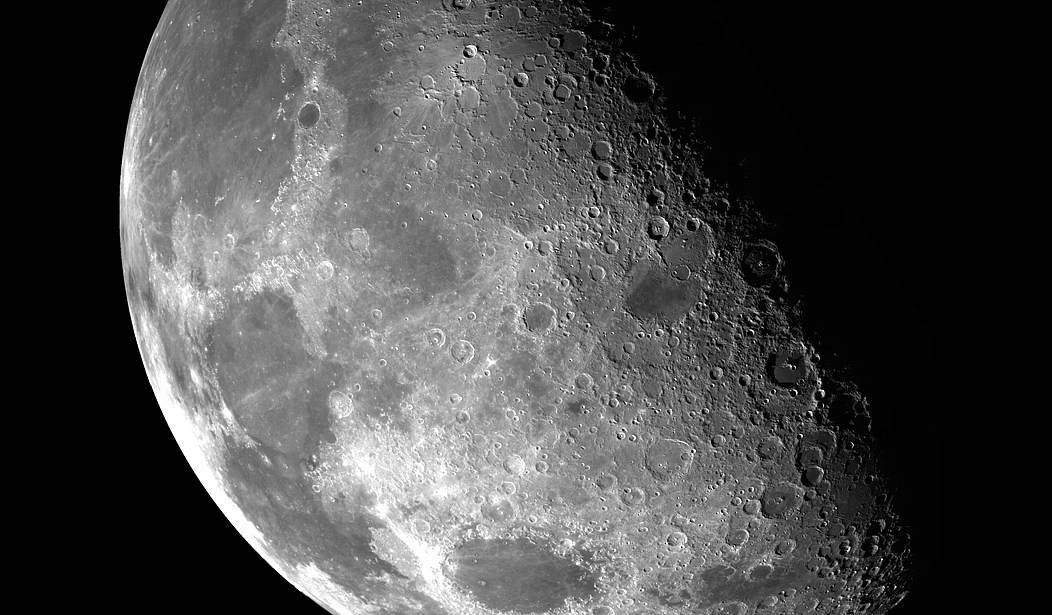
As NASA’s Artemis II mission approaches the moon, astronauts are capturing stunning images, some of them of things never seen before by the eyes of man — like the dark side of the moon:
History in the making
— NASA (@NASA) April 5, 2026
In this new image from our @NASAArtemis II crew, you can see Orientale basin on the right edge of the lunar disk. This mission marks the first time the entire basin has been seen with human eyes. pic.twitter.com/iqjod6gqgz
In another shot, they capture just how far away from their home planet they have journeyed. Earth is just a sliver in a vast expanse of space:
One last look at Earth before we reach the Moon.
— NASA (@NASA) April 5, 2026
This view of the Earth was captured on April 5, the fourth day of the Artemis II mission, from inside the Orion spacecraft. The four astronauts will reach their closest approach of the Moon tomorrow, April 6. pic.twitter.com/z2NJUGWkKc
They’re not just there for the sights, though; on Monday’s flyby, they hope to gather important information about our closest neighbor:
As Artemis II swings around the Moon on Monday, astronauts will track historic Apollo sites, scout future landing zones and capture rare views of nearby planets.
NASA outlined the assignment Sunday during its daily Artemis II mission status briefing at Johnson Space Center in Houston.
“The two Apollo sites they'll be able to see here at the beginning are the Apollo 12 and 14 landing sites as they progress through the several hour period where the moon is illuminated,” Artemis II Lunar Science lead Kelsey Young said.
It’s hard work:
No days off when you’re Moonbound.@Astro_Christina continues prep for tomorrow’s lunar flyby after completing her workout.
— NASA (@NASA) April 6, 2026
Meanwhile, our entire world watches in anticipation with hope and excitement as the @NASAArtemis II crew presses on toward the Moon. pic.twitter.com/iIiAiXHej0
HISTORY IN THE MAKING: Artemis II Astronaut Extemporaneously Delivers the Most Profound Easter Message Imaginable
Boy's Reaction to Artemis II Launch Goes Viral - NASA Administrator's Response Made It Even Better
The Artemis II mission marks the first time in over 53 years — since Apollo 17 in December 1972 — that NASA has sent American astronauts into deep space (defined as beyond near-earth orbit).
Monday promises to be a fascinating day; here’s the partial schedule (emphasis mine):
Monday, April 6
- 12:41 a.m.: Orion [the spacecraft that carries the four Artemis II astronauts around the Moon] enters lunar sphere of influence
- 2:20 a.m.: Crew sleep begins
- 10:50 a.m.: Flight Day 6 begins, Crew wake up
- 1 p.m.: NASA+ coverage of lunar flyby begins.
- 1:56 p.m.: The crew will surpass the record for human’s farthest distance from Earth previously set by Apollo 13, at 248,655 miles from Earth.
- 6:47 p.m.: Predicted loss of communications as crew heads behind the Moon (estimated 40-min.)
- 7:02 p.m. Orion closest approach to the Moon
- 7:05 p.m.: Orion reaches maximum distance from Earth
- 8:35 p.m.: Orion enters period with Moon eclipsing the Sun
- 9:20 p.m.: Lunar observation period (flyby) concludes
- 9:32 p.m.: Solar eclipse period concludes
- 10:50 p.m.: Live downlink event
Like the stunning rescue this Easter Sunday of a U.S. pilot who had ejected inside enemy territory in Iran, the Artemis II mission shows the unbelievable promise of American technology and the American spirit.
NASA will air live coverage of the lunar flyby Monday at 1 p.m. EST. I’ll be watching.
POV: You're flying by the Moon.
— NASA Solar System (@NASASolarSystem) April 5, 2026
This visualization is designed to show you what exactly the Artemis II astronauts will see outside their window during their lunar flyby.
Here, the seven-hour visualization is compressed into 28 seconds. ⬇ (1/4) pic.twitter.com/2OMAy37oht
Editor’s Note: Do you enjoy RedState’s conservative reporting that takes on the radical left and woke media? Support our work so that we can continue to bring you the truth.
Join RedState VIP and use the promo code FIGHT to get 60% off your VIP membership!



Join the Conversation
VIP members get the ability to comment on articles.