






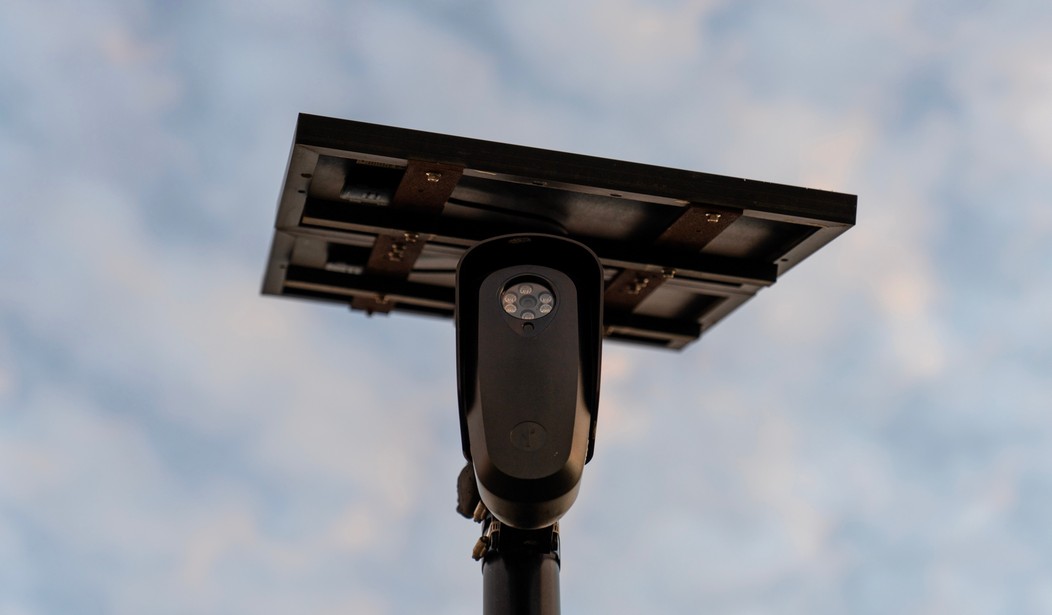
Republican Rep. Pat Harrigan (NC-10) has apparently had enough of the government's growing network of surveillance cameras that track Americans wherever they drive. On Thursday, he introduced legislation to impose serious restrictions on Flock cameras and other automated license plate readers, including requiring warrants before police can search most of the information they collect.
The bill, H.R. 10822, would also require deleting most records within 24 hours, prohibit searches based on political or religious bumper stickers, and stop private vendors from selling the information or using it to train artificial intelligence.
Considering what these cameras can do, it's overdue.
Flock cameras photograph passing vehicles, recording license plates, locations, timestamps, and even identifying features such as bumper stickers. Police departments can search that information, including records shared by other agencies, to reconstruct someone's movements.
The company says its network scans roughly 20 billion license plates every month. That's an awful lot of information on Americans who haven't done anything wrong.
Harrigan explained his concern during an interview published Saturday:
"When you consider that these systems track everything that you do, where you work, where your kids go to school, where you even go to church, I think it's pretty easy to understand why people are concerned."
He continued: "So, that's an extraordinary amount of information about somebody that the government has that has never committed a crime."
He's got a point. Police don't need a searchable history of your daily routine simply because a camera happens to be mounted on a pole outside your neighborhood.
And we've already seen what happens when someone with access decides to get creative.
As RedState previously reported, Florida police officer Christopher Goodson was arrested in August after investigators alleged he searched for his estranged wife's vehicle 717 times using Flock's database. Some searches allegedly occurred while he was off duty.
In North Carolina, another officer was accused of using the system 31 times to monitor her boyfriend's ex-wife. Harrigan pointed to that case during a September interview, warning that the technology was already being abused.
He didn't mince words: "We have to approach this in a 702-like manner."
Harrigan didn't stop there. He had a specific framework in mind.
"We've got to put very, very serious 702-like guardrails on this, where that information comes from, what warrants are required in order to actually query or search the system."
Harrigan was referring to Section 702 of the Foreign Intelligence Surveillance Act, another surveillance authority that has drawn criticism over government access to Americans' information.
His proposed restrictions go beyond warrants. Agencies would face audits and reporting requirements, while people subjected to illegal searches could sue for at least $1,000 per violation. States without qualifying protections could also lose some federal criminal justice funding.
RedState's Susie Moore recently covered a federal ruling in Oklahoma, where a judge found that police violated the Fourth Amendment by searching a month's worth of a driver's movements without a warrant.
Flock and its defenders insist the technology helps catch criminals. Sure it does. That's never been the argument. But a useful investigative tool doesn't automatically justify collecting information on millions of innocent drivers, and warrants exist for a reason.
Harrigan's bill would still allow police to use the technology during legitimate investigations and emergencies. What it would stop is the routine, warrantless collection and searching of Americans' movements, the kind the government has somehow managed to live without for most of its existence. The Constitution didn't come with an asterisk for convenient technology.
Editor's Note: Do you enjoy RedState's conservative reporting exposing the radical left and woke media? Support our work so we can keep bringing you the truth.
Join RedState VIP and use promo code FIGHT to receive 60% off your membership.



Join the Conversation
VIP members get the ability to comment on articles.