


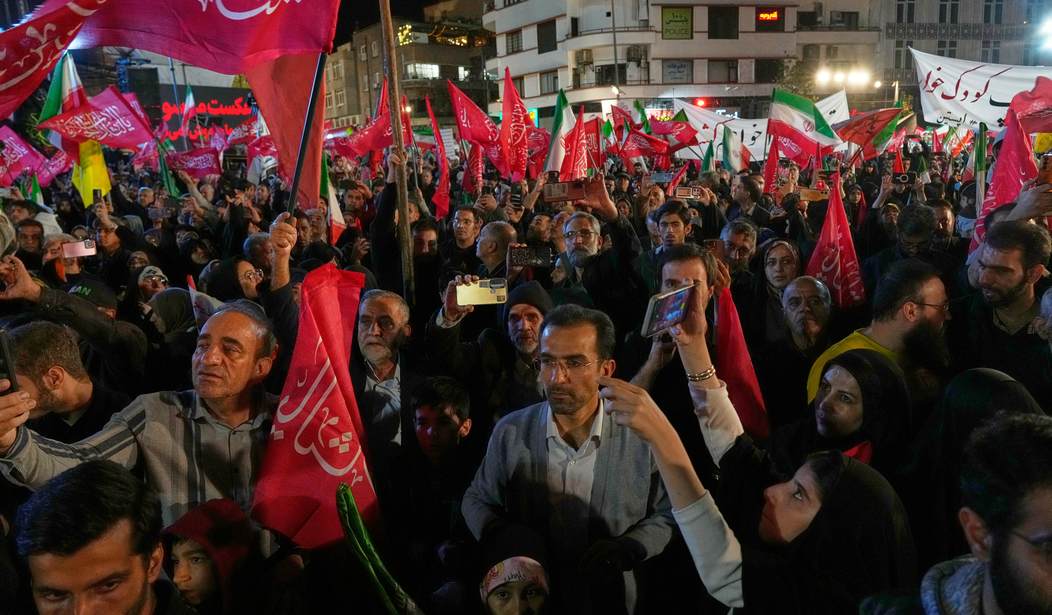

No matter what anyone on the American Left has to say about it, Iran remains a threat to the Western world. They are still the world's number-one state sponsor of Islamic terror. They still harbor ambitions for weapons of mass destruction, including nuclear weapons. All of this will remain the case as long as Iran remains the Islamic Republic of Iran, as long as the mullahs and their fanatical minions keep their stranglehold on Persia.
On Saturday, a report from defense journalist Ben Ollerenshaw, published at RealClear Defense, makes the case that Iran's nuclear program may be further along than many people think. Here's the key point:
On November 12, Iran’s Assembly of Experts, the country’s highest clerical body, urged the Government to consider withdrawing from the Non Proliferation Treaty, (NPT) which prohibits Iran and other non-nuclear signatories from acquiring nuclear weapons, and also prohibits existing nuclear powers from transferring nuclear weapons to other parties.
This statement represents a significant potential shift in official Iranian policy, which until now has generally been to deny that Iran intends to acquire nuclear weapons, and to claim that its current stockpile exists for civilian use only.
A little further back, on October 22, Mohammad-Saleh Jokar, chairman of Parliament's Internal Affairs and Councils Committee, publicly urged the Iranian government to permit the use of nuclear weapons against the US in the event of a US attack on Iran. Jokar’s statement has the probable distinction of being the most explicit and public suggestion of nuclear use by an Iranian public official of some standing so far in this war.
Meanwhile, recent media reports have cited Israeli intelligence that Iran may be considering chemical weapons employment if and when the recent skirmishes with US forces escalate to something more serious.
Chemical weapons are one thing, but nukes are quite another, and we might note that the Little Boy bomb, the one dropped on Hiroshima, Japan in 1945, employed 80 percent enriched uranium; not the 90 percent used in modern uranium bombs, but above the 60 percent that appears to be a floor for making a nuclear device that goes boom.
Here's the onion:
One common misconception about Iran’s nuclear program concerns the term “weapon-grade.” Usually, media reports state that while Iran’s June 2025 stockpile was not “weapons-grade,” it could be rapidly enriched to 90% concentration, allowing for a so - called nuclear “breakout.” Furthermore, it is sometimes added that the 60% enriched Highly Enriched Uranium (HEU) which Iran possessed in June 2025 is “insufficient” to produce nuclear weapons. This is misleading.
In fact, it is entirely possible to produce a relatively powerful nuclear weapon with only the 60% enriched uranium which Iran had already stockpiled prior to US strikes on Iranian nuclear facilities in June 2025. These HEU weapons may be called “devices” or “explosives” rather than “weapons,” but they explode just the same. Enrichment to higher levels provides a greater yield for the same weight, (allowing the weapon to be more easily mounted on a missile,) and provides more weapons per kilogram of fissile material, which would allow Iran to produce more weapons in total. From Iran’s perspective, therefore, enrichment beyond June 2025 levels would have been desirable, but not necessary to obtain a useful nuclear capability.
Similarly, there is no particular need for Iran to use any advanced technology; weapons no more sophisticated than those produced by the US eighty years ago would be minimally sufficient.
The Bulletin of the Atomic Scientists agrees.
In practice, if Tehran recovers its 60-percent enriched uranium, the destruction of its enrichment infrastructure would not necessarily eliminate the possibility of a future nuclear test. The stockpile could still hold enough fissile material for a crude device, although Iran would still have to process the highly enriched uranium into a weapons-usable form, assemble a functioning explosive package, and prepare an underground test site. A nuclear test would generate political shockwaves throughout the region.
But the weaponization scenario would also risk triggering a nuclear arms race in the Middle East. Saudi officials have repeatedly threatened to acquire their own nuclear weapons if Iran develops a bomb.
They aren't the only organization concerned with international politics and military affairs to be concerned over Iran's work on this.
The entire thing, right now, seems to come down to the facility called Pickaxe Mountain, which was under construction when military actions to take out Iran's military began. The site is intended to house a uranium enrichment facility, and at this point the United States just doesn't seem to have a wealth of intelligence on the place, whether it's functioning or not; or at least, if we do have such intelligence, the Trump administration has enough sense to not let Iran know what we know. But we do know that as recently as July 2026, Israel reported indications of centrifuges and other equipment being taken to the Pickaxe Mountain site.
President Trump has maintained that the United States hasn't yet hit Pickaxe Mountain because there's no need to. But this facility, buried in a mountain, is one of the most secure and the most difficult to destroy targets on the planet. Much would depend on the depth of the facility; as Mr. Ollerenshaw points out, the facility could be buried anywhere from 100 to 600 meters deep, under solid rock, to boot. At 100 meters, non-nuclear strikes could seriously damage the facility, including smashing exits and ventilation systems. At 600 meters, though, in this terrain, it's not even certain that one of the United States' nuclear bunker-busters, which have a yield of about 10 kilotons, may not be able to destroy it.
Nor should we discount Iran's chemical and biological weapons programs, either; unlike Iraq in 2003, there is little to no argument or disagreement about Iran's programs, or about whether or not they would use them in extremis. And here's the thing, about nuclear or chemical weapons alike; much has been made of the necessity to weaponize these devices, that is, to take (for instance) a nuclear weapon and refine it to fit in a missile warhead. This isn't necessary. Not by a long shot. If there's one thing we've learned about Iran and the various groups of goblins who they support, it's that they have a certain sinister canniness, and it's not giving anything away to note that a nuclear device, even a crude one, could be the size of a cargo container, and it could still be loaded on to a tramp freighter with a skeleton crew of fanatics, sailed into some major harbor in the dark of night, and set off, perhaps with a bunch of radioactive waste packed around it for added effect.
This is the threat we face.
President Trump is right about one thing: If Iran manages to put together a working weapon, they will use it. And it's very likely that the first indication we have will be a test detonation — or, possibly, a detonation over Tel Aviv — or New York.