






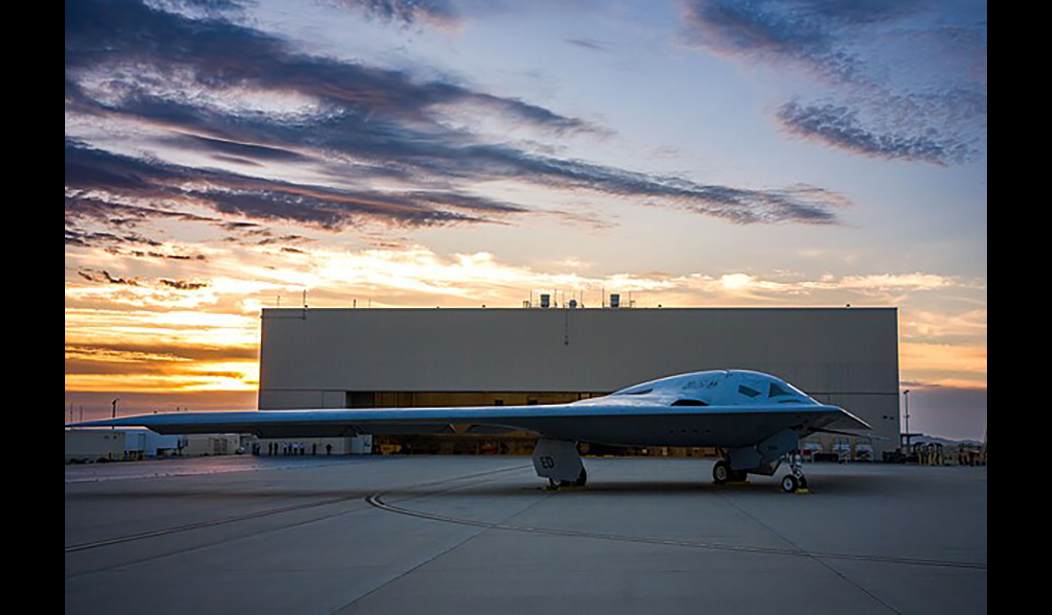
It's great, even for an old former ground-pounder, to see the United States Air Force moving to ensure America's technological supremacy for the decades to come. A key part of that is the new B-21 Raider stealth bomber, the eventual replacement for the B-2 and B-1 fleets. It's an amazing bird, still in testing phases but expected to enter service in 2027.
Now the Air Force reports that, thanks to a new facility that's in the works, the construction of the new bomber will be ramping up.
Northrop Grumman has broken ground on a major new production facility for the B-21 Raider, the company and the Air Force announced Oct. 6. The construction comes as a top service official said testing on the bomber is going well in the lead up to its planned introduction into the operational fleet in 2027.
“It’s more than construction,” Secretary of the Air Force Troy Meink wrote in a social media post. “We’re moving fast to build B-21s!”
Hear hear! Let's move fast to build B-21s and the new F-47s. We can build more of the new F-15EX Eagle II, while we're at it. Since the Great War, air superiority has played a key role in warfare, and since 1945, the United States has maintained, for the most part, a technical edge in air power. It's good to see us keeping it, and the Air Force obviously sees the key role the B-21 will play in any future conflict — and the urgency in getting them into service in significant numbers.
The Air Force Test Center has likewise been moving quickly to test the bomber ahead of its introduction into service next year. Brig. Gen. Mark Massaro, head of the Air Force Test Center at Edwards Air Force Base, Calif., gave an enthusiastic thumbs-up when asked about the program at an Oct. 6 event. The aircraft first flew in 2023, and two bombers are currently known to be undergoing testing at the base.
“I can’t give you many details about specifics on how it’s going, but I am very closely tied into that program and have been getting regular updates,” Massaro said during a discussion hosted by AFA’s Mitchell Institute for Aerospace Studies. “We are actively testing right now.”
Less than 30 miles away, Northrop is already building B-21s at its Air Force Plant 42 facility in Palmdale, Calif., but the new construction will add 1 million square feet of production space. Meink said it will be the “final assembly line” for new bombers.
Technology is a great force multiplier. We saw this in 1991, in the first Gulf War, when our F-15s and F-16s had Iraqi pilots looking at their airplanes and seeing coffins. We saw it when the first stealth fighter, the F-117, proved capable of penetrating Iraqi airspace and dropping smart-weapons with great precision. We saw it when our M1 Abrams tanks went through Iraqi armor like a harvester through a wheat field. And we see it now in Iran, where our bombers destroyed much of Iran's nuclear program in a single night, and how we swept the Iranian armed forces aside in a matter of weeks.
In any coming conflict, we will want to maintain that technological edge, bearing in mind that the United States has not fought a true near-peer conflict since 1945 — but that we'd better be prepared to do so, and that's for sure and for certain. The B-21 will help us do that.
Editor's Note: Thanks to President Trump and War Secretary Pete Hegseth's leadership, the warrior ethos is coming back to America's military.
Help us continue to report on Trump and Hegseth's successes as they make our military great again. Join RedState VIP and use promo code FIGHT to receive 60% off your membership.



Join the Conversation
VIP members get the ability to comment on articles.