
I have long said and written that the conflict between the Western world and Islam is the great clash of our time. And, what's more, when we, the civilized world, enter into conflicts with groups like Al Qaeda, Hamas, Hezbollah, and nations like Iran, this is not a clash of civilizations. It's a clash between civilization and barbarism.
Here's the interesting thing: Some Muslim-majority nations in the Middle East show signs of moderation. President Trump's Abraham Accords, in which the Muslim nations signing on agree to normalize relations with Israel (among other things), include Israel, the United Arab Emirates, Bahrain, Morocco, and Sudan (Sudan's full agreement is not yet finalized) and there are rumors that the Saudis may be on board, which may well bring much of the Sunni world along.
So, the question is this: If the majority-Muslim nations are moderating some, why do we seem to be seeing more and more radicals in Europe and the United States?
Zineb Riboua, a research fellow with Hudson Institute’s Center for Peace and Security in the Middle East, has some thoughtful insights into the majority-Muslim nations, namely, that their behavior lately has been more pragmatic and less dogmatic (with Iran being the exception).
Published in 1996, Samuel Huntington’s Clash of Civilizations predicted that, with the end of the Cold War, global conflict would center on the divide between Islamic and Western civilizations. Thirty years later, however, and a quarter-century after 9/11, the principal fault line runs through Islam itself, separating two ideological worlds.
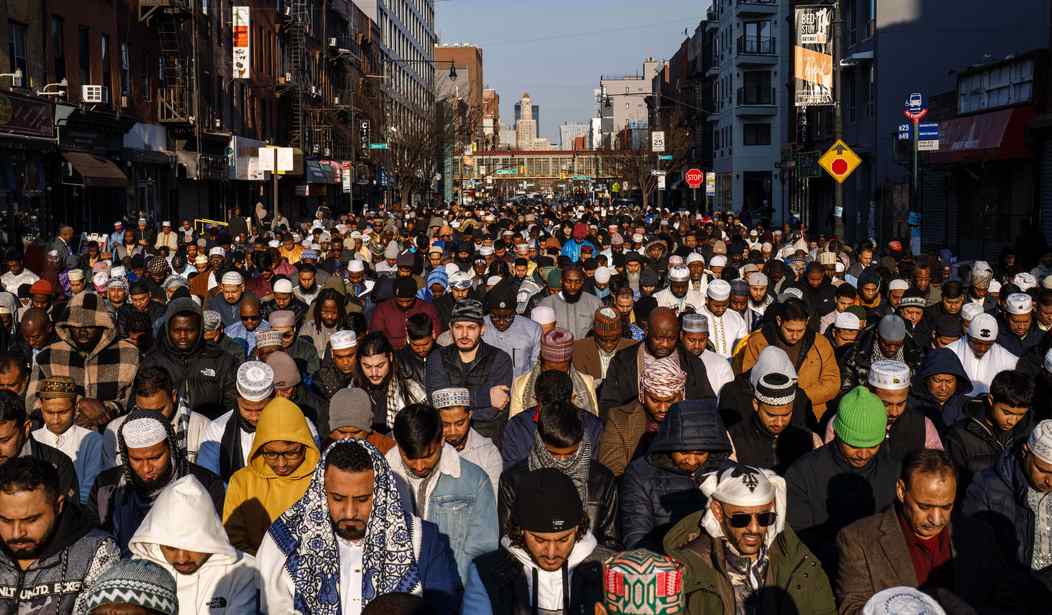
Within Western diaspora communities, Islam has become intertwined with Third-Worldism and postcolonial theory, both of which see Western imperialism as the great evil of the modern era. Meantime, much of the Middle East and Asia has turned toward pragmatism, normalization, and acceptance of Western predominance as a geopolitical reality. The gap between these rival outlooks now exceeds the divide between Islam and the West that Huntington anticipated when his book first appeared.
Mind you, there's a rather huge difference between a majority-Muslim nation becoming more pragmatic and that same nation joining the modern world and starting to recognize fundamental human rights and the blessings of liberty. But when you're flat on your back, the only way you can face is up, and one could argue that any improvement is better than no improvement. These things are relative; we are talking about nations where, for instance, apostasy, meaning leaving Islam for another faith or for no faith, will draw one a death sentence in no less than nine majority-Muslim nations, including Afghanistan, Iran, Saudi Arabia, Yemen, Mauritania, Maldives, Qatar, the United Arab Emirates, and Brunei. Applying the death sentence for something the Western world recognizes as a basic human right, freedom of conscience, is not the act of a civilized culture.
But there may well be a bigger issue at stake. If we assume that this assertion is current, that much of the Muslim world is at least beginning to moderate, where are all the whackos coming from? Could these "moderating" nations be sending us their most troublesome residents?
If so, this may be one of the results:
The consequences extend well beyond the campus. Anti-Israel activism once largely confined to Islamist organizations now operates comfortably within progressive politics. Zohran Mamdani’s appointment of Ramzi Kassem—who represented Ahmed al-Darbi after his conviction for the al-Qaeda-linked MV Limburg bombing—as New York City’s chief counsel illustrates that institutional migration. University encampments, municipal resolutions invoking “from the river to the sea,” and coalitions organized around decolonization reflect the same evolution. Revolutionary Islam now finds expression through postcolonial theory rather than religious doctrine. Iranian-aligned clerical networks in places such as Dearborn, Michigan, frame public life around opposition to American influence and solidarity with Tehran.
I would argue that it's still mostly religious doctrine, but the end result is much the same.
Here's the thing: If this is what is happening, if the radicals in the Muslim world are being quietly foisted off on the West, it sure wouldn't be the first time. Some of us remember the Carter administration and the Mariel Boatlift of 1980, when Fidel Castro emptied Cuba's jails and asylums and foisted those people off on the hapless Jimmy Carter. Could the same be happening here, just in a more decentralized manner? Could that be why we are seeing outbursts like this in the modern, Western world?
Imam in Michigan has a message to Americans:
— Tommy Robinson 🇬🇧 (@TRobinsonNewEra) January 23, 2026
"You Americans are the ignorant. The last hope for America is Islam. We are the leaders of the world, the masters, and the teachers.
We will bring Sharia and spices to the white man's unseasoned chicken."
pic.twitter.com/8jnjXAjdzf
Zineb Riboua names three forces involved in the collision between the radicals and the pragmatists.
First: The two sides of this clash are founded in different sources:
Much diaspora activism is rooted in historical grievance, anticolonial struggle, and opposition to Western influence, producing an anti-system worldview in which cooperation with the U.S.-led order can itself signify submission or betrayal. Pragmatic Middle Eastern governments increasingly see cooperation with the United States and Israel as a means to strengthen security, attract investment, acquire technology, and accelerate economic growth.
That may well be, but this growth in pragmatism is limited; it's not about to develop into some new embrace of basic human rights. The majority-Muslim world is liable to remain as it is: Largely oppressive, antisemitic, misogynistic, and fundamentally opposed to the notion of basic human rights.
Second, priorities have diverged between governments in the Middle East and North Africa and some of their diasporas in the West. Regional governments increasingly prioritize investment, technology, military strength, and economic growth.
Military strength being the key variable here. Their investment will not go towards establishing a free market economy, based on elementary rights including liberty and property. Any prosperity gained through this new pragmatism will be dealt out very sparingly indeed to the common people, just as primitive cultures have always done.
Here's the alarming bit:
Third, Western institutions amplify the diaspora vision far beyond its demographic weight. Universities, philanthropic foundations, professional associations, media organizations, and segments of electoral politics have absorbed postcolonial ideas that recast Middle Eastern affairs through the lens of decolonization and racial justice. By contrast, Gulf restrictions on Islamist financing and expanding cooperation with Israel reflect a deliberate effort to contain the same ideological currents sweeping across Western public life.
And that's key. Our great defining clash of civilization vs. barbarity is not and will not primarily be a clash between nation-states, Iran notwithstanding. The troubling part is this: As Zineb Riboua points out, the radicals seem increasingly to be already among us: They are sunk into academia, they are embedded in politics, some of them are American citizens, born here in the United States, just as some were born in and are citizens of the nations of Europe, of Australia, and other nations in the Western world.
This clash, this fundamental conflict, is still to be fought, and the very worst of the other side may already be among us - and we may have let them in, and in so doing, let the Middle Eastern nations, those majority-Muslim nations, rid themselves of some of their own worst troublemakers.