






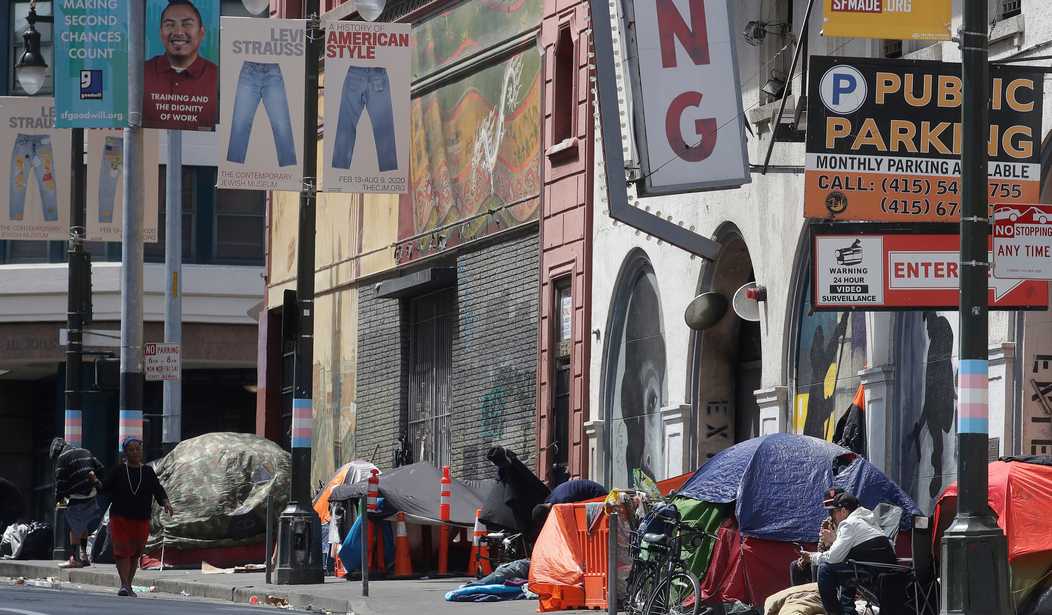
If California were trying to drive all the productive residents out of the once-Golden State, it's hard to see what it would do differently. California Democrats, like Democrats everywhere, have never seen a tax hike they didn't fall in love with, and with those tax hikes, as inevitably as spring rains, come spending hikes.
Now, in California, it's not just the state that is seeking more taxation. Many of California's cities are now seeking sales tax increases, to further erode their appeal to businesses and productive residents.
Two years ago, 125 local tax measures appeared on ballots. Ninety, says the Howard Jarvis Taxpayers Association, passed. A number of cities now have local sales taxes that exceed 10%.
Several cities in “conservative” Orange County are likewise asking voters to approve various local tax increases. We won’t know until the deadline in August how many local governments will be begging voters to raise taxes in November, but the numbers will be mind-blowing. It’s a one-way ratchet every election cycle.
“Historically, whenever there’s a gubernatorial election or a presidential election year, you’re going to see a lot of local governments asking the voters to approve tax increases,” says David Kline of the California Taxpayers Association.
And with each tax increase comes another wave in what I've been calling the Great Sorting. But that's not stopping these cities from doubling down on stupid.
Pasadena is one of several cities where voters will likely have to decide this fall if they want higher taxes. Local governments that already have measures on the ballot include Los Angeles (raising the sales tax from 9.75% to 10.25%), San Diego County (half-cent sales tax hike) and the city of Orange (a full cent added to the sales tax). Five Bay Area counties and the city of San Francisco will have a transit tax on their November ballots.
These measures are usually placed on the ballot by elected officials, which is the case in Rocklin, where the sales tax will grow to 7.75% if the proposal passes. In other instances, advocacy groups ask for tax hikes to be put before the voters through signature-gathering. Politicians love to say that the people are voting for these taxes themselves, but that’s often a dodge they use to avoid having to make hard decisions.
This isn't just a California problem, of course. Plenty of municipalities have sales taxes, some of them prohibitive. But California is bleeding businesses and bleeding productive citizens, far faster than it can afford to keep doing.
Read More: DeSantis Now Targeting Gradual End to Florida Property Taxes
Art Laffer to Georgia: No State Ever Prospered After Adding Income Tax
So, what's to be done? Three things: Cut spending. Cut taxes. And, local leaders must actually do their jobs, to make these cities places people want to live.
Despite the spending, which exceeds the rate of inflation, residents aren’t seeing their cities improve. Using federal data, the RCI analysis reports “that key quality of life metrics in major cities have mostly been stagnant during the spending spree.” The return on “investment” has been rather poor.
“The cities that boosted their spending the most were, on average,” says the RCI report, “no more or less likely to see measurable progress in” tackling homelessness, cutting violent crime rates, smoothing income inequality nor making rental property more affordable.
Far too much of cities’ unsustainable spending habits are eaten up by snowballing bureaucracies, cushy retirement plans for city workers, out-of-control healthcare costs and bloated union contracts.
These things are a laundry list of "fix it now" items - up to a point. If these cities are concerned about "smoothing income inequality," that's an agenda item that can be chopped right out of the cities' laundry list right there. It's not the role of government to decide these things; not in a free economy. It's not the role of government to pick winners and losers in an economy, nor to seek to balance incomes (and wealth) between producers and non-producers, which is always what this comes down to.
But the snowballing bureaucracies, the retirement plans, all of that can go. No city worker should have a retirement plan any better than any retirement package on offer to the general run of the American people. Let city workers stick some of their paychecks into a 401K like the rest of us. And no city worker should be paid a penny more than an equivalent worker in the private sector, and yes, the value of benefits must be included in that determination.
Conditions in these cities, and the flight of the productive from these cities, and these states, will continue until the people of those jurisdictions vote in politicians who will release the catch on that taxation ratchet and return some semblance of fiscal and governmental sanity to the once-Golden State - and elsewhere.

Join the Conversation
VIP members get the ability to comment on articles.