
We all want clean air, clean water, and a clean environment. Nobody likes smog or polluted lakes and rivers. Some of us are old enough to remember what a mess things were not all that long ago: Smog warnings in the major cities, rivers that you couldn't eat the fish out of, if you could find any fish, and trash-strewn roadsides. But this is a problem that's largely been solved, no matter what the environmental lobby and climate scolds claim; they are, after all, trying to keep the donations coming, so it's in their interest to keep people worried and upset that we're burying the planet under a layer of pollution.
Well, we're not. Some of the reason for that is the Clean Air Act of 1970, and more is due to the general increase in efficiency of our industrial processes since then; the automobile industry alone has vastly decreased emitted pollutants while increasing gas mileage and efficiency.
The result? Despite fossil fuel use in the USA increasing, air pollutants have dropped dramatically.
From 1970 to 2023, U.S. emissions of six criteria air pollutants declined 78% while GDP grew 321% and energy consumption rose 42%—consistent with the Environmental Kuznets Curve and driven by wealth creation and market incentives rather than central planning. pic.twitter.com/CTXjysyrZi
— Institute for Energy Research (@IERenergy) February 3, 2026
A recent post at one of my favorite energy and climate sites, Master Resource, has more data. Note that it starts in 1970, with the passage of the Clean Air Act.
This progress can be traced back to 1970[.]
Here's the graph that follows:
Air pollution since 1970. pic.twitter.com/IODa5YB0kY
— Ward Clark (@TheGreatLander) May 9, 2026
Note that there is more to this than just the environmental data. The very top line, the one that shows the greatest increase, is Gross Domestic Product. The next greatest increase is in vehicle miles traveled. After that? The population is still rising, slowly. Energy consumption is flat - in large part because of increased efficiencies, and if you doubt that, start up your buddy's 1970 F-100 and compare the tailpipe emissions to a 2026 F-150. Huge difference.
CO2 emissions have dropped. Aggregate emissions have dropped dramatically.
These are facts. No matter what the environmental activists claim, we have won this fight.
Read More: Scientists Stunned, Media Stammering: Pollution Cuts Now Fueling Warming
Bold New HHS/EPA Move: Cleaner Water Free of Microplastics and Drugs
Our environment is cleaner than it's been in many years, maybe since the start of the Industrial Revolution. That will only continue to improve, especially if and when we rely more on nuclear fission for electrical generation. And think on this: This latest data set only goes back to 1970, with the passage of the Clean Air Act. Conditions had already improved vastly since the late 1800s, when people heated and cooked with coal, and the coal smoke was "scrubbed" by being passed through a metal pipe to the roof. On the city streets as recently as the 1920s, one had to step smartly to avoid treading in the stuff horses leave behind.
All of that is gone now.
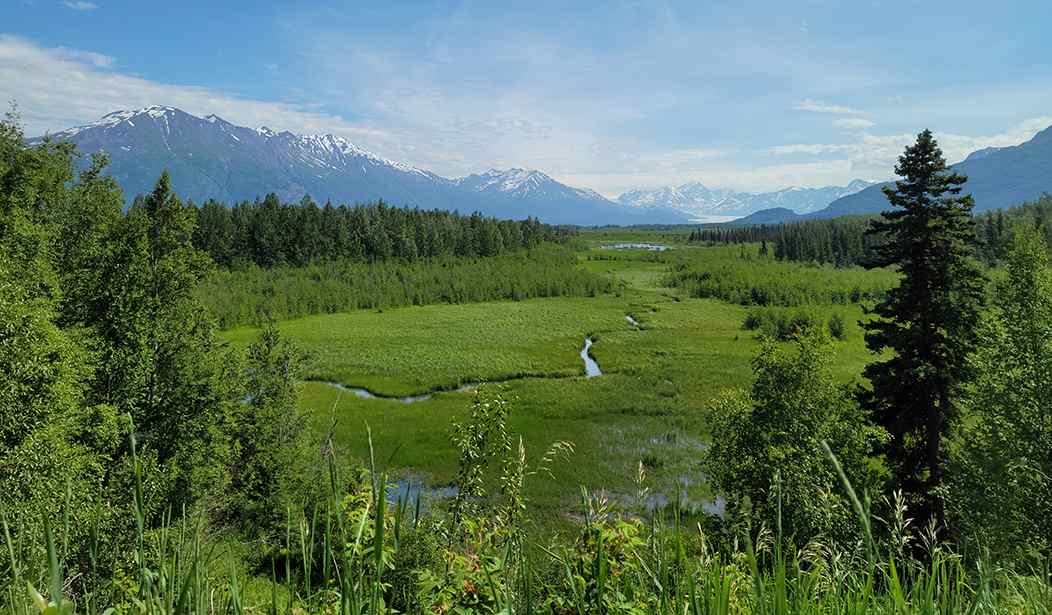
Look, I love clean air and water. Everybody does. Even Republicans. I care about the environment. Maybe more than some, because unlike most of the whiners who claim to be “environmentalists,” I actually live out in the environment, amongst the trees and the critters. Rural Alaska is a great place to live if you like wildlife watching. In fact, at times, it’s hard not to watch the wildlife, as there’s so much of it around. Sometimes the wildlife watches us, which can be a trifle unnerving. Imagine sitting in your kitchen and having a 1,800-pound bull moose saunter up and look in your picture window, and you’ll have some idea what I mean.
This is the simple disconnect with the “environmental” movement, or worse, the hyper-annoying climate-change scolds: This is a battle that has already been won.
The 1970 Clean Air Act and other regulations and laws, granted, forced the initial cleanup of air and water. And hey, it worked. You just can’t compare the environment today with how things were then. Even wildlife bounced back. Our national symbol, the Bald Eagle, was in danger of extinction. Now it’s plentiful. Here in the Great Land, some call them “Alaska crows,” they are that common. When I was a kid, seeing a white-tailed deer was a big deal, and you told everyone you knew. Now they’re a pest; there are so many of them. In my old Iowa stomping grounds, the farmers are now calling them "hoofed rats." It's not just the air, either. You can catch fish for the table in places you couldn't a few decades ago. You can swim in places that would have made you very sick not all that long ago.
The air is cleaner. The waters are cleaner. The lands are cleaner. The campaign to clean up our environment was won some years ago. And it was just as many improvements in automobiles, electrical generation, and even the refining of those fuels that made the lion's share of the difference.
We can, in this matter, have our cake and eat it, too. We can have a modern, high-tech lifestyle and a clean environment as well. This data serves as further proof of that - and it's another data set that puts the radical environmental lobby back on its heels.