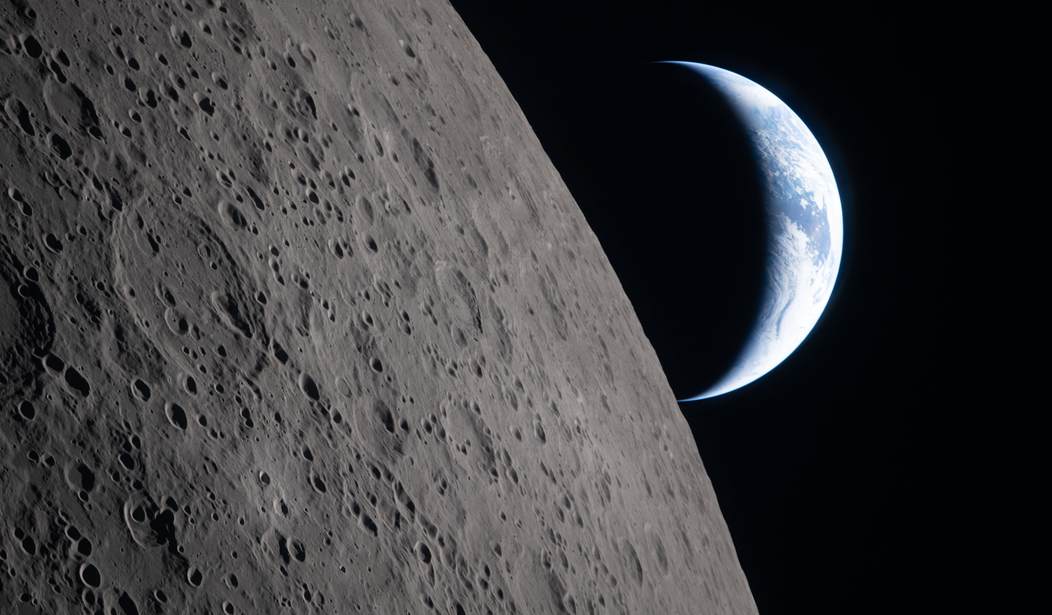

The Artemis II astronauts have returned safely home on Friday, while many of us watched in awe. These people have literally gone where no one has gone before, in the biggest scientific and engineering flex the United States has pulled off since the Apollo missions. Finally, finally, we've ventured beyond low orbit again - and this was more or less a proof-of-concept. Now we know everything works, and we'll be going back.
There's another great thing about this: China, India, and any other nations with space-faring ambitions are on notice: The United States is back, baby. The question is this: Can we keep up the momentum Artemis has given us?
The day after Artemis II launched (Apr. 2), the Department of Energy announced an initiative called the Genesis mission, and it's bringing along an interesting set of goals.
The Department of Energy's Under Secretary for Science, Dr. Dario Gil, is leading the Genesis Mission, a bold initiative to transform how the U.S. conducts scientific research and engineering. By leveraging a convergence of high-performance computing, AI, and quantum computing, the Genesis Mission seeks to double the productivity and impact of the nation's trillion-dollar R&D engine within 10 years.
Why it matters
The Genesis Mission has the potential to dramatically accelerate breakthroughs in critical areas like fusion energy, power grid optimization, and materials science. By democratizing access to advanced computing capabilities, the initiative could unlock new levels of scientific discovery and innovation that benefit the entire country.
Worthy goals all, and by focusing on cutting-edge computing power and artificial intelligence, it looks like the main purpose of Genesis isn't to reform a planet into a life-bearing world suddenly, as was done in a certain film that was part of a world-famous science fiction franchise, but instead to supercharge technological research and development. Anyone who has worked in research knows there is a lot of number-crunching involved, and it's true, computer power and AI can bring that along much more quickly than any number of high-forehead types with slide rules could ever do. And the goals set out for Genesis are nothing if not ambitious:
The details
The Genesis Mission is built on three pillars: a computing platform for accelerating discovery, a portfolio of national challenges to serve as proving grounds, and a university engagement effort to rethink STEM education. Key examples include using AI-powered surrogate models to compress fusion reactor design timelines from months to minutes, and developing AI emulators that can complete 20 years' worth of power grid simulations in just two months.
- The Genesis Mission was launched by President Trump shortly before Thanksgiving 2025.
- A 10,000-GPU AI supercomputing cluster is expected to be operational at Argonne National Laboratory in Illinois this year.
- A similarly sized cluster is planned for Oak Ridge National Laboratory in Tennessee, also targeting 2026 operations.
- A 100,000-GPU supercomputer is scheduled for deployment at Argonne in 2027.
The people behind this aren't thinking small - not by a long shot. Nor should they, frankly. We're not France. We're not Luxembourg. We're not China. We're the United States of America. We are the cutting edge, and we have to stay the cutting edge. We do the big things. We send people on a roaring trip around the moon, father and faster than ever before, and bring them home without incident; we did that, and we should do this, too.
Read More: From Science to Advocacy: Why the National Academies Should Be Disbanded
NASA Boldly Goes Where No Man Has Gone Before As Astronauts Make Some Very Special Dedications
There's more. Writing at Watts Up With That, Duggan Flanakin, a senior policy analyst at the Committee For A Constructive Tomorrow, has this to say:
To kick off the Genesis Mission, the DOE announced a $293 million Request for Application (RFA), “The Genesis Mission: Transforming Science and Energy with AI.” The agency invited interdisciplinary teams to leverage novel AI models and frameworks to address 26 national challenges spanning advanced manufacturing, biotechnology, critical materials, nuclear energy, and quantum information science.
The RFA is open to teams from DOE National Laboratories, U.S. industry, and academia. Phase I awards range from $500,000 to $750,000 for a 9-month project period. Phase II awards range from $6 million to $15 million over a 3-year project period. Phase I applications and Phase II letters of intent are due April 28, and Phase II applications are due May 19. Successful AI models and workflows may be integrated into the American Science Cloud.
In concert with the mission, the DOE, in collaboration with Idaho National Laboratory INL), Argonne National Lab (ANL), Microsoft, and Everstar, used AI mapping to convert a safety analysis document needed as part of the Nuclear Regulatory Commission’s licensing process.
I have but one concern: This all sounds great, and will doubtless work great - for now. But what happens when the next Democrat administration, the next Democrat Congress, takes the reins? Will the efforts continue to supercharge our scientific and engineering capabilities, or will this be used as another jobs program for anyone with the latest neurosis du jour? Will some future Democrat president be breathlessly announcing the first three-spirit wood nymph of color to be the director of this effort? Or will it stay focused on what it should - science and engineering?
I have my doubts, and if you need yet another reason to vote in the upcoming midterms, here you are.
This Genesis project could end up being a mixed bag. Science and the engineering that flows from it depend on the free flow of information, but more than that, it depends on a strict, even ruthless evaluation of facts. People with a non-scientific agenda can't be allowed near the controls of an effort like this. When bureaucrats become involved in this kind of thing, facts often are forced to give way to agendas, and that can't happen here.
If this helps the United States be once more the nation that does the big things, the hard things, the world-changing things, then it's good. But it had better stay focused; that means making sure the left keeps their hands off.