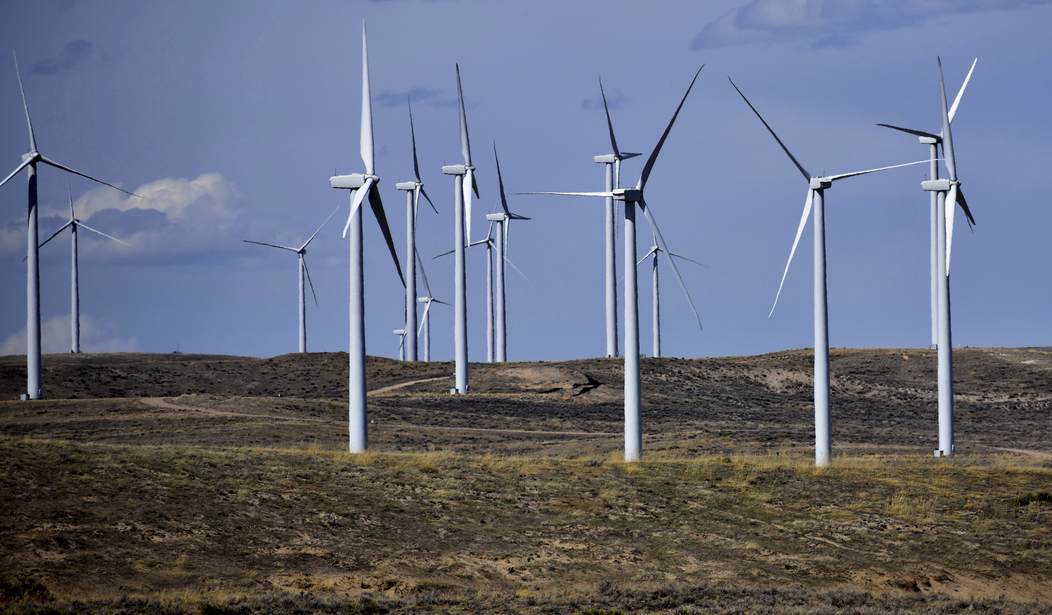

File this under "unintended consequences." For decades, the climate scolds and green energy proponents have been singing the praises of (unreliable, low-density) wind power. For decades, these big, ugly wind turbines have been springing up, like huge, ugly weeds, over vast stretches of landscape.
There's one more problem: These wind turbines, many of them, are reaching the end of their useful lives. That means those enormous carbon-fiber blades are no longer useful. The problem is, they can't practically be recycled or refurbished. So what's happening with large numbers of these things?
Dr. Bonner R. Cohen, a senior fellow at the Committee For A Constructive Tomorrow, has the answer: They're being dumped.
In February, Texas Attorney General Ken Paxton announced his office was suing Global Fiberglass Solutions, Inc. and all affiliated entities for allegedly “dumping thousands of wind turbine blades and related materials at two disposal sites in Sweetwater, Texas,” KTAB/KRBC reported. The suit, filed on behalf of the Texas Commission on Environmental Quality, alleges the company failed to properly dispose of turbines it was hired to dismantle, transport, and recycle, resulting in the illegal stockpiling of over 3,000 turbine blades in Sweetwater. Some of the industrial waste abandoned in Sweetwater dates to 2017, prompting Paxton’s office to seek up to $1 million in civil damages.
“Illegal disposal of wind hurts our land and will never be permitted under my watch,” AG Paxton said in a statement. “Just because the radical left calls something a ‘green industry’ does not give any company a free pass to harm the Texas countryside, break our laws, and leave Texans to deal with the negative impacts.”
Sweetwater officials are bringing their own criminal charges against those they deem responsible for polluting their city. “Earlier this week, four individuals were indicted on criminal charges related to these wind blades. I hope this sends a distinct and clear message that individuals who think they’re going to dump in our community are going to be held accountable and there will be consequences,” City Manager Bryon Sheridan said in a Feb. 26 press conference.
It's not just Texas, either, that is contending with this idiocy.
Texas isn’t the only place that has had to cope with wind turbine waste. A thousand miles to the northeast, residents of Grand Medow, Minn. had to put up with 111 fiberglass turbine blades haphazardly dumped in their community for four years. Locals in the southern Minnesota town of 1,100 complained that the cavities of broken and stained turbines drew feral cats and foxes and posed a risk to children climbing on the junk, The Star Tribune reported. The mess unfolded in 2020, when renewable-energy developer NextEra Energy rebuilt a wind farm in Mower County but had trouble finding a company to recycle the discarded fiberglass blades.
Despite a growing chorus of complaints by locals, it was not until October 2024 that the blades were removed, and then only after the Minnesota Public Service Commission ordered NextEra Energy to clean up the site.
While there have been some attempts at developing ways to recycle the materials in these blades, so far nobody has come up with a method that's economically viable. But then, there's nothing that's economically viable about this mess in any case.
Not that recycling is always the answer. There are materials where recycling is a practical notion; aluminum, iron, and steel can be reused over and over. But paper and cardboard, for example, require more energy to recycle than it does to simply make new paper and cardboard from pulp timber, which we might note is a renewable resource. (Here in the Susitna Valley, we recycle paper and cardboard with kerosene and a match.)
But just piling up blades in a landfill? What's "green" about that?
Read More: Fossil Fuels v. Green Energy, Part II - The Horrible Cost of Wind Power
Green Blades of Death: Wind Farms' Massive Eagle Kills About to Be Unveiled
It's going to get worse. The Environmental Protection Agency (EPA) reckons that, by 2030 - only four years from now - there could be as much as one million tons of these used-up blades to contend with. Solar panels may be even worse. I've described in the past that, while the land around wind farms can at least be put to some additional uses, solar panel fields are single-use; the land under those panels is good for nothing. Solar panels, just like the wind turbine blades, wear out, and like wind turbine blades, are ending up in landfills, where they leach things like lead, cadmium, and other metals into groundwater.
There's no good way, at present, to dispose of these things without causing greater environmental problems than they purport to fix.
Add this to the long list of reasons that wind and solar power aren't any answer to grid-scale electricity generation. Niche applications, yes; I've described them many times. Now we see how deep the convictions of the climate scolds go; they agitated for these windmills, claiming concern about the climate, about the environment. Now those windmills are aging out, with no measurable effect on the global climate, and landfills are filling up with thousands upon thousands of tons of used, useless, enormous carbon-fiber blades.
This is what happens when environmental policy is set by people who have little, if any, contact with the actual environment.