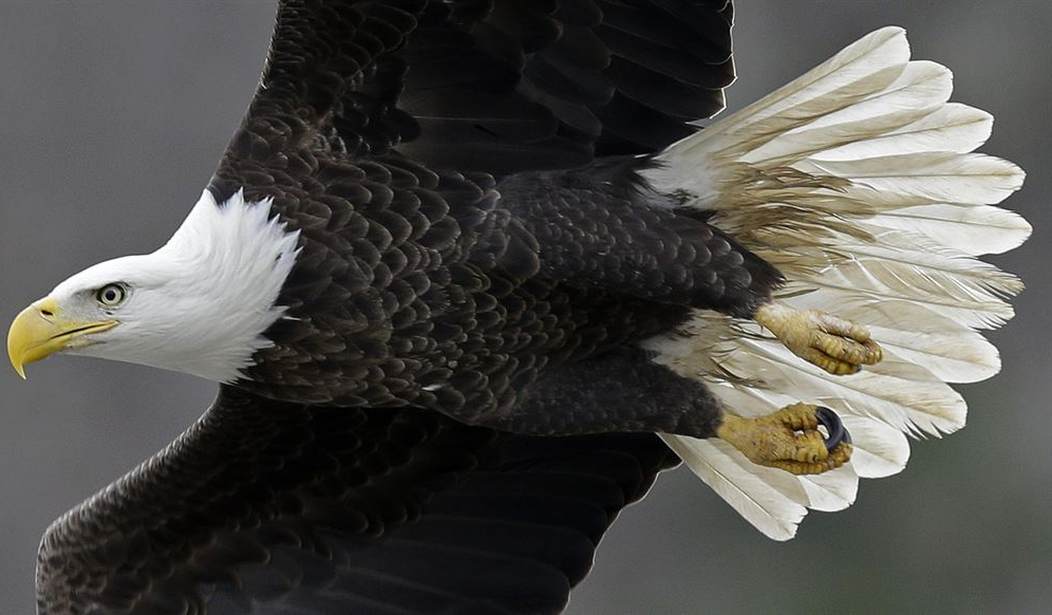

The recovery of our national symbol, the Bald Eagle (Haliaeetus leucocephalus), is a remarkable story. When I was a kid in the late '60s, even in the relative wilds of northern Minnesota, where we went fishing every summer, sighting an eagle was a rare thing. Such a sighting prompted phone calls and letters to relatives: "We saw an eagle today!" Bald Eagles, at that time, were in real danger of extinction.
No longer. They've made a remarkable comeback. The year before my parents sold my childhood home in Allamakee County, Iowa, there was a winter-killed deer in the bottomland across the creek from the house, and one morning the Old Man counted twelve eagles feeding on the carcass. Here in Alaska, some locals jokingly call them "Alaska crows" because they sometimes seem as common as ravens.
Now, though, eagles, not only bald eagles but also golden eagles, as well as other magnificent soaring birds, are in danger from the proliferation of big, ugly, wasteful windmills, put up in the name of "green" energy. The U.S. Fish and Wildlife Service, whose job it is to monitor these things, has been very tight-lipped about the number of eagles killed by these things. However, a Freedom of Information Act suit may force those numbers out into the open, and that's good; we have a right to know about this threat to our national symbol.
A new lawsuit could finally end the secrecy surrounding wind turbines killing eagles. Wyoming’s Albany County Conservancy (ACC) is suing the US Fish and Wildlife Service (FWS) for failing to provide the mandatory eagle kill reports for three big wind facilities.
This is a Freedom of Information Act (FOIA) case. ACC made a proper FOIA request. Five months later FWS said they had over a thousand responsive document but ACC could only see a small fraction.
Since ACC is after total kills this fraction is useless. Moreover the reason FWS gave for withholding most of the kill records looks to be invalid. So ACC is asking the Court to require FWS to cough up the kills.
Here is, for my money, where the ACC hits at the heart of the matter.
1. This is an action under the Freedom of Information Act (FOIA or the Act), 5 U.S.C. § 552, seeking to compel Defendants U.S. Department of Interior (DOI) and the U.S. Fish and Wildlife Service (FWS) to comply with their statutory obligation to disclose nonexempt information concerning the mortality and injury of legally protected eagles at three major wind energy projects located in Carbon County, Wyoming.
Understanding the ecological impacts of the emerging and rapidly proliferating wind energy sector is imperative to Plaintiff Albany County Conservancy, which strives to protect the rugged Western landscapes of Wyoming and the sensitive wildlife that call it home. Disclosure of the requested information is particularly warranted here since it concerns the otherwise illegal take of iconic, federally protected species—Bald and Golden eagles—and because collecting this information is a necessary condition of the permits that exempt these energy projects from incidental take liability under the Bald and Golden Eagle Protection Act (BGEPA), 16 U.S.C. §§ 668-668d.
We've covered the failures of wind power as a viable source of electricity time and again. They are, to put it bluntly, a massive failure. The energy they produce is intermittent, low-density, and expensive; these things never recoup the cost of building them, which, by the way, consumes an awful lot of good old fossil fuel in manufacturing, transport, setup, not to mention the materials of which they are made.
Read More: Wind Power May Be Putting Eagles at Risk of Extinction
The Truth About Windmill Wildlife Damage: It's Worse Than We Thought
If you've ever watched an eagle soaring, though, you'll understand why these things are a danger to these birds in particular. Soaring birds like eagles, like the soaring hawks of genus Buteo, like the Red-Tailed Hawk and Rough-Legged Hawk, and other soaring birds such as the Turkey Vulture, employ an aerial mastery of winds and thermal columns in the air to stay aloft with barely a wing-flap. They fly with wings extended, their almost finger-like flight feathers on the ends of their wings extended to feel the air, to make the most of every little updraft, of every puff of breeze.
But when a windmill blade hits one of these extended wings, it is a disaster that almost always results in a dead bird. The bones that support their wings are hollow and fragile, which is what makes these big birds light enough to fly. A blade strike will easily break these fragile wing bones. If the fall doesn't kill the bird, it will never fly again, as these kinds of injuries seldom heal enough to support flight. The result is almost always a dead or crippled raptor, and the American people don't even know how many, except that it's a lot.
All of this happens in the name of "renewable" energy boondoggles. Intolerable.
The American people have a right to know how many of the birds that are our national symbol are being killed by these things every year. We have a right to know how many birds in total are dying, and we need to know why these wasteful boondoggles aren't being taken down. That's what the ACC is suing for, and we wish them every success.