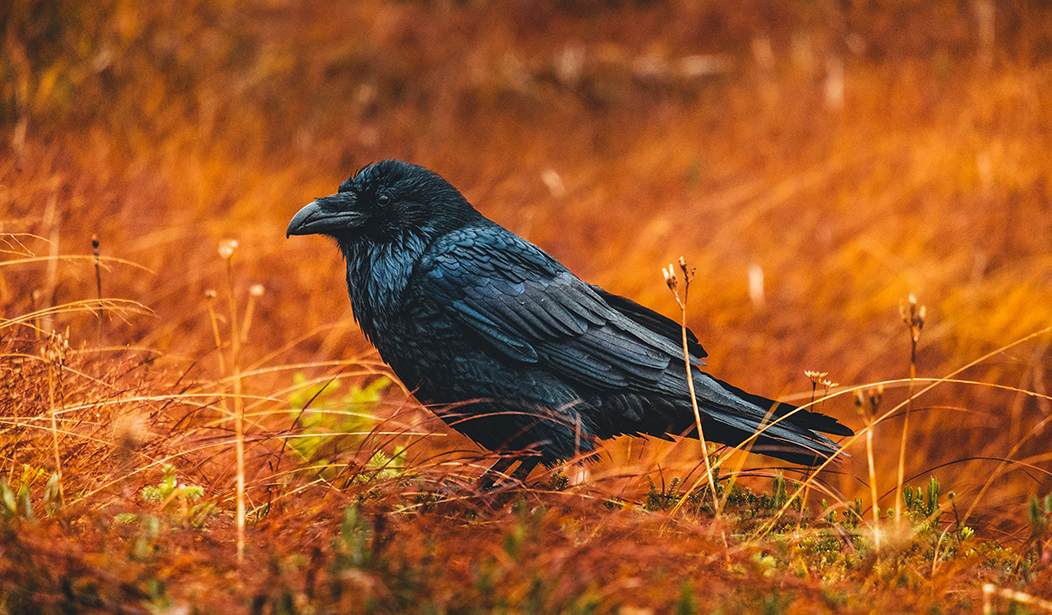
I've mentioned before that my wife, as a memorial to her Gulf War service, wears a silver raven on a chain around her neck. Why a raven? Because in Celtic mythology, ravens are the agents of the Morrigan, the death-goddess, who fly over a battle and choose who will live, and who... won't. My wife was, in 1991, a triage officer for her platoon; when large number of injured people came in, as sometimes happened, she was the one who had to decide who was treated, who could wait - and who they couldn't help. She lives with those decisions even now, and thus, the raven.
Mythologies aside, though, ravens are pretty fascinating birds. There's a fair amount of discussion around as to what one calls a group of ravens. Not a murder - that's crows. Some use the terms "unkindness" or "treachery," but I don't like those, as ravens are neither unkind nor treacherous. No, I like a "conspiracy" of ravens, as ravens, when they do get together, often bend their considerable brainpower to a joint goal.
Corvids in general are pretty smart cookies. The Corvidae are a family of the passeriformes, or perching birds, and in North America are represented by crows, jays, magpies, nutcrackers, and ravens. When I was a kid in Iowa, we had a lot of crows around. The Old Man gave me standing orders to shoot every crow I could lay gunsights on, as they are notorious nest-robbers, but they are also canny creatures, and I wasn't able to shoot that many of them. I was and am firmly convinced that a crow could tell the difference between an unarmed human and a human carrying a rifle or shotgun, and they reacted accordingly.
Here in Alaska, we have a wealth of ravens (Corvus corax), and it is these birds that are really canny. All of the Corvidae are smart, as anyone who has tried to keep jays from raiding bird feeders will attest. But ravens have serious problem-solving smarts. You won't see as many at once, as crows tend to group up while ravens are generally seen in pairs - and they mate for the long-term, sometimes for life.
Many animals undertake tasks that aid their future welfare, such as beavers and squirrels storing food to eat when resources are scarce. But no animals, other than humans and possibly some apes, were thought to forward-plan and map out a number of possible future outcomes. But it was proved for the first time that ravens had planning capabilities. In one experiment, they were trained to return a token in exchange for a food reward, before then having to choose between several items, including a low-quality snack and one of the tokens. 73 per cent of the time, the birds picked the token, assuming that better food would be provided, rather than grab the food in front of them.
Here's the really fascinating bit, about crows, but still:
It’s well documented that corvids can use tools to obtain food, but also use sticks to carry more than one item at once. Remarkably their tool use is even more involved: they found crows understand the science of water displacement, being able to add items to tubes containing liquid to secure a treat. But even more remarkably, research has also shown that corvids can make tools, as well as use them.
That's some serious smarts right there. Similar work has been done with ravens, and yes, they understand things like not only using tools but making them. They seem to have that innate understanding of displacement in fluids. How smart is that?
If only they had opposable thumbs, who knows what they might be capable of?
Read More: Alaska Man Monday: Squirrels, Turtles, and Ravens
Green Blades of Death: Wind Farms' Massive Eagle Kills About to Be Unveiled
One might wonder how ravens could be so smart, given their brain size compared to ours. The answer is that bird brains are different than ours, condescending use of the term "birdbrain" by humans notwithstanding. Birds in general and corvids in particular get a lot more bang for their buck when it comes to brains; the neurons in their noggins are much more tightly packed than in mammals.
They also get a big break in their respiratory systems, which use a system of air sacs to make sure that every breath results in a one-way flow of oxygenated air through their lungs, instead of the in-and-out we poor mammals are stuck with.
That brain power can be put to nefarious use, which is another reason I like the term "conspiracy" for a group of ravens. In grocery store parking lots in places like Wasilla, Palmer, and Anchorage, especially in winter, it's common to see ravens perched on the light poles or on the edge of the roofs. If you leave your loaded cart unattended, even for a moment, a raven or two will swoop in while your back's turned and seize their favorites. They know how various consumables are packaged, and tend to grab meat first; anything wrapped in white butcher's paper draws special attention. You've gotta admire that kind of canniness.
Perhaps the thing I like best about ravens is that they, like me, tend to like wild places. They do hang around in cities and towns here in Alaska, but most places, human settlements are more suited to crows. Ravens are creatures of wild places; we see them here regularly, and we have a pair that nests in the woods not too far from our house. They are smart, they are adaptable, they are survivors, and may well be around long after we're gone.
We're lucky to have them around.