








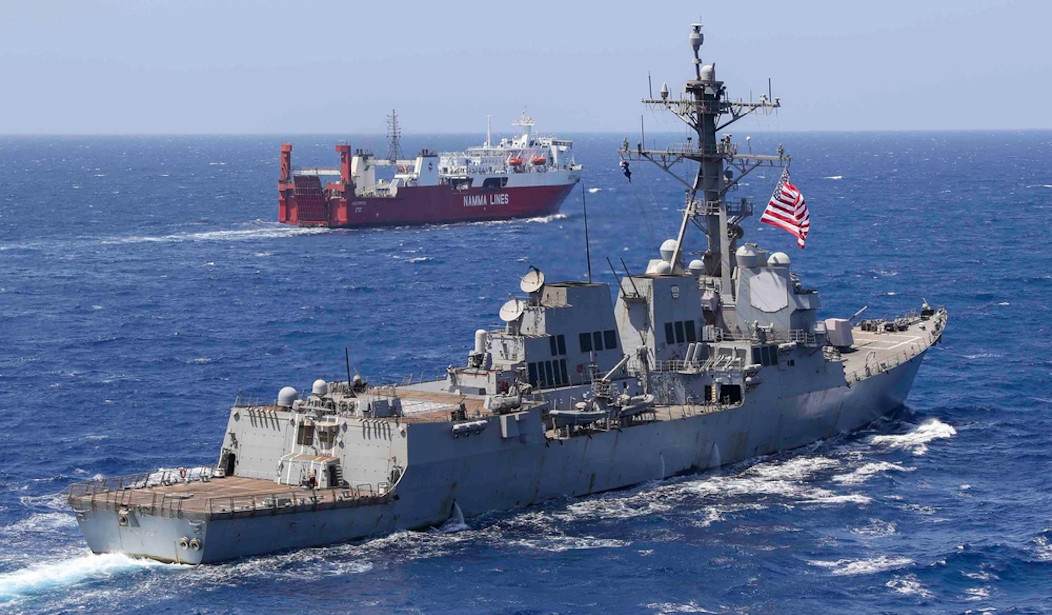
Military life can be a dangerous business, and even some routine peacetime operations can be dangerous if just one thing goes wrong. I'm given to understand that refueling is one of those things; in-flight refueling for aircraft, and of course, underway refueling for Navy ships.
That's what was underway in the Caribbean on Wednesday, when two U.S. Navy ships collided. Two sailors were reported to be injured.
Two U.S. Navy sailors were injured on Wednesday after a U.S. Navy destroyer and a supply ship collided in the Caribbean, military officials said.
"Yesterday afternoon, the Arleigh Burke-class guided missile destroyer USS Truxtun (DDG103) and the Supply-class fast combat support ship USNS Supply (T-AOE-6) collided during a replenishment-at-sea," a U.S. Southern Command spokesperson said in a statement to Fox News on Thursday.
Two personnel reported minor injuries but are in stable condition, the official said, adding that both ships have reported sailing safely.
The cause of the collision remains under investigation, according to the spokesperson.
I'm not familiar with the methods of steering ships; I was Army, not Navy. But it would seem like you'd have a couple of sailors watching over the side, to make sure the gap between ships doesn't get too narrow. The sea, however, like all natural things, is unpredictable. Could the ships have encountered a rogue wave? A sudden burst of wind? So far, the Navy isn't releasing any information. It's not clear if the seas were rough or if any other external conditions of wind and sea may have contributed to the mishap.
At least the two sailors, it seems, are going to be all right.
Read More: Iran Snaps Back: US Bases, Carriers Now in Crosshairs
US Boards 'Dark Fleet' Tanker Loaded With Venezuelan Oil in the Indian Ocean
One wonders if there may be a couple of ship captains looking for new jobs once the Navy's investigation is complete.
Here's the interesting bit:
Both vessels were assigned to the military buildup in the Caribbean that President Donald Trump ordered in recent months to combat drug trafficking in the region.
This type of replenishment operation at sea involves the transfer of supplies and fuel between two ships sailing side-by-side.
The Journal reported that even though the Navy owns ships like the Supply, they are typically operated by civilian mariners.
There are precedents for civilian operators in some garrison operations; a lot of Army chow halls used to be run by civilian contractors, and at least back in my day, the food was generally better when the civvies ran the show. But on an at-sea replenishment ship? It seems like one would want Navy personnel at the controls, not that some of our Merchant Marine sailors haven't done heroic work in wartime service.
I had an uncle who spent 30 years as a destroyer sailor in the post-World War 2 Navy, retiring as a Master Chief. He would tell you sea stories all day long. One of the pearls he dropped was that Navy officers tended to give merchant ships a wide berth, lest you end up exchanging paint. But he was a curmudgeonly sort, much like his nephew today, so who knows?
Editor’s Note: The 2026 Midterms will determine the fate of President Trump’s America First agenda. Republicans must maintain control of both chambers of Congress.
Help RedState continue to report on the Democrats’ radicalism and inform voters as our nation faces a crossroads. Join RedState VIP and use promo code FIGHT to receive 60% off your membership.



Join the Conversation
VIP members get the ability to comment on articles.