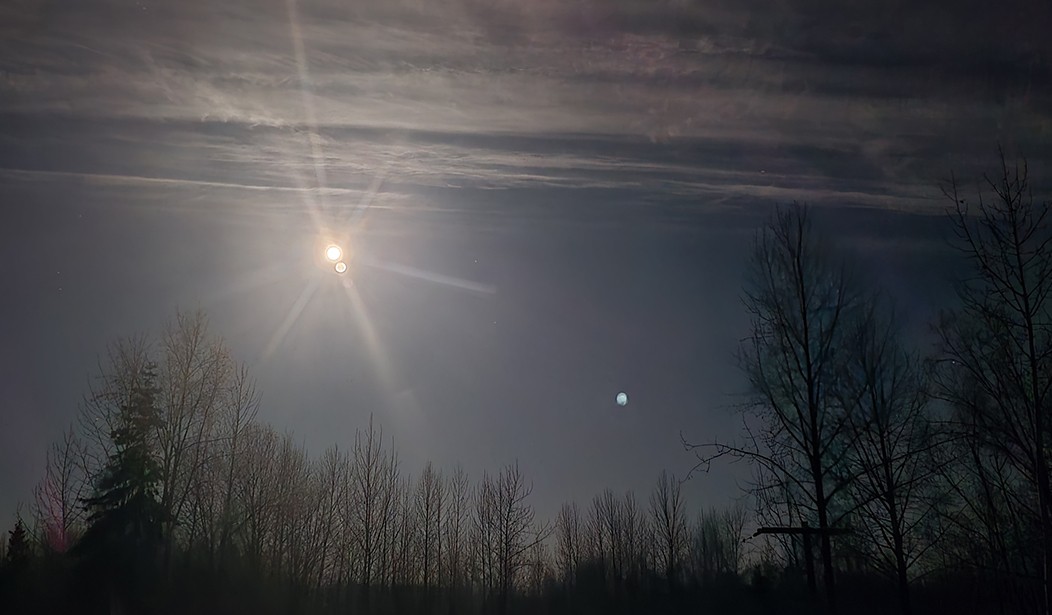

Honestly, we could use a little global warming here in the Great Land this Thursday morning. We rural folks pay close attention to the weather, as it affects everything we do, especially in the winter in Alaska. Coming off a warm spell that dropped a foot and a half of snow on us, now the sky has cleared, a high-pressure system is pushing Arctic air down from north of Broad Pass, and we're back in the deep freeze; -33 this morning.
That's fine. These things happen in the far north. Our local, interim temps don't change the fact that the Earth has been slowly warming, with some dips and spikes, since the end of the Wisconsin glaciation, and will do so until we drop into the next major glaciation. And speaking of those dips and spikes, climate scolds and the legacy media (but I repeat myself) seem to pay a lot of attention to those spikes, otherwise known as anomalies. They do not, however, seem to pay much attention to the dips, and data shows that the dips are outweighing the spikes in the 2025 record. The Daily Sceptic's Environmental Editor, Chris Morrison, has the numbers.
Global temperature anomalies on both land and sea are dropping like a stone. Net Zero-obsessed mainstream media, science and politics do not do cooling. Confirmation bias that holds humans responsible for hockey-stick style global warming with all its risible ‘settled’ notions has gravely damaged genuine climate science. But the world is cooling rapidly and the silence from the mainstream is both laughable and disgraceful.
Here's a key table:
— Ward Clark (@TheGreatLander) January 8, 2026
This is compiled from data recorded by the University of Alabama-Huntsville's most recent Global Temperature Report. Note that, yes, as I've said for a long time, the data, which begins in 1979, does show a slight warming trend. But look at the sudden dip beginning about 2023. That's the data that the climate scolds are ignoring. As Mr. Morrison points out:
Needless to say, mainstream media ignore satellite temperature data. In January 2022 at the height of the Greta climate hysteria, Google AdSense banned a page promoting the monthly update on the grounds of publishing “unreliable and harmful claims”. In the UK, the stone-dropping global inconvenience was passed over recently in favour of highlighting the latest hooey from the Met Office claiming another local ‘hottest year evah’ based on its junk, unnaturally heat-ravaged weather stations. Rather than advance a balanced global view (or even mention it), the Met Office activists proclaimed that its six hundredth of a degree centigrade ‘record’ was made 260 times more likely due to humans fiddling with the weather. Such imaginative precision from such junk data is a wonder to behold. Science, it is not.
A large part of the increase in dips over spikes has to do with the Pacific Ocean. The world's largest ocean is a major driver of global climate, mostly (but not completely) in the northern hemisphere. The Pacific in itself is a vast, complex, and chaotic system; it personifies what Robert Heinlein called the "ungrokkable vastness of ocean." But we can derive some broad trends, and these trends tell us right now that sea surface temperatures in the Pacific are actually dropping, following a more active than usual El Niño cycle.
Read More: Scotland's Biggest Wind Farm Is Wasting Over Half Its Energy
Are Men 'Climate Deniers' Because They're Insecure in Their Masculinity?
Along the equatorial Pacific Ocean, sea surface temperatures (SSTs) have been falling for months. In its recent report on the formation of El Niño (warming) and La Niña (cooling) oscillations, the US weather service NOAA provides the latest three-month running anomalies. Since last September, NOA notes “below average SSTs persist across most of the equatorial Pacific”.
There's another event that the scolds are ignoring, and that was the massive underwater 2022 Hunga Tonga eruption, which may have increased atmospheric water vapor temporarily by as much as 13 percent. Hunga Tonga is at level 6 of 8 on the Volcanic Explosivity Index, with the Yellowstone caldera being an 8; this is a pretty serious eruption, and one that doesn't (fortunately) happen all that often. Water vapor, we might correctly note, is a more potent greenhouse gas than CO2, and likely resulted in some of those temporary spikes.
All of these things are inputs. All of these things are transitory. All of these things massively outweigh the impact we humans have on the global climate.
The broad trends, right now, are interesting enough. 2026 - granted, it's early - is starting a little cooler than 2025, which was a little cooler than 2024. There's no reason to panic. There's no reason to give up our gas stoves or our traditionally-powered cars. There's certainly no reason to cover the landscape with solar panels and windmills.
This just presents further confirmation of what I've been saying for years: Yes, the Earth is in a slight warming cycle. It has been since the last major glaciation, and rather more so since the Little Ice Age, which was a nasty time indeed. That's good for humans, actually; we are, biologically, creatures of warm climates, and it's only our brains and our technology that allow us to live in cold climates. And yes, that technology that allowed us to spread across the planet does have some effect on the climate. But when you set it against the great, vast, chaotic, unpredictable cycles of the planet, some of which have cycle times measured in millennia, we see once again that we really aren't that much of a much.
Meanwhile, until a little of that warming reaches the Susitna Valley, I have to go bring in more firewood. It's cold!