
You all know that I have been and still am an odd one to be writing about the state of America's urban areas. If you've been reading my work, you know I grew up in a rural setting in Iowa and am a happy rural dweller myself now. I have little or no time for cities, despite having lived in them for four decades. I find them unpleasant; crowded, noisy, and, to be honest, they stink. I like the clean country air of Alaska's Susitna Valley, and if that means I have to put up with temps requiring me to chisel a hole in the air to walk, that's fine.
With that being true, why am I still worried about America's cities? Because our cities are the beating hearts of our nation. Much of the country's economic activity happens there. Urban areas contain a lot of the country's industry and academia. What's more, our cities used to be the pride of the nation, but that's not so much the case anymore. Crime and mismanagement may well have driven our once-great cities to the point of no return.
Today's case, though, looks at state laws and practices, and how some of them, particularly in dealing with mental illness, are endangering the people of California cities, like San Francisco and Los Angeles, as an editorial in the San Francisco Chronicle documents. And to tell that tale, we begin with a man named Bill Gene Hobbs.
How did San Francisco’s most notorious serial harasser, Bill Gene Hobbs, wind up back on city streets, free to slide — seemingly unsupervised — into his old ways after brief stints in jail, prison and a state mental hospital?
The answer starts with 13 words:
“Hopefully, he is telling us the truth, and he will take his medication.”
That's laughably naive. But it gets worse.
San Luis Obispo County Superior Court Judge Barry LaBarbera spoke those words in March when he ordered that Hobbs be released from Atascadero State Hospital, where Hobbs was serving parole after being sentenced to 5½ years in jail and prison for grabbing, groping, forcibly kissing and chasing more than a dozen known victims.
Three psychologists testified about Hobbs’ condition. They all agreed that Hobbs had a serious mental health disorder that was not in remission. Two further testified that Hobbs represented “a substantial danger of physical harm to others.”
Yet despite noting that Hobbs showed “little insight” into his disorder and that there “is certainly an argument that he represents a substantial danger” to the public, LaBarbera was not convinced beyond a reasonable doubt that Hobbs met the criteria required by state law to remain in the state hospital, so he had to be released.
Unsurprisingly, this didn’t end well.
It ended with Hobbs arrested for harassing women in San Francisco's Duboce Triangle neighborhood. He was reportedly in an "erratic and agitated state," and it's a miracle it didn't get far worse, far more quickly. Hobbs, given his documented mental illness and apparent reluctance to independently follow his medicine regimen, is clearly a danger to the public.
But, before we get too angry at Judge LaBarbera, he may not have had any choice.
California law doesn’t just permit offenders with violent histories to be released from mental hospitals despite still being severely ill and potentially dangerous. In some cases, it requires this to happen. And the state has few protocols to ensure these individuals, once released, safely reenter society — leaving local communities to suffer the consequences.
If this sounds familiar, it’s because we’ve been here before. In 2023, exactly one week after his release from Atascadero after a court found he was no longer eligible for involuntary confinement, a man named Fook Poy Lai was accused of stabbing a Chinatown worker in the neck. Lai is currently in a state hospital after being found mentally incompetent to stand trial.
This is a backlash to the days of padded rooms, straitjackets, and lobotomies, but this isn't 1962, and modern mental hospitals aren't One Flew Over the Cuckoo's Nest. Mental health care has advanced a great deal, but the laws around it haven't kept up, and have clearly swung too far in the opposite direction. Potentially violent, mentally ill people are being turned loose, with a pat on the back and a promise that they'll take their meds. It's not working.
Read More: The Downfall of America's Cities: An Epidemic of Unprovoked Violence
The Downfall of America's Cities: The Homeless Problem Nobody Wants to Discuss
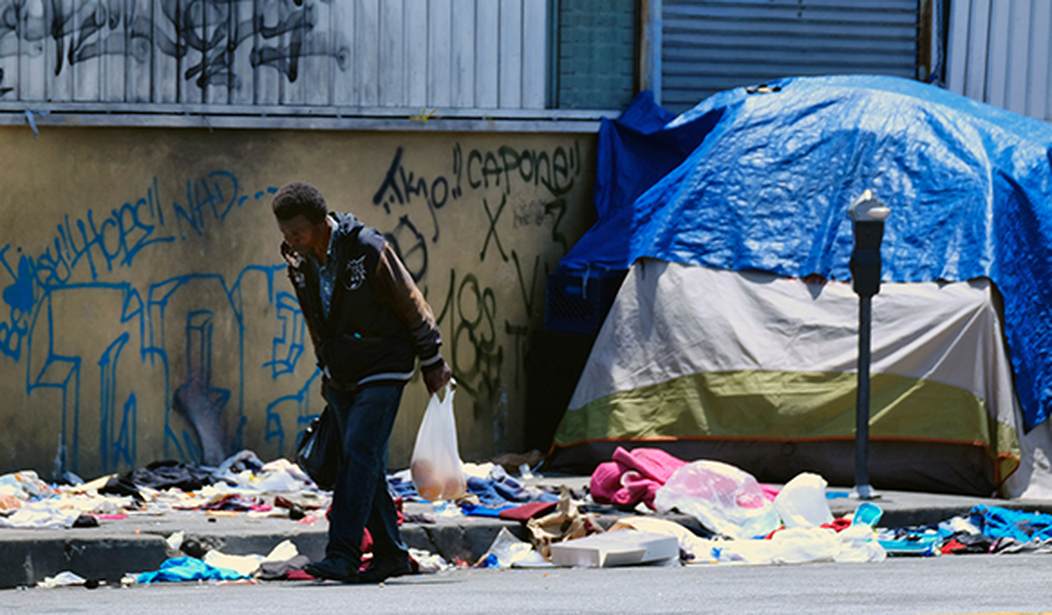
There has to be a sane middle ground. People like Bill Gene Hobbs may never qualify for unsupervised release, and there's a need to accept that reality. The fact is that this policy is already yielding bitter fruit. Some indications are that almost 2/3 of California's homeless population, the largest in the 50 states, suffer from some mental illness, ranging from around half with anxiety or depression to 12 percent having hallucinations. Hallucinations are a pretty serious sign that this is a person who shouldn't be wandering around loose, and if 12 percent of California's estimated 187,000 or so homeless are this seriously ill, then this presents a major public health and safety crisis. That's 22,440 people, walking the streets, seeing aliens, giant bugs, Viking raiders, who knows what?
A middle ground must be found. Nobody wants a return to lobotomizing mental patients. But neither do we want people like Bill Gene Hobbs walking around, people who could escalate at any moment, people who suffer from severe mental illnesses and who refuse to comply with medical treatments. Housing for the mentally ill, for those who cannot be redeemed, who will not recover, need not be cruel. But it must be a tool available for the courts and for healthcare providers. The alternative is what we see now - mentally ill people, potentially dangerous, walking the streets among the innocent.