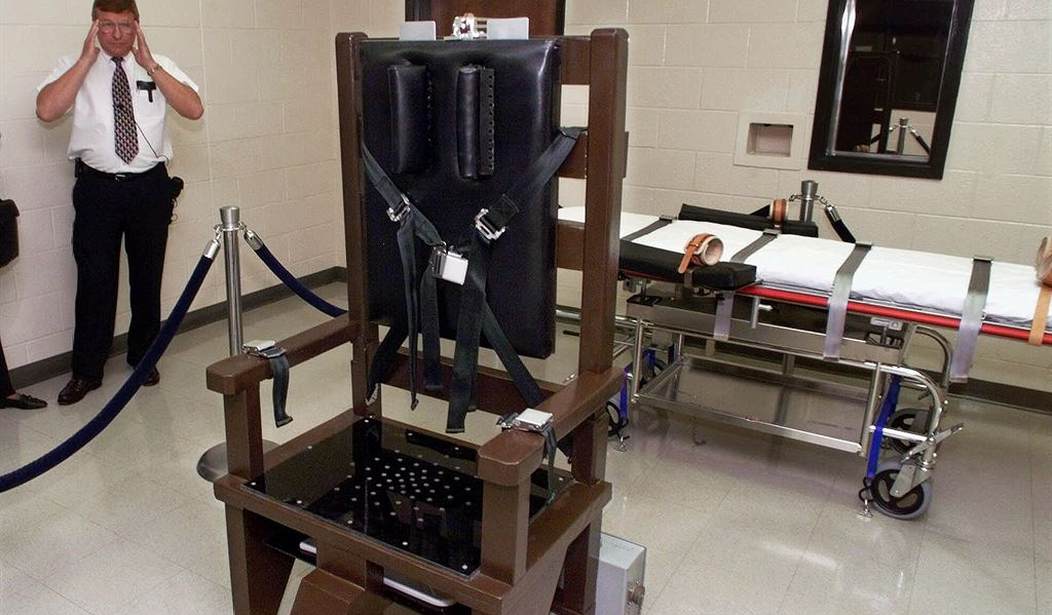

For years, it seemed like the death penalty was dying a slow death of its own in America.
Logistical and procedural roadblocks were put up, and the number of executions dwindled as states started imposing moratoriums and governors refused to sign death warrants. Then, pharmaceutical companies started making lethal-injection drugs increasingly difficult to obtain.
All the while, opponents of capital punishment began pushing for it to completely disappear, treating the issue like it was an inevitable next step for the country.
Just as it seemed like the anti-death penalty crowd was ready to declare victory, the state of Florida came along and said "Hold my orange juice."
Axios reported Wednesday that 47 people were executed in the United States in 2025 – the highest number since 2009 and a huge jump from the 25 executions that were carried out in 2024. Florida, by itself, accounted for 19 of them.
And the Sunshine State doesn't seem to have plans to let up any time soon.
Florida – which is, of course, led by Republican Gov. Ron DeSantis – executed its 14th inmate of 2026 on Tuesday, meaning DeSantis' state is responsible for more than half of the executions carried out across the country so far this year. And at least a dozen more are scheduled nationwide before the end of 2026.
DeSantis acknowledged in July that his administration is headed into uncharted territory, saying, "I think we'll probably end up having done more [executions] than any administration in the history of the state of Florida. I'm not like taking any pride in that, because it's a weighty thing."
America is seeing an uptick in executions https://t.co/g4KGFRwvfC
— Axios (@axios) September 2, 2026
The governor's acknowledgment of the gravity of these kinds of decisions is an altogether appropriate thing, since capital punishment is quite literally the most irreversible power the state possesses. There are no do-overs or takebacks.
There is another side to the story, too: these aren't just death sentences being handed out willy-nilly from the comfort of the governor's mansion. They are punishments that have been imposed following murder convictions, trials, appeals and, in far too many cases, decades upon decades of additional litigation.
Take, for instance, Harold Gene Lucas. The 74-year-old convict was put to death by lethal injection for the murder of 16-year-old Jill Piper – a crime he committed 50 years ago.
Harold Gene Lucas was put to death by lethal injection Tuesday evening at Florida State Prison, 50 years after killing 16-year-old Jill Piper at her home in Bonita Springs. https://t.co/su42ttVdLA
— News 6 WKMG (@news6wkmg) September 2, 2026
Lucas shot Piper to death in 1976 after she rejected his sexual advances; he also shot and wounded two of her best friends. He was re-sentenced to death four times as his case wound its way through years of appeals and court hearings. By the time Florida finally carried out his sentence, one-half of a century had gone by.
Jill's family and friends had to wait a long time to finally get justice.
Federal executions are also on the upswing after President Trump removed a hold put in place by Joe Biden shortly before he left office. Biden also commuted the death sentences of 37 of the 40 prisoners then on federal death row to life imprisonment.
Said Trump of his decision, "It is the policy of the United States to ensure that the laws that authorize capital punishment are respected and faithfully implemented."
The American public seems to be somewhat on board with the trends. A Pew Research Center poll conducted in July found that 66 percent of Americans favor the death penalty for people convicted of murder, compared with only 32 percent who oppose it. Strikingly, a full 68 percent said the death penalty is morally justified in murder cases.
Other states, including Alabama, Texas, Tennessee, Oklahoma and Georgia, have joined Florida and are moving ahead with their own executions.
The death penalty may not be back to its 1990s-era highs, but its long decline appears to have hit a wall.