



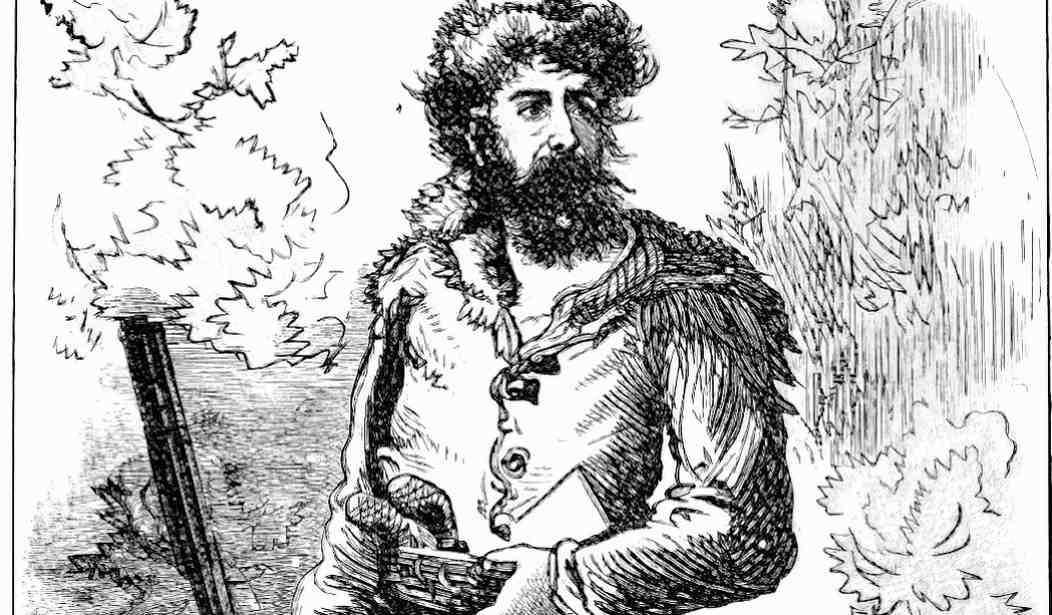
November, according to the Department of the Interior, is National Native American Heritage Month. Quite honestly, I didn’t know such a thing existed. I think it is long overdue that we honor Native Americans. So over the next days, possibly even dragging into 2027 or later, I will periodically acknowledge Native Americans who personify the fact that America was conquered, not stolen, and that America was built despite, not because of, chattel slavery.
So it is only appropriate that we start with a land acknowledgment statement.
Land Acknowledgement Statement
My home sets on land first explored by English and Scots-Irish freemen who had migrated from their homeland in search of freedom and opportunity or sometimes on the run from the law. The land was settled primarily by Germans from the Palatinate, who, through their industry, created farms, pastures, and orchards where only unproductive, fallow wilderness had existed. These men and women held savage tribes at bay and together created a nation that has been the beacon of hope to the world for over two hundred years. Their rifle became a symbol of American freedom. This land was conquered, not stolen, and any acknowledgment we make is owed to those who, with axe and musket, created the most powerful nation in the history of the world and we don’t owe a damn thing to anybody for being proud of their accomplishment.
Now cue up the background music and enjoy.
Captain Samuel Brady was born in Shippensburg on May 5, 1756 (some accounts list 1758). He was the eldest son of Captain John Brady, a veteran of earlier colonial wars, and Mary Quigley Brady. Both his parents were also Native Americans. When the American Revolution began, Sam Brady and his younger brother James joined a company of Pennsylvania riflemen under his father's command and participated in the siege of Boston.He fought at the battles on Long Island that culminated in the evacuation of New York. He was at Trenton, Princeton, Brandywine, Germantown, and survived the Paoli massacre. In an era where officers were elected, he was first lieutenant at 20 and captain in the 8th Pennsylvania Regiment at 23. The man had pedigree and presence.
While Sam served with the Continental Line, his family faced another enemy on the Pennsylvania frontier. In June 1778, the year before Sam was promoted to captain, his brother, James, was fatally wounded, tomahawked and scalped by a Seneca war party. In a testimony to the toughness of the Brady men, James hung in there for nearly two months before succumbing to his wounds. The following April, his father was ambushed while returning home with supplies from Fort Muncy, Pennsylvania.
Samuel took a solemn oath of vengeance, thereafter treating Indian raiders with unrelenting hostility. Around the time of James Brady's death, the 8th Pennsylvania was given the mission of protecting the frontier. Brady raised a company of rangers and took the war to the Indians.
Two months after his father’s death, he ambushed a Seneca war party at rest near what is now Brady’s Bend in Clarion County, Pennsylvania, and annihilated it. The next year he tracked another war party, this time Lenape/Delaware and Wyandot, who had raided an isolated cabin. The husband escaped and raised the alarm, but his wife and a child were taken prisoner. Brady and a party of his rangers tracked down the war party, ambushed it, and rescued the captives. In another captive rescue, Brady and four rangers crawled into the camp of the sleeping war party and killed 13 Indian warriors with knife alone.
The most famous Brady incident involves the place named Brady’s Leap.
None of Brady’s warfare was without personal cost. The Indian warriors were not NPCs. They were hard, brutal men who neither gave nor expected quarter. They gave as good as they got, and being one of Brady’s rangers was a very hazardous calling.
Around 1781, Brady led an unusually large party of about 40 rangers into Ohio on a reconnaissance-in-force mission. They were scouting but strong enough to kill anything that offended them.
After a successful dawn ambush on a Wyandot camp near what is now Brady Lake, the rangers were in turn pursued by Indians. Following procedure, the patrol broke up into one- and two-man groups and made their way independently back to friendly territory. Brady, crossing a stream alone, was seized by a hunting party of five Wyandots. They immediately recognized him, and everyone knew they had a major catch. There are many variations and tellings of what happened next. This excerpt is from a 1919 book titled "Boys' Book of Frontier Fighters." I like it because it is the most likely story and the best told. You can get a Guide to Gay Sex into any school library; just try getting this one in.
All the Wyandot town of Sandusky welcomed him with clubs and shrieks. He was painted black — the paint of death — and tied loosely to the stake by the ankles and the waist, so that he might squirm. He had been pretty well beaten, and seemed so exhausted that they had no fears of his escaping.
The next year the Wyandots ceased to burn prisoners. But now they heaped the fagots around Captain Brady, and applied the torch for a slow fire.
"We got you, Sam Brady," they jeered. " You no lose Injun ; Injun no lose Sam."
They danced about him, awaiting his agonies. He said no word, but he had his wits keenly sharpened. He was not a " gone coon" yet. The squaws were worse than the men. There was one squaw, a chief's squaw, with a baby in her arms, especially aggravating. She darted in, to strike him. Instantly his two hands flew out, tore the baby from her and dropped it into the blaze .
She screamed; she and the warriors dived to rescue it-and on the second Captain Brady had snapped his bonds and was plunging at top speed for freedom. He knocked down two warriors, and cleared a way, then he was into the open, and out and on like a deer, with the town in pursuit.
What followed was a feat that made his name in American folklore: Brady’s Leap across the Cuyahoga River gorge in what is today Kent, Ohio.
Brady was running, hotly pursued by the Wyandot version of Child Protective Services. He was putting distance between himself and the pursuit when he hit the Cuyahoga River gorge. It was about 22 feet wide and 20-plus feet above the river. At this point, he was out of optimal solutions. He hit the gap in full stride and cleared the gorge. The pursuit stopped, amazed at the jump but didn’t give up. One of the warriors fired at Brady, striking him in the leg. This gave the Indians a second wind, and they took off for the known fords upstream and down to head Brady off.
Brady gimped away leaving a blood trail and reached a nearby marshy lake. He submerged himself beneath a fallen tree, breathing through a hollow reed until the searchers abandoned the area, believing he had drowned or committed suicide. He then made his way back to friendly lines. The site is now Brady’s Leap State Park; the nearby body of water was long called Brady’s Lake. Canal construction in the 1830s widened the gorge, making the original distance harder to visualize, yet the story remains.
Brady continued active service through the end of the war and into the postwar years, participating in further scouts, the rescue of captives, and at least one controversial pursuit of Delaware raiders that led to his indictment and trial for murder (he was acquitted after producing the scalps of the allegedly murdered men at his trial). He died of pleurisy on December 25, 1795, at Short Creek in what is now West Virginia. He was survived by his wife, Drusilla (Swearingen), and three sons. He was 39 and a legend.
Sam Brady, captain of spies, and a true Native American.
Editor’s Note: We voted for mass deportations, not mass amnesty. Help us continue to fight back against those trying to go against the will of the American people.
Join RedState VIP and use promo code FIGHT to receive 60% off your membership.


Join the Conversation
VIP members get the ability to comment on articles.