






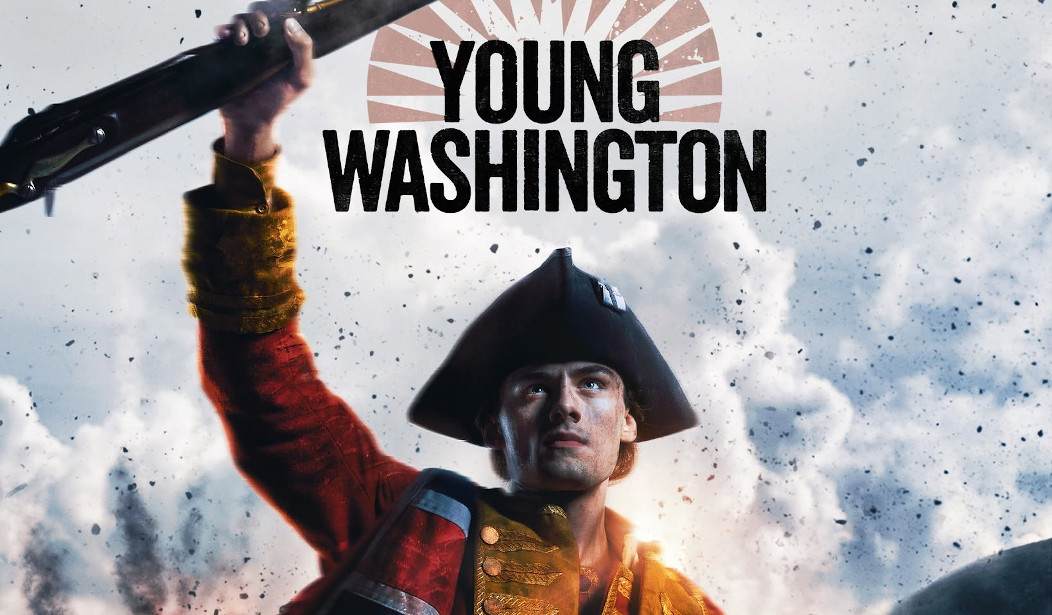
If you've followed my writing, you know that I am very much a fan of George Washington and a firm believer that he was THE indispensable man of the American project. His private life was beyond reproach; he was on the cutting edge of Virginia's gentry weaning themselves from betting their existence on the price Glasgow merchants would pay for tobacco. He is clearly out of his depth tactically in the early part of the American Revolution, but he thought big; he believed in his cause, and his moral and physical example held a battered Continental Army together when, by all rights, it should have melted away. His example of forbidding a military coup during the Newburgh Conspiracy and voluntarily vacating the presidency after two terms set the tone for both our military's approach to politics and the peaceful change of governments.
RELATED:
George Washington: Original American Badass – RedState
June 28, 1778. Battle of Monmouth – RedState
Let's get started with the basics. The film was released by Angel Studios (full disclosure, I'm a donor to that studio). Angel Studios films have been reviewed several times on RedState (see Sound of Freedom; Cabrini, The Last Rodeo), and its television series, The Chosen, has a massive following.
Young Washington begins with the death of Augustine Washington in 1743, leaving 11-year-old George and his widowed mother, Mary, in genteel poverty. George is mentored and schooled by his half-brother Lawrence, as there is no money to send young George back to England for a proper education. This introduces a theme that runs through the rest of the movie. Washington's ambitions are stymied at every turn by his lack of proper social standing, which he overcomes by perseverance and native talent. He also learns a valuable life lesson about social status when the woman who was the love of his life, Sally Cary, becomes engaged to George Fairfax because money, status, and did I mention money and status?
The movie covers Washington's mission to deliver Governor Dinwiddie's demarche to the French commander at Fort LeBoeuf, Washington and Christopher Gist's epic midwinter journey from Fort LeBoeuf to Williamsburg. The battles at Fort Necessity and Braddock's Defeat are inspiring despite some AI slop making its way into the movie as four-wheeled cannons.
The cinematography captures the size and solitude of Colonial America. The characters are skillfully written so they don't apologize for the society they live in. No one rails against slavery, or classism, or gargles on-and-on about "stolen land." Those things exist and they simply "are." The characters are in their time, and that is refreshing.
British actor William Franklyn-Miller does a job that Americans just won't do and plays the title role. I think he pulls off the Young Washington of the film very well. He's believable as a "young man in a hurry" who is beginning to trust his instincts and judgment over those of his social superiors. His height and athleticism make him a good fit for the historical character. Mary-Louise Parker does a great job in portraying the anger and frustration of a woman who sees her social standing collapse after the death of her husband. Kelsey Grammar is a natural as Lord Fairfax. Ben Kingsley portrays an irascible Virginia Governor Robert Dinwiddie who warms to Washington's perseverance.
While some reviewers have described the movie as a biopic, it most assuredly is not. It is in the tradition of Hollywood films that are billed as "based on a novel by ..." Go watch the movie for what it is, and don't use it to write your American History term paper.
The way writer-director Jon Erwin ran history through the woodchipper took me aback until I discovered the Zen of chanting "It's only a movie...It's only a movie" and focused on the art, not the history. Some of the changes were understandable dramatic license, while others make no sense. Lawrence Washington was 14 years older than his half-brother George. In the movie, you get the impression that he's a lot older. He was also dead before the main events in the film. Throughout the events of the movie, George Washington was a close friend of the Fairfax family and had led surveying expeditions in the Shenandoah Valley. He was a tough and seasoned frontiersman. I think Erwin missed a critical element when he marries off Sally Cary (Mia Rodgers) to an arrogant, overbearing George Fairfax. The two Georges were actually close friends, and Washington remained deeply in love with Sally Cary Fairfax for the rest of his life; however, his sense of honor and propriety prevented him from ever causing a whiff of scandal, though he was a frequent guest of George and Sally Fairfax. Losing the love of your life to your best friend is arguably a greater tragedy than losing her to someone you hate.
While not a member of the upper crust of Virginia aristocracy, George was within spitting distance. Lawrence's marriage into the Fairfax family created a powerful patron for him. For instance, in 1749, at age 17, he was appointed as the official surveyor for Culpeper County, Virginia. Starting in 1750, he was the official surveyor for the Fairfax family. The Fairfax land grant, called the Northern Neck, covered all land between the Rappahannock and Potomac. This meant that every plot of land laid off in that county and the Northern Neck generated income for him. In terms of annual income, he was in the top fraction of one percent of all Virginians.
Frontiersman Christopher Gist, sort of Washington's Falstaff in the movie, was quite a stud in his own right and saved Washington's life at least twice on the return from Fort LeBoeuf. The French did not kill Gist at Fort Necessity; he died of smallpox in 1759. Captain James Mackay (who correctly pronounces the name "Makaigh"), who commanded the South Carolina Independent Company of the British Army at Fort Necessity, was not the arrogant ass depicted. He did have a conflict with Washington over precedence of rank and whether a colonial major outranked a regular army captain, but they worked through it. Mackay was not killed in that battle. He and Washington became close friends, and he died in Alexandria, VA, in 1785 en route from Georgia to visit his old comrade at Mount Vernon.
Washington was bedridden with dysentery when the Battle of the Monongahela (see Braddock At The Monongahela – RedState) took place. Nevertheless, he mounted his horse and played a pivotal role in preventing Braddock's entire army from being wiped out. There is no doubting his personal bravery. He had four bullets pass through his coat, and two horses shot out from under him. General Edward Braddock is just a series of tropes that make him a one-dimensional Colonel Blimp character that doesn't credit him for marching from Alexandria, VA to Pittsburgh, PA, across the Alleghenies; see July 8, 1755. Braddock at Camp 20. A reassessment. – RedState. By killing him off at the Battle of the Monongahela instead of having him linger for four days, they missed the chance to show Washington carrying Braddock from the battlefield and Braddock giving his pistol and leopard-skin saddle pad to Washington as gifts on his deathbed.
On the other hand, Ryan Begay plays the cynical "Half King" of the Iroquois Confederacy, Tanacharison, pitch-perfect. He doesn't like the French or the English, but he can go either way depending on the best interest of his Confederacy. I was hoping they'd show him washing his hands in the brains of French Ensign Joseph Coulon de Jumonville, but the creative team took a pass and reduced that epic act to a few seconds of tomahawk chops...no word if Elizabeth Warren is offended.
In short, this is the kind of film Hollywood used to make. The history is merely the jumping-off point for a quintessentially American tale of talent and grit overcoming social strictures and lack of money. Go see it. It shows a side of our first president that is deliberately blotted out by our current society in favor of demonizing him as a genocider and slave owner. It tells the true story of American greatness that resonates today: we are a nation where you have a huge say in your own destiny.
Go see it.
Editor's Note: It’s America’s 250th birthday! Help RedState celebrate the greatest nation in history by honoring its past, defending its present, and preserving its future with reporting you can trust.
Join RedState VIP and use promo code AMERICA250 to receive 74% off your membership.


Join the Conversation
VIP members get the ability to comment on articles.