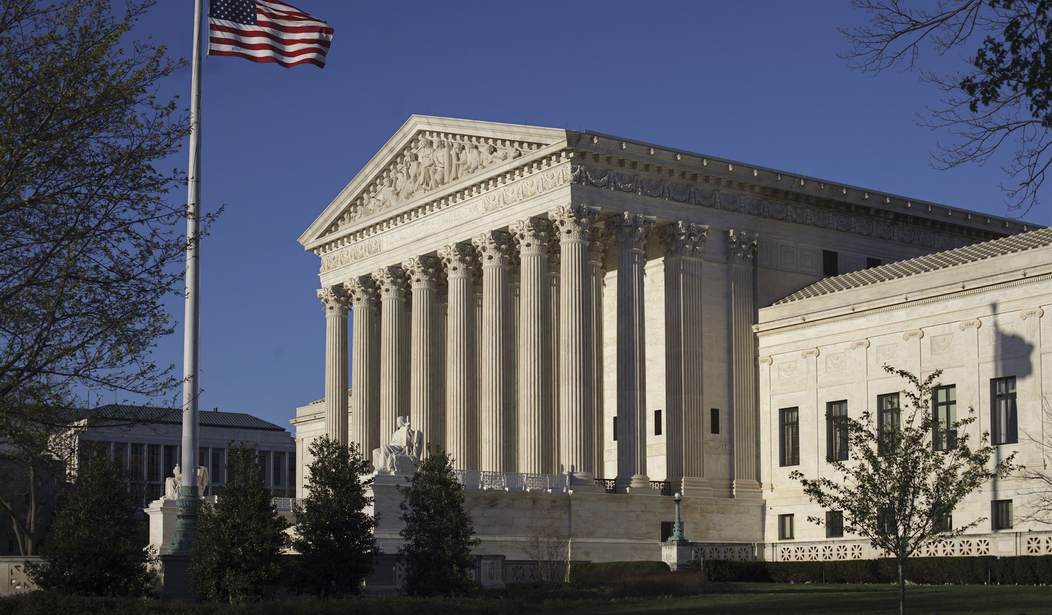

April saw the Supreme Court issuing a handful of decisions (while closing out oral argument for the 2025 term). In this first batch, in cases involving the Fourth Amendment as well as jurisdiction and immunity for government contractors, we've got one unanimous decision and two splits — both of which were rather interesting.
First, there was a 7-2 split that had Justice Elena Kagan siding with the six conservatives on the Court (in the Fourth Amendment case). Then, there was a 6-3 split, with Justice Clarence Thomas penning the majority opinion, but Justices Samuel Alito, Brett Kavanaugh, and Chief Justice John Roberts in the dissent.
Let's take a look:
April 2026 Decisions — Part One
Chevron USA Inc. v. Plaquemines Parish
Date: April 17, 2026
Author: Clarence Thomas
Split: 8-0
Dissent: N/A
Appeal From: 5th Circuit
Basic Facts:
The federal officer removal statute, 28 U. S. C. §1442(a)(1), authorizes removal of state-court suits against federal officers or persons ‘acting under’ them ‘for or relating to any act under color of such office.’ This case concerns whether, for purposes of the statute, a state-court environmental suit challenging Chevron’s crude-oil production during the Second World War is ‘for or relating to’ Chevron’s wartime refining of crude oil into aviation gasoline for the U. S. military.
In 1978, Louisiana enacted the State and Local Coastal Resources Management Act, which prohibited certain uses of Louisiana’s coastal zone, including oil production, without a permit. The Act exempted uses legally commenced before 1980. In 2013, Plaquemines Parish and other parishes filed 42 state-court suits against oil and gas companies under the Act. They alleged that the companies lacked permits and that some uses, although initiated before 1980, were illegally commenced and therefore not covered by the exemption. An expert report filed by the parish made clear that it intended to challenge certain defendants’ crude-oil production during the Second World War. The report alleged that Chevron failed to use steel tanks instead of earthen pits, should not have used vertical-drilling methods, and failed to equip fields with sufficient roads, using canals instead.
Chevron removed the suit to federal court under the federal officer removal statute, arguing that the suit ‘relat[ed] to’ its contractual duties to refine crude oil into avgas for the military during the war. The District Court rejected this argument and granted the parish’s motion to remand to state court. The Fifth Circuit affirmed, agreeing that Chevron had ‘acted under’ a federal officer as a military contractor but concluding that the suit was not ‘for or relating to’ those acts because Chevron’s refining contract did not specify how to acquire crude oil. Judge Oldham dissented, reasoning that crude oil was ‘indispensable’ to avgas, such that its production necessarily related to Chevron’s performance of its federal avgas refining duties.
Issue:
Whether a state-law suit challenging wartime crude-oil production is sufficiently connected to a defendant’s federal duties to satisfy the “relating to” requirement of the federal officer removal statute.
Holding: Vacated and remanded.
Chevron has plausibly alleged a close relationship between its challenged crude-oil production and the performance of its federal avgas refining duties—not a tenuous, remote, or peripheral one—and has therefore satisfied the "relating to" requirement of the federal officer removal statute.
Skinny: Cozying up to the federal government has its jurisdictional perks.
Date: April 20, 2026
Author: Per Curiam
Split: 7-2
Dissent: Jackson, Sotomayor
Appeal From: D.C. Circuit
Basic Facts:
In the wee hours of a winter morning in Washington, D. C., District of Columbia Metropolitan Police Officer Clifford Vanterpool received a radio dispatch call directing him to check out a suspicious vehicle at a specific address. Officer Vanterpool reached the apartment building at that address around 2:00 a.m. As he turned his marked police vehicle into the parking lot, he saw two people immediately flee from a car, ‘unprovoked,’ after ‘[p]olice had not done anything other than simply pull up.’ App. to Pet. for Cert. 48a. The runners left open at least one of the car doors. The driver then began to back out of the parking space, rear door still open. Officer Vanterpool decided to investigate. He parked directly behind the car, left his own vehicle, ordered the driver, R. W., to put his hands up, and drew his service weapon.
R. W. raised a ‘single argument’ on appeal—that Officer Vanterpool lacked reasonable articulable suspicion sufficient to justify the seizure. In re R.W., 334 A. 3d 593, 599 (D. C. 2025). The District of Columbia Court of Appeals held that Officer Vanterpool, by stopping R. W. without reasonable suspicion, violated the Fourth Amendment. We disagree.
Issue:
Whether police had reasonable suspicion to stop a driver based on a suspicious-vehicle dispatch, the unprovoked flight of passengers, and the driver’s conduct upon police arrival.
Holding: Reversed and remanded.
In assessing whether an officer had reasonable suspicion, a reviewing court must ‘look at the “totality of the circumstances” of each case’—an analysis that precludes the ‘evaluation and rejection’ of ‘factors in isolation from each other.’ Arvizu, 534 U. S., at 273–274. Because the D. C. Court of Appeals departed from these principles—and because Officer Vanterpool clearly had reasonable suspicion to stop R. W.—we reverse.
Skinny: Suspicious behavior will generally justify a stop, and courts shouldn't play "divide and conquer" with the facts in assessing that.
Date: April 22, 2026
Author: Clarence Thomas
Split: 6-3
Dissent: Alito, Roberts, Kavanaugh
Appeal From: 4th Circuit
Basic Facts:
Respondent Fluor Intercontinental, Inc., contracted with the U. S. Army to provide services at Bagram Airfield in Afghanistan during the war there. One of Fluor’s employees, an Afghan national, carried out a suicide bombing attack at the base, killing and injuring several U. S. servicemembers. Petitioners—servicemembers injured in the attack and representatives of those killed—filed suit in Federal District Court, alleging that Fluor negligently hired and supervised the bomber despite warning signs that he posed a threat.
Fluor moved to dismiss, arguing that petitioners’ state-law claims were preempted under Boyle v. United Technologies Corp., 487 U. S. 500 (1988), and Saleh v. Titan Corp., 580 F. 3d 1 (CADC 2009). The District Court denied the motion, but the Fourth Circuit reversed, holding that the claims were preempted because they arose out of wartime activities integrated with military operations.
Issue:
Whether state-law tort claims against a military contractor are preempted simply because the claims arise out of wartime activities connected to military operations.
Holding: Vacated and remanded.
State-law claims against a military contractor are not preempted where the contractor’s allegedly tortious conduct was not directed or authorized by the Federal Government.
Skinny: No orders, no immunity — military contractors don’t get a wartime blank check.
Added Note: This serves (somewhat) as the flip side of the holding in Chevron v. Plaquemines Parish (above) — those "perks" of cozying up to the government have limits: They don't shield you from liability for actions that fall outside of your contract.
Second Added Note: The split here is quite interesting. Alito's dissent (in which Kavanaugh and the Chief Justice joined) essentially turns on the idea that the realities of wartime operations necessitate a broader reading of immunity:
The Constitution divides authority between the Federal Government and the States in many areas, but not when it comes to war. War is the exclusive domain of the Federal Government, but the Court allows state (or foreign law) to encroach on that domain. The Constitution precludes that encroachment, and therefore petitioner’s suit is preempted. Because the Court holds otherwise, I respectfully dissent.
You can check out prior installments of The Skinny on SCOTUS series here.