






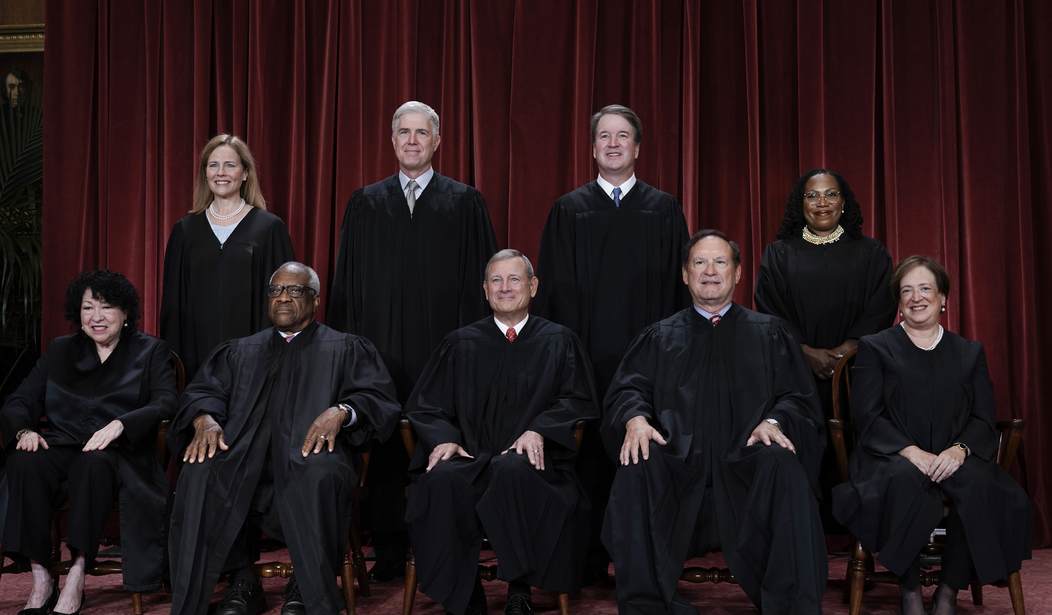
We're still awaiting the Supreme Court decision in the Voting Rights Act case (among others) and Wednesday's oral argument on birthright citizenship — which should be fascinating. But the High Court did hand down a significant decision on Tuesday, this one having to do with free speech/the First Amendment.
In Chiles v. Salazar, the Court was asked to examine whether a Colorado law that censors certain conversations between counselors and their clients based on the viewpoints expressed regulates conduct or violates the Free Speech Clause of the First Amendment.
Now, before I go further, I want to pick a nit: What the Court did not do in Tuesday's decision was strike down the Colorado law — nor did it directly hold that the law is unconstitutional. What it did do is strongly signal that the law, as applied to talk therapy (i.e., speech, rather than conduct), likely violates the First Amendment, and send it back to the lower courts to revisit it applying strict scrutiny (which will likely result in the law — or at least, that portion of it dealing with speech rather than conduct — being struck down).
Alright, so, nit picked, Tuesday's decision does represent a major First Amendment win. To give some background: The plaintiff, Kaley Chiles, is a licensed Colorado mental health counselor who provides talk therapy aimed at helping individuals — including minors — work toward their own stated goals concerning sexuality and gender identity. In 2019, Colorado enacted a law that bars licensed counselors from engaging in “conversion therapy” with minors, defined to include efforts to change sexual orientation, gender identity, behaviors, or same-sex attractions. However, the law expressly permits counseling that offers acceptance, support, identity exploration, and assistance with gender transition. Chiles sued before any enforcement action, arguing that the law violates the First Amendment as applied to her speech-based counseling. The U.S. District Court for the District of Colorado denied preliminary injunctive relief sought by Chiles, treating the law as regulation of professional conduct rather than protected speech. The Tenth Circuit affirmed the district court.
The Supreme Court, in an 8-1 decision, reversed and remanded the case, determining that the lower courts applied the wrong standard in evaluating the law. Justice Gorsuch wrote the majority opinion, in which he was joined by Chief Justice Roberts and Justices Thomas, Alito, Sotomayor, Kagan, Kavanaugh, and Barrett. Justice Kagan filed a concurrence joined by Sotomayor, and Justice Jackson dissented.
ALSO SEE: KBJ Comes Up With a New Word in SCOTUS Trans Athletes Case That Has Everyone in Stitches
One Supreme Court Justice Has Nosedived Into Irrelevance; Can You Guess Who?
In a nutshell, the Court held that when a state regulates pure talk therapy by allowing one viewpoint (“acceptance,” “identity exploration,” “gender transition support”) while forbidding another (speech aimed at reducing same-sex attraction or aligning gender identity with biological sex), it is regulating speech based on viewpoint, not merely professional conduct. In other words, this is classic viewpoint discrimination, and, per the Court:
As a general rule, such “content-based” restrictions trigger “strict scrutiny,” a demanding standard that requires the government to prove its restriction on speech is “narrowly tailored to serve compelling state interests.”
The majority opinion concludes with this:
We do not doubt that the question “how best to help minors” struggling with issues of gender identity or sexual orientation is presently a subject of “fierce public debate.” Tingley v. Ferguson, 601 U. S. ___, ___ (2023) (THOMAS, J., dissenting from denial of certiorari) (slip op., at 1). But Colorado’s law addressing conversion therapy does not just ban physical interventions. In cases like this, it censors speech based on viewpoint. Colorado may regard its policy as essential to public health and safety. Certainly, censorious governments throughout history have believed the same. But the First Amendment stands as a shield against any effort to enforce orthodoxy in thought or speech in this country. It reflects instead a judgment that every American possesses an inalienable right to think and speak freely, and a faith in the free marketplace of ideas as the best means for discovering truth. However well-intentioned, any law that suppresses speech based on viewpoint represents an “egregious” assault on both of those commitments. Rosenberger, 515 U. S., at 829.
The judgment of the Tenth Circuit is reversed, and the case remanded for further proceedings consistent with this opinion.
Thus, the case will head back to the 10th Circuit, which is expected to return it to the district court for reconsideration under the proper First Amendment standard. But also note: This is all about the issuance (or lack thereof) of a preliminary injunction. It will be a bit before the court(s) ultimately sort out the law on the merits.
Either way, this is a solid First Amendment victory.
Editor’s Note: Do you enjoy RedState’s conservative reporting that takes on the radical left and woke media? Support our work so that we can continue to bring you the truth.
Join RedState VIP and use the promo code FIGHT to get 60% off your VIP membership!


Join the Conversation
VIP members get the ability to comment on articles.