
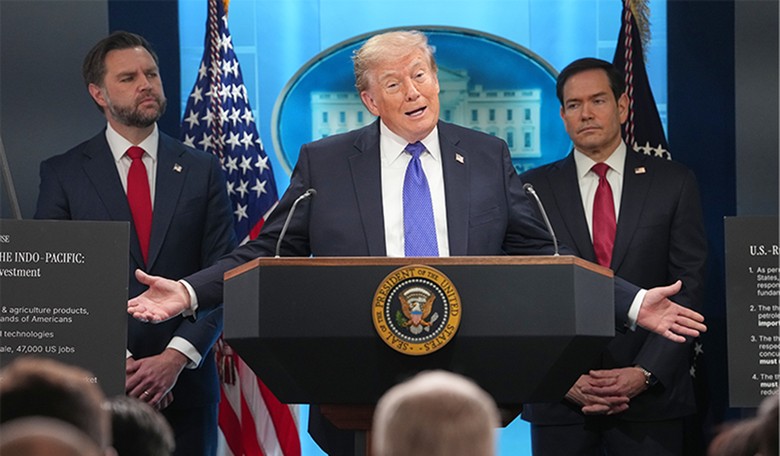
CNN political commentator Scott Jennings came out guns blazing on Sunday. And he had a suggestion for a few Trump officials that are raising some eyebrows.
Resign.
Jennings suggested that if Vice President JD Vance and Secretary of State Marco Rubio have presidential ambitions of their own, they might want to consider resigning from the Trump administration.
Now, understandably, a lot of people got bent out of shape about Jennings' suggestion. But there is definitely an argument worth having about it.
“If I were in the administration and I were going to run in ’28, I would probably resign,” Jennings said during an appearance on CNN's “State of the Union,” as Mediaite reported Sunday. “I mean, it’s hard to run a presidential campaign out of it, and it’s hard for a sitting vice president to become president. And it’s only happened four times. And so there’s there’s some consideration to that.”
But Jennings also made a broader observation about the American political landscape.
“We’ve been dominated by one person for a decade,” Jennings said. “I think the American people are going to want some separation.”
Scott Jennings: Rubio And Vance Should Resign If They Intend To Run In 2028https://t.co/95LpmXoehr
— RealClearPolitics (@RCPolitics) November 29, 2026
"If I were in the administration and I were going to run in '28, I would probably resign... I think the American people are going to want some separation." pic.twitter.com/qJ2zhfqlnF
I actually think this is a fair point to make, even if it is just fodder for debate.
How does a potential Republican presidential candidate step out of the shadows of one of the most polarizing presidents in modern American political history?
Conversely, how does that candidate explain to Republican primary voters why he walked away from the president at a time when his services may be needed?
“They will never win the Republican nomination if they resign and turn their back on Trump now,” one commenter argued on X.
Rubio, in particular, already has quite the track record, regardless of whether or not he’d stay with the Trump administration. Plus, I don’t think people see Rubio as a Trump lapdog.
His years in the Senate have also established a political resume beyond his years with Trump as one of the most effective Secretaries of State in modern history.
In August, as my colleague Nick Arama reported here, Rubio helped secure an oil agreement with Venezuela that the Trump administration expects to generate nearly $100 billion in private investment.
Earlier this month, the Danish Parliament unanimously approved a historic security agreement involving Greenland, which Rubio characterized as strengthening the national security of the United States and its NATO allies.
My RedState colleague Andrew Malcolm made an interesting observation about Rubio's political prospects in a column Sunday: His apparent lack of interest in campaigning for president may be precisely what has made his public profile more presidential.
There is something to be said for a politician demonstrating his qualifications for higher office by doing the job he already has.
Vance, meanwhile, has had a mixed experience in the Trump administration. And he doesn’t have as much of a resume as a senator from Ohio.
One of his most substantive contributions has been spearheading the administration's efforts to combat fraud in government programs.
As my colleague RC Maxwell reported in August, those efforts have identified $6.3 billion in suspected fraudulent government contracts and resulted in the referral of $22 billion in pandemic-era loans for collection.
Vance's involvement in negotiations with Iran, however, has been considerably less fruitful.
The vice president was instrumental in negotiating the memorandum of understanding with Iran this past summer. Unfortunately, it didn't produce the lasting agreement that the administration had sought.
Trump himself expressed frustration with the arrangement during a recent Fox News interview, as my colleague Ward Clark reported here.
The president described the MOU as a waste of time, although he stopped short of calling it a mistake and defended Vance when asked about his removal from the negotiating team.
Staying in the administration gives Vance an opportunity to build on his accomplishments. It also means that he will continue to be associated with the administration's setbacks, including those over which he exercises relatively little control.
Another consideration is how the national news media will treat Trump's potential successors.
Does anyone seriously expect the media's adversarial approach to Republican presidential candidates to disappear when Trump leaves office?
We've seen the politics of personal destruction playbook deployed plenty of times before Trump came along. Does Mitt Romney’s “binders full of women” ring a bell?
There might be some value in Rubio and Vance establishing independent political identities outside the administration.
But resigning isn't the only way to establish an independent political identity. Nor does it necessarily require repudiating the president under whom they have served.
Rubio himself has already dismissed speculation that he's planning to leave the administration.
“And plus I always laugh when they say he’s going to leave his job,” Rubio joked earlier this month. “I go, ‘Which one?’”
meme
There is also the practical complication that replacing a vice president requires confirmation by both chambers of Congress. That's quite a parting gift to leave Trump with a Democrat-controlled Congress.
At the end of the day, it’s a debate worth having because we have to start thinking about what the Republican Party will look like without Trump on the presidential ticket.
But nobody should be fooling themselves: Even without Trump, the activist media playbook is not going to change. It is going to engage in the politics of personal destruction no matter who is on the ticket.