






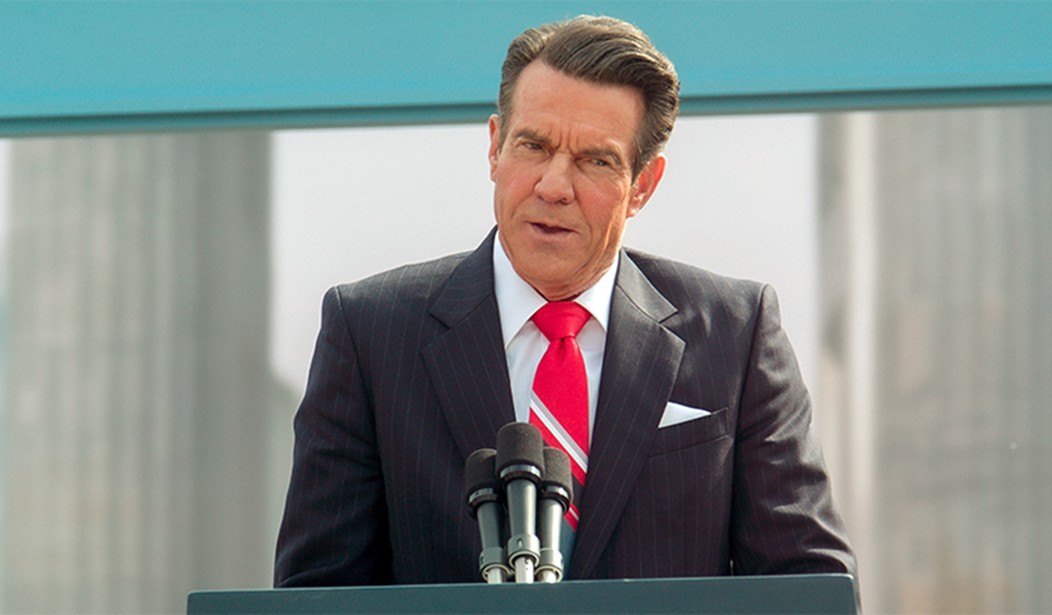
“Reagan,” the 2024 biopic starring Dennis Quaid that Hollywood did its best to quash despite doing solid box office numbers and racking up a 98 percent approval rate on the Rotten Tomatoes website, where moviegoers can have their say on any given film’s quality, is going to be re-released into some 600 theaters on September 25, 2026. Billed as a director’s cut, the re-release features three previously unseen scenes totaling some 10 minutes.
I recently spoke with the film’s producer Mark Joseph about the movie. Joseph’s previous credits include “Max Rose” and “The Vessel.” Joseph was gracious with his time and comments, so the interview is running in three segments. Here’s the first.
When did you first get the idea to make the movie?
It goes back about 20 years. I was working at Walden Media at the time and happened to be driving through Dixon, Illinois, Reagan’s hometown. I got pulled over for speeding, which turned out to be a very expensive way of discovering Ronald Reagan. I had to spend the night there and face the judge the next day, so my family and I spent the day taking in all the Reagan sites: his boyhood home, the river where he was a lifeguard, etc. Being in Dixon got me thinking about Reagan not simply as a president or political figure, but as a person who had come out of this very particular place and time in America. I had been familiar with Paul Kengor’s book "The Crusader," which focused on Reagan’s lifelong opposition to communism. I called Paul, and that really began what became a 20-year journey to get the movie made. I go into more detail in my book, "Making Reagan," but that's how it all started.
What sparked the idea?
What interested me was that I didn’t think Reagan’s story had ever really been told on film. Everybody knew pieces of it — the actor, the governor, the President, “Mr. Gorbachev, tear down this wall” — but there was a much bigger story connecting all of those things. What fascinated me particularly was that Reagan had been thinking and talking about communism long before he became president. The Cold War wasn’t something he suddenly discovered when he arrived in Washington. It was part of the arc of his entire life. Once I understood that, I thought there was a movie there. But I never really saw it as a political movie. Reagan happened to be a politician, but that was his occupation. The story was about the boy who became the man — where he came from, what formed him, the failures he endured, and what he ultimately did with his life.
Was Dennis Quaid always your choice to play Reagan?
Yes. But he wasn’t always available, so there were detours with others along the way-like Nic Cage, who was on the project for a year or so. And I talked to others like Jim Caviezel, but Quaid was always at the top of my list. There was something about Dennis that I thought was right beyond simply trying to find somebody who looked like Reagan. Dennis has that same kind of openness and optimism. And the more I learned about Dennis, the more parallels I saw between their lives — strong Christian mothers, alcoholic fathers, careers as actors, complicated marriages with wives who outshone them and periods when both men had to reinvent themselves. Dennis was understandably terrified of the role at first. Reagan is one of those people everybody thinks they know, but he didn’t want to do an impersonation, and I didn’t want one either. I wanted somebody who could find the man underneath the familiar voice and mannerisms. That’s what Dennis ultimately did.
What kind of pushback did you get within the entertainment industry?
There were people who simply didn’t believe a movie about Ronald Reagan should be made, and others who assumed that if Hollywood made one, the purpose should be to tear him down. We also encountered people who thought the project was impossible commercially. Then there were all the normal filmmaking problems multiplied by twenty years — financing that appeared and disappeared, people who weren’t what they claimed to be, COVID shutting us down, and later the actors’ strike affecting our release plans. But there was another kind of skepticism that was interesting. When I began interviewing people who knew Reagan, some were suspicious of me because I was coming from Hollywood. They assumed, “Here comes Hollywood to destroy Ronald Reagan.” We had to earn their trust. Once one Reagan associate trusted us, that opened the door to another and another. Eventually I interviewed more than 50 people who knew him. I spent time with George Schulz, Ed Meese, Dick Allen, Justices Scalia and Kennedy, and dozens of others.
Editor's Note: The mainstream media continues to gaslight, spin, and lie about President Trump, his administration, and conservatives.
Help us continue to expose their left-wing bias by reading news you can trust. Join RedState VIP and use promo code FIGHT to receive 60% off your membership.
Join the Conversation
VIP members get the ability to comment on articles.