






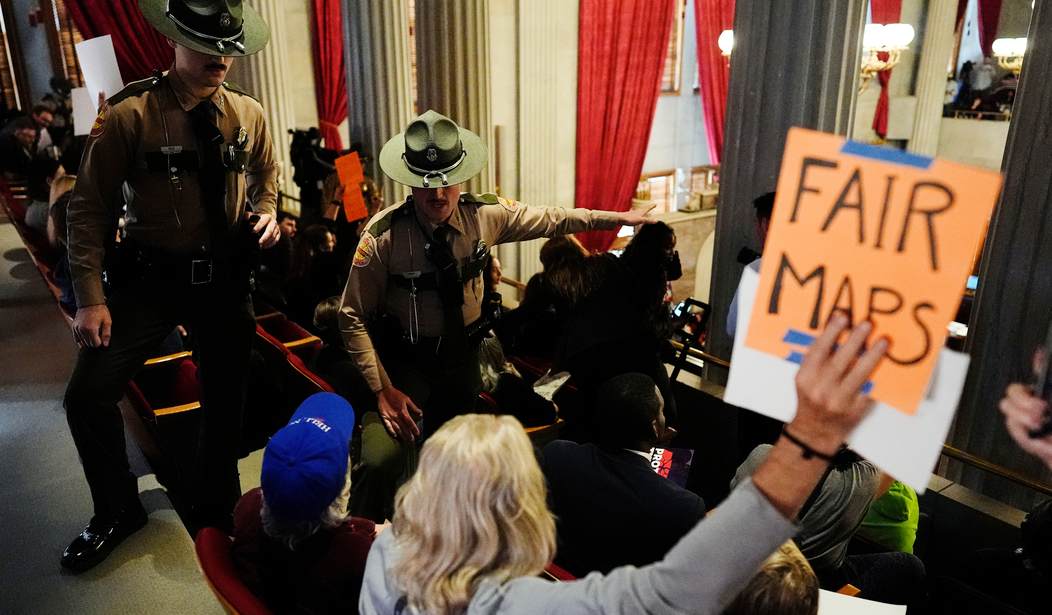
As RedState reported, in 2023, a district court three-judge panel blocked the use of 2023 maps drawn by the Alabama legislature and forced them to draw a second majority-minority district. After the Supreme Court of the United States' decision in Louisiana v. Callais, Alabama petitioned for redress of this ruling, and SCOTUS vacated the district court decision in early May, sending it back to the district court to review the case.
On Tuesday, this same three-judge panel once again blocked the use of 2023 maps on the same basis: that the maps are deliberately discriminatory and violate Section 2 of the Voting Rights Act. The district court panel claims they are striving to prevent confusion among the voters. However, their refusal to apply the latest SCOTUS ruling to determine this case has bred more confusion than maps that change two districts.
As projected, on Wednesday, Alabama attorney general Steve Marshall filed an application for an emergency stay with SCOTUS, which would allow the state to still use the 2023 maps.
Alabama's Solicitor General A. Barrett Bowdre presented the brief:
In its filing on Wednesday, Alabama urged the court to freeze the lower court’s ruling and allow it to use the 2023 map in the upcoming elections. That map, Bowdre wrote, “addressed this Court’s concerns about the State’s prioritization of core retention” – the principle of trying to have districts resemble their earlier iterations as closely as possible – “at the cost of splitting the Black Belt region,” an area in central Alabama originally named for its rich, dark soil but now named for its large Black population, the descendants of formerly enslaved people. The 2023 map, Bowdre said, divided the Black Belt “as little as possible, while also keeping together the Gulf Coast as the State had done for 50 years.”
As stated in Alabama Map Fight Erupts Again As Federal Panel Defies SCOTUS Momentum, the district court's interpretation comes off as utter nonsense. Either maps are being drawn without racial specifications, or they are not.
“Callais,” Bowdre continued, “vindicates Alabama’s position on the lawfulness of the 2023 Plan, yet the district court decided in one week that Callais changed nothing.” The district court, Bowdre stressed, did not require the challengers to offer alternative maps that would achieve Alabama’s goals while still maintaining two majority-Black districts, as the Supreme Court suggested it should have, and “[i]t did not matter to the district court that drawing an additional race-based district came at the cost of sacrificing communities of interest and pairing incumbents.”
“Worse,” Bowdre concluded, the district court’s conclusion that the state intentionally violated the Constitution rests on the idea “that Alabama intentionally discriminated by refusing to intentionally discriminate.”
Shorter, Bowdre is begging the court to make it make sense.
As stated before, this makes little sense except as a tactic to prevent the August 11 special election from moving forward. The work of reassigning voters to new districts was scheduled to begin on Wednesday, May 27. Last Friday, Alabama Director of Elections Jeff Elrod testified to the panel that the window for voter rolls to be unlocked would be between Wednesday, May 27, and Tuesday, June 2. This is an exceptionally tight window in which to work; thus, the state's request for an administrative stay.
U.S. Supreme Court Justice Clarence Thomas has purview over this Northern Alabama district court, so the petition for a stay ended up on his docket.
On Wednesday afternoon, Justice Thomas issued his response but declined to immediately restore the use of the 2023 maps. Thomas did order the plaintiffs in this action to respond to Alabama's request by Monday, June 1, at 4:00 p.m.
Justice Thomas declines to immediately restore Alabama's 2023 congressional map, but orders VRA plaintiffs to respond to Alabama's request by Monday, June 1st at 4pm.
— SCOTUS Wire (@scotus_wire) May 27, 2026
Alabama requested a ruling from the Court by 10am on June 1st or as soon as possible thereafter. https://t.co/S2h9nK2n6Z pic.twitter.com/JmSj02GbRX
Read More: New: Alabama Is Free to Redraw Its Maps After SCOTUS Vacates District Court Ruling
Alabama Map Fight Erupts Again As Federal Panel Defies SCOTUS Momentum
What may weigh in Alabama's favor is the amicus brief filed by the Civil Rights Division of the Department of Justice. In it, Assistant Attorney General Harmeet Dhillon and Solicitor General John Sauer argue that the district court is not assessing the case with the newly established precedent of Callais in the forefront.
Another day, another great amicus brief filed by @AAGDhillon and SG John Sauer--this time supporting Alabama's request to stay a deeply flawed order enjoining the State's new congressional map. pic.twitter.com/PkwxdotMlC
— Jesus A. Osete (@JesusOseteDOJ) May 27, 2026
On remand, however, the district court promptly reinstated its pre-Callais injunction largely based on its pre-Callais reasoning. The court held that Alabama had engaged in intentional discrimination by declining to draw a second black opportunity district that the court had earlier suggested was a required remedy for a Section 2 violation. And the court again held that Alabama had violated Section 2. Those holdings were wrong even before Callais and are indefensible after it.
With respect to intentional discrimination, the district court paid only lip service to its obligations to “disentangle race and politics” and to begin “with a presumption that the legislature acted in good faith.” Alexander v. South Carolina State Conference of the NAACP, 602 U.S. 1, 6 (2024). The court disregarded Alabama’s indisputably partisan aims when the 2026 legislature chose to use the 2023 map for the upcoming midterms and when the 2023 legislature pursued incumbency protection.
Essentially, Dhillon and Sauer surmised the three-judge panel disparaged Alabama's good faith intent, twisting it into an effort to be intentionally racist.
The district court instead concluded that Alabama must have intended to discriminate because it declined to draw a second black opportunity district that the district court had signaled Section 2 required. But a State’s insistence on pursuing its partisan goals in the face of an earlier Section 2 holding does not somehow make those partisan goals racially discriminatory. The district court’s contrary holding flouts a central lesson of Callais: that the pre-Callais Section 2 standard improperly condemned the refusal to create additional majority-minority districts in situations that did not even support “a strong inference” of intentional discrimination. 146 S.Ct. at 1157; see id. at 1157-1161. In any event, Alabama sought in good faith to correct the disparate treatment of two communities of interest—the Gulf Coast and the Black Belt—that was the premise of this Court’s pre-Callais holding in Allen v.Milligan, 599 U.S. 1 (2023), that an earlier map violated Section 2. That legitimate effort to comply with this Court’s decision cannot be reasonably construed as racial discrimination, particularly in light of the presumption of good faith.
The district court’s decision to reinstate its Section 2 holding despite Callais was tainted by the same errors.
The court again failed to disentangle race and politics, ignored Alabama’s partisan goals, and deemed illegitimate the State’s effort to preserve the Gulf Coast community. The court also failed to hold respondents to their burden to control for party affiliation in analyzing racial voting patterns, relying on a smattering of largely irrelevant pre-Callais findings. And the court used its flawed intentional-discrimination analysis to conclude that the totality of circumstances demonstrated likely intentional discrimination in violation of Section 2.
For all intents and purposes, the district court panel is ordering Alabama to violate the Constitution.
Thus, as in Callais, the court ordered a racial gerrymander, mandating a minority-opportunity district that the State never would have created based on its race-neutral districting principles and political goals. See 146 S. Ct. at 1161-1162; see also Malliotakis v.Williams, 146 S. Ct. 809, 810 (2026) (Alito, J., concurring in the grant of stay)
Dhillon and Sauer further argued that the district court was acting in bad faith to disrupt an already established election. The district court did not stay in its lane in its attempt to dictate what would or would not be a burden to voters.
Worse still, the district court issued its injunction deep into the election calendar—less than three months before the primary and after the candidate-qualifying window had closed. The court excused that clear violation of Purcell v. Gonzalez, 549 U.S. 1 (2006) (per curiam), on the theory that Alabama had created the timing problem by deciding to use the 2023 map only after Callais, even though the State acted as soon as it could once this Court vacated the prior injunction in light of Callais. But state legislatures are democratically elected bodies that are competent to make the policy judgments inherent in late election changes and are accountable to the voters for any ill effects. Federal district courts do not have the same license to interfere with election rules at the eleventh hour, particularly on such dubious merits theories.
Pretty brutal. We will see what counterargument the plaintiffs in this case choose to submit and what SCOTUS will decide to hopefully put this to bed once and for all.
Editor’s Note: The 2026 Midterms will determine the fate of President Trump’s America First agenda. Republicans must maintain control of both chambers of Congress.
Help RedState continue to report on the Democrats’ radicalism and inform voters as our nation faces a crossroads. Join RedState VIP and use promo code FIGHT to receive 60% off your membership.
Join the Conversation
VIP members get the ability to comment on articles.