






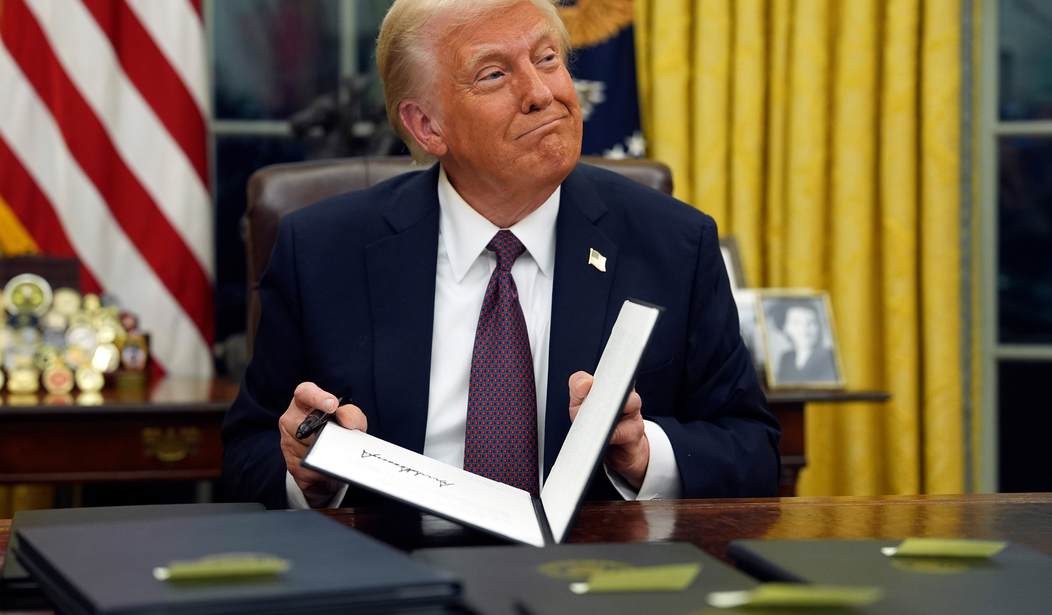
On Wednesday, President Donald Trump rendered the first vetoes of his second term. The two bills in question that were pushed through Congress amazingly enough have lingered for decades, and have already cost the taxpayers millions. How does this happen? Having fossils in Congress (or their hand-picked replacements) who resurrect old legislation that suits their agenda rather than the needs of the American people is one reason.
Congressional Bill H.R. 131 seeks to continue the construction of the Arkansas Valley Conduit (AVC) water pipeline. Original construction was authorized by President John F. Kennedy 63 years ago, with the pipeline's intent to provide municipal and industrial water to communities in southeastern Colorado. The federal government was supposed to originally fund the project, with state and local municipalities paying the government back with interest. Look at California to see how well that works. It doesn't.
Read More: Kevin Kiley Owns Gavin Newsom With Receipts That CA Is the True 'Fraud Capital of America'
Trump Goes Scorched Earth Over Dems Blue-Slip Block of Habba, Other U.S. Attorney Picks
Trump's veto explained why the United States taxpayer remains on the hook for a project that should have been completed decades ago. As with the (UN)Affordable Care Act, you can thank former President Barack Obama for it.
In 2009, President Obama signed the Omnibus Public Land Management Act of 2009, which not only reduced the repayment obligation from 100 percent to 35 percent but also provided that miscellaneous revenues from the Fryingpan-Arkansas Project at large would count towards the AVC cost share. Even then, however, construction did not begin until 14 years later, after the State of Colorado authorized $100 million in loans and grants for the project.
The current bill would now have the Federal Government extend the repayment period (on the already-reduced repayment requirement) for an additional 25 years, creating a 75-year repayment period. The bill would also cut the interest rate in half.
Our modern example of this is California's High-Speed Rail boondoggle, which has siphoned the federal coffers to the tune of $16 billion over 17 years, with not an inch of track laid down. The uncompleted AVC is more than half a century old and has cost the taxpayer more than $249 million. The estimated total cost if the project is completed? $1.3 billion.
Ain't nobody got time for that.
California’s high-speed rail has all the marks of a boondoggle:
— Secretary Sean Duffy (@SecDuffy) June 4, 2025
- $16 billion spent
- 17 years gone
- No high-speed track laid
We have put California on notice: If you can’t deliver, American taxpayers will not fund your train to nowhere. pic.twitter.com/EHradMYSRv
H.R. 131 would continue the failed policies of the past by forcing Federal taxpayers to bear even more of the massive costs of a local water project — a local water project that, as initially conceived, was supposed to be paid for by the localities using it.
Enough is enough. My Administration is committed to preventing American taxpayers from funding expensive and unreliable policies. Ending the massive cost of taxpayer handouts and restoring fiscal sanity is vital to economic growth and the fiscal health of the Nation.
H.R. 504, the Miccosukee Reserved Area Amendments Act, has been hanging around for not quite 30 years, but that's still way too long. For the 119th Congress, Republican Rep. Carlos Gimenez (FL-28) sponsored the bill, which appears to be a concession to the Miccosukee tribal leaders. Florida Republican Sens. Rick Scott and Ashley Moody also supported this bill.
The subject of this bill is a specific area in the Everglades National Park known as the “Osceola Camp.” In 1998, the Congress passed the Miccosukee Reserved Area Act, which authorized the Miccosukee Tribe of Indians of Florida (Tribe) to permanently occupy a certain area within Everglades National Park. The reserved area did not include the Osceola Camp. Nonetheless, the Tribe has a residential community in that area, including infrastructure for wastewater treatment and water supply, and is experiencing periodic flooding. H.R. 504 would require the Secretary of the Interior, in consultation with the Tribe, to take appropriate actions to safeguard structures within the Osceola Camp from flooding events.
The Miccosukee Tribe received favorable treatment from the Biden-Harris administration, which approved a plan to protect and replace the infrastructure of the Osceola Camp to the tune of $14 million. This particular veto shows that President Trump does not take lightly the tribe's obstruction in opposing the Alligator Alcatraz detention center, a signature part of Trump's immigration agenda.
The Miccosukee Tribe officials say they are moving forward with their legal battle against the "Alligator Alcatraz" immigrant detention facility in the Everglades, arguing that Florida's acceptance of more than $600 million in federal funds for the facility represents a major concession that strengthens their case.
The Tribe remains "strongly opposed to Alligator Alcatraz's unpermitted and unlawful construction, on public lands seized by State emergency order," Tribal officials said in a statement on Tuesday.
It seems the Trump administration would rather use that potential $14 million to defend the lawsuit brought by the Miccosukee Tribe than shore up the Osceola Camp.
My Administration is committed to preventing American taxpayers from funding projects for special interests, especially those that are unaligned with my Administration’s policy of removing violent criminal illegal aliens from the country. Ending the massive cost of taxpayer handouts and restoring fiscal sanity is vital to economic growth and the fiscal health of the Nation. This principle carries especially heavy weight here; it is not the Federal Government’s responsibility to pay to fix problems in an area that the Tribe has never been authorized to occupy.
The presidential veto is supposed to be the original DOGE. If a bill crosses that president's desk that he neither spearheaded nor supported, and if it does not align with the agenda of benefiting the American taxpayer, then the president should veto it.
Congress has greater concerns in 2026: like figuring out what to do with the now-expired enhanced ACA subsidies, preventing another government shutdown, and ensuring Republicans don't lose their majorities in the midterms. So, these bills probably will not see the light of day again in the 119th Congress, and after many decades, may finally be allowed to die.
Editor’s Note: We voted for mass deportations, not mass amnesty. Help us continue to fight back against those trying to go against the will of the American people.
Join RedState VIP today and use promo code MERRY74 to get 74% off your VIP membership.



Join the Conversation
VIP members get the ability to comment on articles.