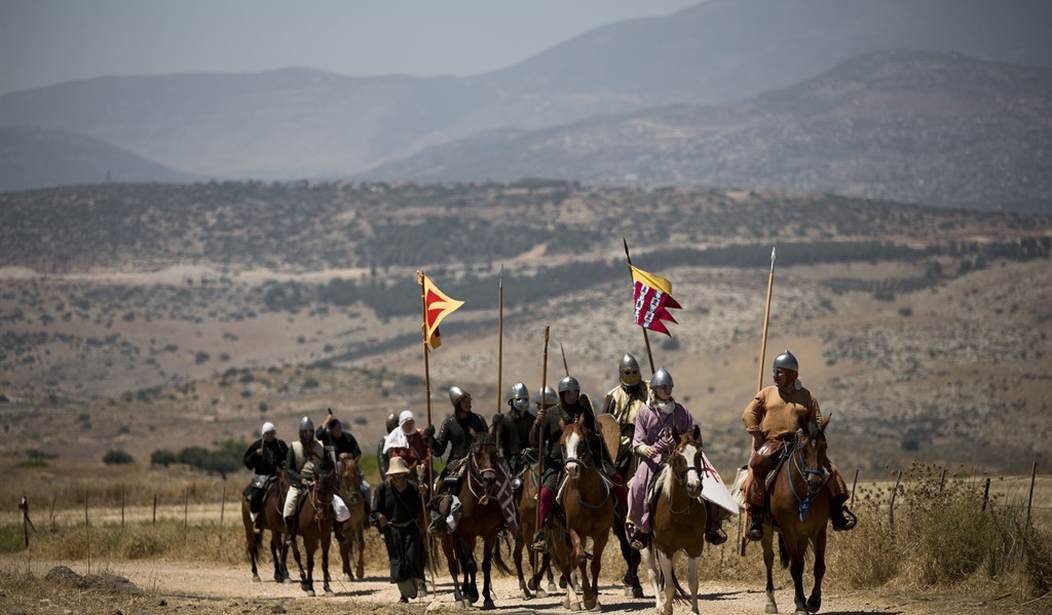

Here in Dallas, we have a place called "Medieval Times." It's effectively dinner and a show, with the show being a live-action jousting tournament featuring men in armor, horses, and steel swords. My friend and I have been planning to take our young sons to see the show. To be clear, the food is apparently abysmal, but nobody goes to Hooters for wings, and nobody goes to Medieval Times for chicken tenders. You go because it's something cool to see.
The cool thing to see there is knights in shining armor battling for honor and glory. There's something primal and awesome about it that I want my young son to see, to identify with, and adopt into his little developing brain.
In the back of my mind, I always knew knights were something I wanted to show my boy because it's healthy for him on a soul level. It's a good representation of how it's okay, even good, to be dangerous, but it must be tempered with a noble spirit and the willingness to do good and to serve. It's not something I really gave much conscious thought to until this article from the Financial Times popped up, titled "Why is the far right so obsessed with knights?"
I'd say the better question is, why is the Financial Times so obsessed with the far right?
But I digress.
Peering into the article, you get the typical leftist deconstruction of the "knight." First, it warns that the image of the knight has been adopted by extremists, and includes anti-muslim sentiment:
References to its symbolism have become increasingly common in far-right spaces on platforms like Instagram, Reddit, YouTube and 4chan. Some of this content is innocent: reels by historians discussing the history of the knights. But on the extreme end are social media accounts that wrap white supremacist and anti-Muslim politics in the romanticised imagery of holy war, medieval chivalry and Christian martyrdom.
And goes on to tie them to evil groups often brought up by the left:
What is being signalled requires an understanding of the broader historical context. This is not the first time the image of the knight has been used by extreme political groups. Twentieth-century fascist movements, including the Nazis and the Ku Klux Klan, relied heavily on imagery of them and other medieval Christian symbols.
There's nothing new under the sun, and that especially goes for leftists using critical theory to destroy something.
Read: The Coward's Way to Slay a Hero
The article goes into the history of the knights, namely the Templars, who went from a good idea to a bad one that the church had to dissolve. The real point of the article is a bit later, where the author writes:
More recently, it has gained a particular cultural purchase. Parts of rightwing discourse offer a picture of a Christian society under siege again, echoing the myth of warrior monks who went to battle for a Europe supposedly under attack by Islam.
Unfortunately, the appropriation of these symbols is not usually the harmless fun and simple hurrah for St George that is claimed. It can signal a more sinister desire to return to hegemonic white Christendom.
The thing is, he's not wrong there. The image of the knight is gaining real popularity as an image of resistance, and yes, even a return to hegemonic Christendom. The "white" part isn't very accurate, because a lot of people with differing melanin levels would love to see Christendom return, but no leftist can resist making anything that challenges their agenda out to be anything but a white plot. Makes it sound so much more sinister, because you know how evil those whites can be!
They've spent decades trying to convince you, after all.
But reality is reality. Western peoples, particularly men, are becoming more and more adoptive of knightly symbols for the same reason we adopted them during the time of the Crusades. There is an Islamic incursion happening; it's fundamentally counterintuitive to Western values, and it needs to be pushed back.
Many people in the modern era have been convinced that the Crusades were just an overall evil plot by England and the Catholic church to seize land, kill Muslims, and get rich. To be sure, there were power grabs, money-making, and Muslim murdering involved, but again, to highlight that only is to completely ignore everything else that went down.
Here's a fun fact: The Crusades were both justified and a good thing, because it was necessary to stop the Muslim invasions that were killing and enslaving innocent peoples, including in Christian lands. There's an excellent video that explains this that you should watch, because I'm not going to get too far into the history of it here. That's not the purpose of this article.
I don't necessarily agree with his take on "Kingdom of Heaven," by the way. I think it's a fantastic movie, but I digress... again.
Read: Ridley Scott Unintentionally Made One of the Best Pro-Christian Movies
But the point is that knights represent something that we Westerners, especially Western men, feel is needed in society today, which is the good but violent man doing what's necessary to protect his family, his people, and his country, and all in the service of our Holy God.
Because we've seen what Islam is. Unfettered migration has turned countries into cesspools of violence, rape, and corruption. Where it touches Western civilization, de-civilization follows. Women are no longer safe to go out alone; our legal system turns against us in favor of the migrants who weasel their way into positions of power and begin remaking it from the inside.
A deeper part of us senses something akin to what happened long ago that caused the First Crusade, but this time the strategy isn't swords and spears; it's slow corruption and influence. While the means might be different, the goal is still the same. Domination and subjugation. Those doing the work aren't even shy about admitting it.
So the knight is making a return. The entity that wielded the sword to push back the enemies of Christendom.
And I'll throw one more little factoid in there.
It's not the far right who's interested in the image. It's normal people, because that's how far the radicals have taken things. We aren't the extremists; they are, and if the extremists want to continue doing things in an extreme way, then they can expect an extreme response at some point.