
Recently, there has been plenty of coverage on Diego Garcia, the military installation that is most literally in the middle of Nowheresville, Indian Ocean. It began when there were some initial moves of brinksmanship seen from England last month, where that British squish Keir Starmer was initially restricting the U.S. from accessing the base for the Iranian mission. Starmer soon backed away from that resolute posture, squish that he is.
Then, just over a week ago, Iran fired a pair of long-range missiles that saw our hot and bothered media complex become even hotter and more bothered. Iranian missiles were targeting that military base, a move with the same level of desperation and accuracy as a last-minute Hail Mary passing play. That this effort failed was not surprising, but it was enough to get opponents of Donald Trump further worked up into a lather.
Never mind the contradictions.
DIVE DEEPER: Latest Action Against U.S./U.K. Base Shows Trump Had Justifiable Concern About Iranian Threats
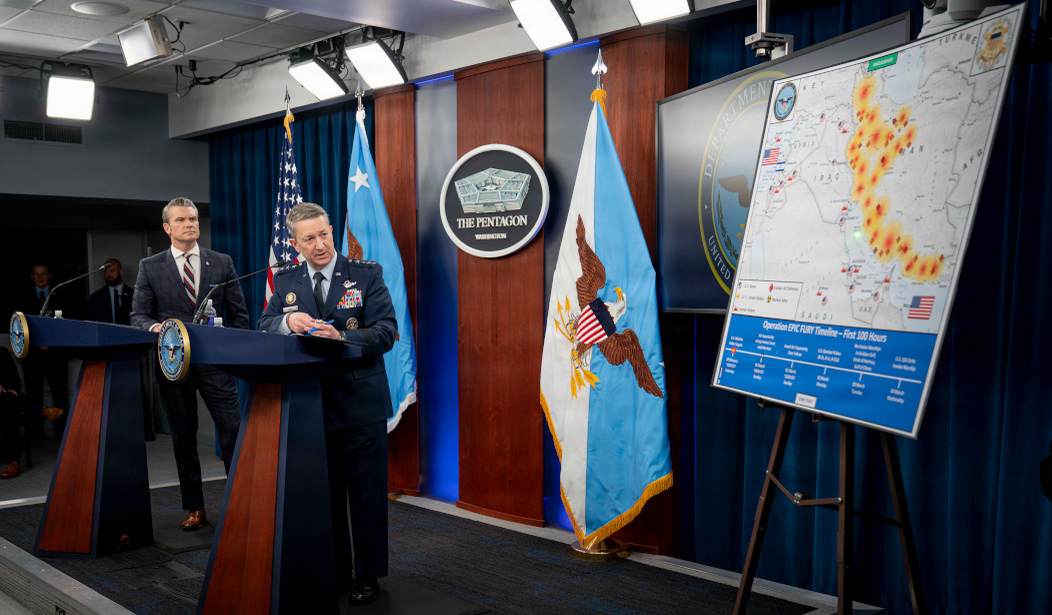
Prior to these launches, the prevailing narrative was that Iran posed no real threat, and we were moving forward with Operation Epic Fury for no sound cause. Then Iran displayed both the ability and tendency to fire off missiles that greatly exceeded their claimed threshold, and the narrative flipped. This strike attempt by Iran showed they had the means, and that the leadership had been lying all along, but the new press stance became that the administration was inept for not recognizing this threat, and Iran was showing itself to be more of a powerhouse.
It must be such a breeze to move through life with this ability to skirt accountability on a whim. Even as the press had been shown 100% in error on this matter, they still managed to peacock around as if they possessed all the wisdom. But a few sane minds began to extrapolate what this attempt represented, and they cracked out the protractors. Sure enough, if the Iranian psychos could reach that outpost military base, it meant portions of Europe could also be in the crosshairs.
And just that quickly, the staging at Diego Garcia became all the more vital to what is playing out in the Middle East. This spit of land has been a point of controversy between Britain, the U.S., and the island nations of Mauritius and the Maldives, which are both looking to butt in, and it is a key point of operations for our efforts in this part of the globe. Getting the deed settled on this outpost is a bit of a necessity for our military.
Iran targets US-UK military base - 2K miles away - with ballistic missiles: report https://t.co/UiP3rbowSO pic.twitter.com/wmX4HMsRgx
— New York Post (@nypost) March 21, 2026
No Question Atoll
The first thing when discussing this island base is getting the names right, as many are bandied about, given the area is littered with locations and no fewer than three nations are involved. Diego Garcia is the southernmost island in a collection called the Chagos Archipelago, and the provenance of these sparsely populated islands is in flux.
Britain is currently in possession of the Chagos Islands, but is in the process of handing over the rights to Mauritius. Diego Garcia is jointly operated by England and the U.S., and the effort to hand over the mortgage is done with the proviso that we get to maintain the base operations on Diego Garcia.
The history of this place is that odd mixture of uselessness and pride of ownership. First discovered by the Portuguese in the 1500s, the uninhabited island was so unimpressive that about 30 years later, another Portuguese explorer rediscovered the island and named it after himself.
France came into possession at one point, and the area was a little more than a spot for fishing and fruit gathering, and then what few dozen Frenchies pitched huts there bailed out when the British East India trading company set up shop on the land.
They had a few hundred East India workers operating there until it was overrun – by another few hundred East India workers. Their ship went down, and they had to take refuge there, but double the manpower soon wiped out their stocks, so the Brits pulled up stakes and just left. Some time later, the place fell back under French rule, and by the late 1700s, they were using the place as either a coconut plantation or a place to dump their lepers. Talk about mixed fortunes.
As part of the Peace Treaty of Paris, the French tossed in the Chagos Islands to the British, along with future draft pick considerations. Some decades later, it dawned on them to use the island as a weigh station for British steamers, where they could reload coal to finish their lengthy treks in the Indian Ocean, and this led to military usefulness going into the 1900s. After WW2, the Brits were scaling back their footprint in the Indian Ocean, and that was when Uncle Sam came calling.
Diego Garcia was seen as a vital spot as it was both in a position for staging or refueling in this part of the world, and it was remote enough not to be threatened so easily. The British-US agreement involved the need to evict the few residents on the island, called Chagossians, who were not actually native inhabitants but the descendants of generations of workers from the coconut plantations. Most were ultimately brought to either Mauritius or the nearby British colony, the Seychelles.
🚨🇮🇷 PICTURED: The implied range of Iran’s missiles
— Politics Global (@PolitlcsGlobal) March 21, 2026
It was believed that Iran’s max firing range was 2000km, but this has been revised after they fired at the Diego Garcia base, which is roughly 4000km away pic.twitter.com/yiyWfRyg2f
The Step To the Med-East
Diego Garcia is a ribbon of an atoll, a tapeworm-looking map feature whose footprint shape lends itself perfectly for runways. As the U.S. became established, the buildup of Diego had been done with an eye on the East, as it was seen as a component to help in the dissolving fortunes in Viet Nam. The Brits allowed greater development of the runways, as well as expanding the deep harbor access. This proved fortuitous when the Shah of Iran fell, and US interests shifted to the oil-rich Gulf States.
Desert Storm, Afghanistan, and other military maneuvers relied significantly on this location, and it continues to be a linchpin base in our actions in this region. For that reason, we became concerned when English leaders became wobbly over the United Nations, and others, who were upset with the rude manner in which the Brits displaced the Chagossian population, and Mauritius's laying claim to the islands. Except Britain had separated the Chagos island chain from Mauritius years prior to the nation gaining independence, but this being the hyper-sensitive U.K., they are serious about being on the good side of the useless UN.
Then, adding to the atlas intrigue, the Maldives have stepped in to kill the new deal and tried to lay claim to the Chagos Islands as their own. Maldives leaders are citing centuries of ownership at some point in time, when no one was sure what to even do with the collection of uninhabited spits of land. As such, all of this drama is done with one focus in mind: Diego Garcia. The rest of the islands have no residents and no resources, so it is all a gambit for monetary restitution.
In the handoff agreement signed last May, Mauritius will take control of the islands, but the U.K. and U.S. will maintain their presence on Diego Garcia and have authority over the land for 99 years, with terms to be extended after. In return, Mauritius will be paid out annual sums that will total in the billions over that century.
One other concern for the U.S. is that by not controlling the regional Chagos Islands, it could leave the door open for either Russia or China to establish a beachhead on one of the outer spots, for spying purposes. The fact that Mauritius officials have been taking junkets to Beijing makes this concern a bit more than paranoid reactions.
It certainly appears we have not much to fret over at the moment on Diego Garcia, as long as we can keep the keys and renew the lease. But nothing is firm in dealing with the current British leadership, and their desire to curry favor with the entirely impotent UN is always a cause for concern.