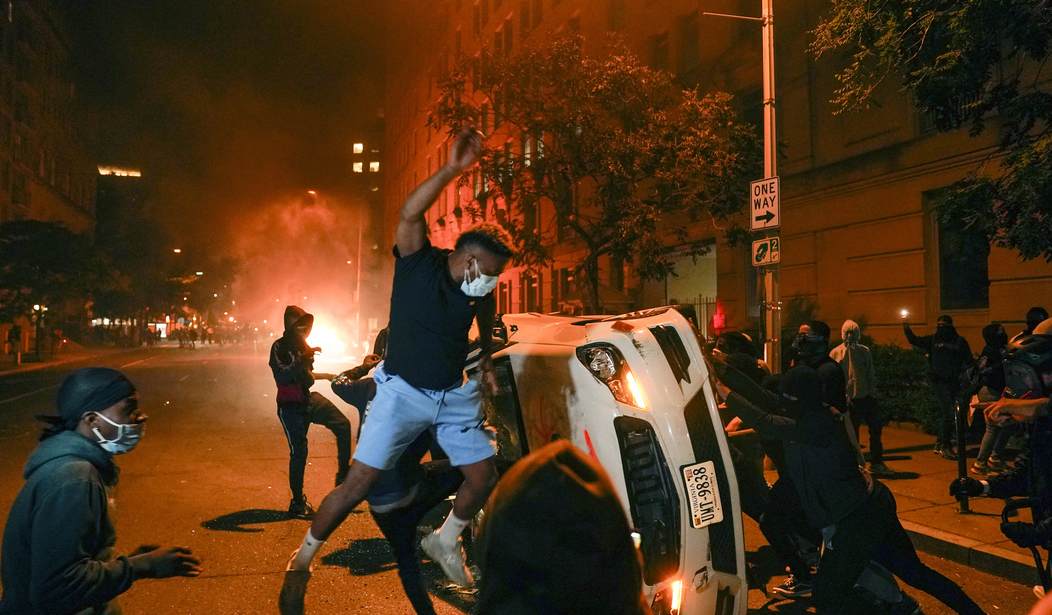

Has it really been over six years since the George Floyd rioters torched significant portions of Minneapolis? It feels fresher than that, maybe because parts of me still can’t quite believe what was allowed to happen in a major American city in the 21st century.
The riots, which occurred during the COVID crisis, marked a seminal moment in my political evolution. I had been aware for years that the Left was not in favor of celebrating and improving our country, but the adoration of the violence by Democrats and the mainstream media was as appalling as anything I’d ever seen. Meanwhile, their almost unfathomable hypocrisy was exposed by their insistence that if you left your house to see your dying mother in a nursing home, you were an evil COVID denier and spreader… Unless you planned on rioting. Well, that was different.
You weren’t breaking protocol; you were being virtuous.
It was at that moment in history that I realized we weren't just dealing with people with different political opinions, we were facing an existential crisis for the Republic, one which is still being fought over today.
Remember: Vandals, looters and agitators raged in the city for five horrific days after George Floyd, an African American male with a lengthy rap sheet, died after a confrontation with police. Although a 19-year veteran of the MPD, former Officer Derek Chauvin, sits in a federal prison after being convicted of four charges — including third‑degree murder — controversy still rages over whether Floyd died because of a fentanyl overdose or because of Chauvin’s restraining technique.
The riots caused over $500 million in damages as over 1,500 buildings were partially or utterly destroyed — the costliest civil unrest in U.S. history. Gov. Tim Walz was notoriously slow to act as his wife enjoyed the smell of burning tires.
Over half a decade later, the Twin Cities are still feeling the effects, according to The Washington Examiner:
Market valuations for downtown Minneapolis commercial buildings have dropped by about $3.4 billion from 2021 to 2026, or about 45%, according to Minneapolis City Councilman Michael Rainville, who said that the number is still dropping. According to Rainville, “every renter, every homeowner, every small business building owner outside downtown is making up for that with their property tax.” Minneapolis homeowners were responsible for 49.4% of property taxes in 2021, but that share has risen to 55.6%.
🚨 Downtown Minneapolis commercial property values continue to collapse. They are down 45% since 2021 and fell another 14% in the last year alone.
— Dustin Grage (@GrageDustin) June 17, 2026
Now Minneapolis residents are being forced to take out loans just to cover their property tax bills.
Good job, Democrats. pic.twitter.com/MXZSUhi412
Many businesses were caught between a rock and a hard place:
These struggles are a holdover from the chaos and disorder brought by the Black Lives Matter summer of 2020, which had businesses contemplating fleeing the city. Businesses were forced to close as they were caught up in “no-go zones,” where they were subject to the whims of violent rioters and criminals because the beleaguered police department wouldn’t even send officers to accompany ambulances, despite paramedics requesting the extra protection. As of last year, local media detailed how businesses are still “hoping they can go back to what they remember before everything changed in 2020.”
MORE MINNY: Too Funny: Trump Now More Popular Than Walz in Deep Blue Minnesota
Tim Walz Had the Power to Stop the Fraud in Minnesota - He Didn't
Is Minneapolis now on a better path? If so, it’s got a long, long way to go:
Minneapolis Violent Crime Map 1/1/2026 - 6/19/2026
— MNConservative🇺🇸⭐️ (@RealJMPeterman) June 20, 2026
This is what "thriving" looks like to @GovTimWalz and Senator @amyklobuchar.
5010 Assaults
1021 Burglaries
24 Homicides
366 Robberies
409 Sexual Assaults / Rapes
69 Car Jackings
567 Domestic Assaults
source: MPD 6/20/2026 pic.twitter.com/djVdeT45qm
Minneapolis now has George Floyd Square, but it also sports numerous empty lots where people’s dreams once stood, and many small business owners are still struggling just to keep their doors open. State leaders say things are on the upswing, but a devastating 2025 report printed in, of all places, The Minnesota Star Tribune, revealed a much darker reality:
Serious crime is way up since before the death of George Floyd. In Minneapolis, homicides increased 43%, auto theft surged 67% and vandalism rose 73%, per data from the Minneapolis Crime Dashboard comparing Jan. 1-Sept. 15, 2019, vs. Jan. 1-Sept. 15, 2025. While facing some of the highest rates of crime and violence in Minneapolis’s history, CBS News reports, the Minneapolis police force is down 40% in the last four years.
In the downtowns of Minneapolis and St. Paul, many businesses are not flourishing. Some have closed. Some have left.
Investment is down — due to elevated risk assessments by institutional investors. Minneapolis-St. Paul has long punched above its weight attracting institutional investment, but that has changed since 2020. Institutional investors tell Minneapolis commercial real estate leaders it’s “career suicide” to recommend this area to investment committees. They see Minneapolis-St. Paul like they see Portland, Ore., and Oakland, Calif.
Job growth here is not a reality. Jobs are in decline — not just relative to our own history but relative to most of the rest of the nation today. According to the Bureau of Labor Statistics, since 2020 (the last five years) Minneapolis-St. Paul sits at a net negative of 26,900 jobs and ranks 48th out of 49 markets measured (only San Francisco performs worse). The top 10 markets added a cumulative 2.28 million net new jobs.
Most Minnesota public school students are now failing science, math and reading, according to annual testing assessments.
The article was written by investigative reporter Rick Kupchella, who produced a documentary on Minnesota called “A Precarious State.” I’m amazed the Star-Tribune even ran the piece, and didn’t immediately set fire to the computer it was written on.
One of the most amazing things about this story — and the myriad others coming out of the Gopher State exposing the epic level of corruption that’s evidently a way of life there — is that Kamala Harris vetted Tim Walz and thought he’d be a good vice president. If being good at watching things go up in flames were a requirement, I guess Tim and his wife would certainly fit the bill.
Meanwhile, Minneapolis continues to scratch the scars of inaction, six years later. When you hear the phrase, “leftist Democrats want to burn it all down,” it’s not just a euphemism.
Apparently, many of them mean it quite literally.