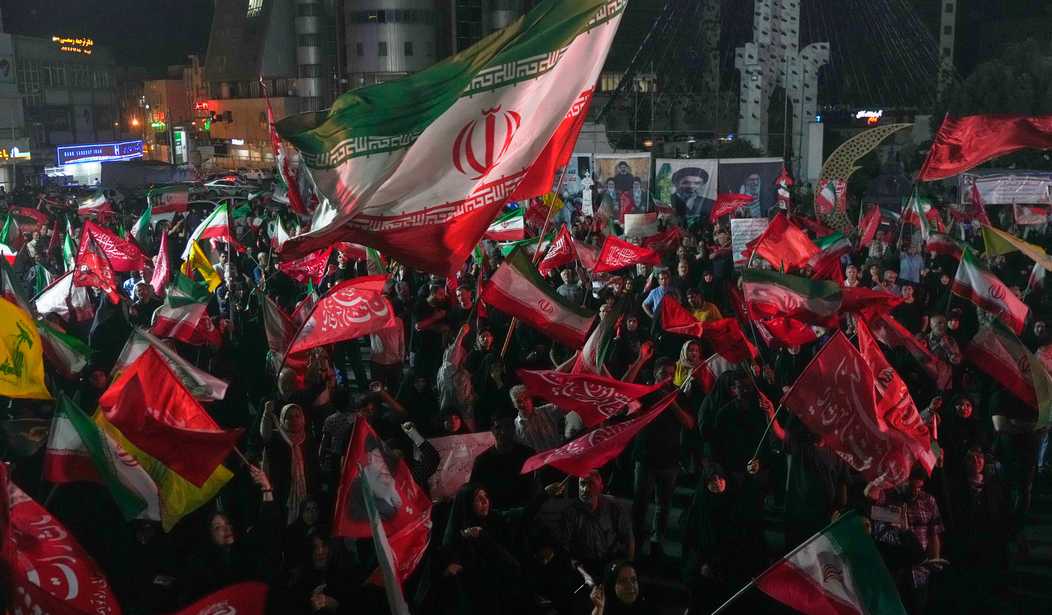

So, what's going on in Iran right now? Affairs within the Islamic Republic have always been something of a mystery; it's hard to get a good bead on things in that insular, heavily propagandized country, especially when we've been methodically disassembling that nation's political and military leadership with high explosives. As President Trump puts it, their political leadership has been reduced down to the third tier, and the Islamic Revolutionary Guard Corps (IRGC) appears to have taken over what's left of the military.
As for their military, as much of a beating as they have taken, it seems they keep pulling missiles and drones out of, well, somewhere.
In the latest development, President Trump has canceled the latest round of attacks, in part at the request of some of the other Persian Gulf states. Some of these other nations have had Iranian missiles and drones hitting their own bases and facilities. For now, at any rate, hostilities appear to be on hold.
Read More: Trump Cancels Iran Attack, Calls for Immediate Peace Deal After Allies Make Unusual Request
The shooting may have stopped, but the struggle for control of Iran has not.
On one side, the ultra-hardliners who oppose any negotiations with the United States are pressing for total victory in the war. Known as the “Paydari” movement – Persian for “stability” – they are hard-core ideologues who want to enforce the Islamic Republic’s control over society.
On the other, those who support President Masoud Pezeshkian and powerful parliament speaker Mohammad Bagher Qalibaf — who doubles as Iran’s chief negotiator — see military pressure as a way to win a negotiated deal with the United States. This camp is also spurred by concern over the economic toll Iran is suffering from the war and the need to adapt to social change in the country.
“Negotiation is a political tool and a complement to military action to force the enemy to a point of compulsion and extract real concessions,” an adviser to Qalibaf, Mahdi Mohammadi, wrote on his Telegram channel Thursday.
Note what isn't mentioned there? The possibility of an uprising by the Iranian people. There's good reason for that. Any such uprising, if it were successful, would see these leaders either fleeing the country with their families for whatever nation might take them in and from which they can access the Swiss bank accounts that it's pretty certain they all have, or suffering the fate the Italian people visited upon Benito Mussolini. The Iranian regime still has quite a few people, but Tehran has no shortage of lampposts, and this is very often the fate of the members of a fallen dictatorial regime.
There are indications that just such an uprising may be simmering right now, as my colleague Nick Arama has pointed out:
Read More: Report From Inside Iranian Resistance: Revolution Could Happen 'Any Day Now'
Nick writes:
The question that's been hanging out there for a bit is: With all the chaos, where is the reaction of the Iranian people?
Well, now there's indication that reaction is coming, and the regime isn't going to enjoy it.
The streets of Iran are near a breaking point over public executions, economic collapse and a war that’s been raging on for more than five months, anti-regime figures in Tehran told The Post.
“A revolution can happen any day now — people want revenge,” a protest leader said, referring to the regime’s brutal January crackdown that President Trump said killed 52,000 people.
An independent journalist active in the Iranian underground said that preparations are already being made for the next uprising, and that activists from all walks of life are determined to make a final, decisive blow against the regime.
The protest leader said they were evaluating what had and hadn't worked in prior actions to maximize their effectiveness.
The journalist said the resistance had hidden makeshift weapons throughout the country: "bricks, rocks, wooden clubs, chairs and tires used to block roads" in preparation for an uprising.
Here's the thing: The United States can only offer so much support. But there are a few things we could do.
First, the resistance is, as Nick reports, depending on "bricks, rocks, wooden clubs, chairs and tires." There are doubtless ways we could improve those odds by finding a way to funnel some better weapons and ammo to the resistance. And boy howdy, if you want a great illustration as to why the Second Amendment is so vital in our own country, here you have an example of what can happen to a people denied that basic human right.
Second, the United States (and Israel) could make sure that the Iranian people, if and when they do rise up, do so under an umbrella of steel. We shouldn't intervene with ground forces, but we can utilize our control of Iran's airspace and our huge technological advantage to clear the road for the rebels.
From the very beginning of this thing, I've been saying and writing that the ultimate end of the rule of the mullahs has to come from the Iranian people themselves. They have to rise up and take their country back. That won't be cheap and it won't be easy. The revolution will come at a horrible cost. But, a quick look through history, including at our own revolution, the 250th anniversary of which we just celebrated, reminds us of the amazing things that can be achieved by people who have nothing left to lose.
The big question will be the IRGC. How tight a grip do they have on what's left of Iran's rank and file military? Will the IRGC's leadership dig in and fight, or will they join Iran's political leadership in lining up for plane tickets to Russia? That seems to be the question on which any potential revolution hangs.
Either way, there is a historic opportunity here. If the reports are correct, and there is an uprising in the works, the United States should help the rebels in any way possible short of American boots on the ground.