






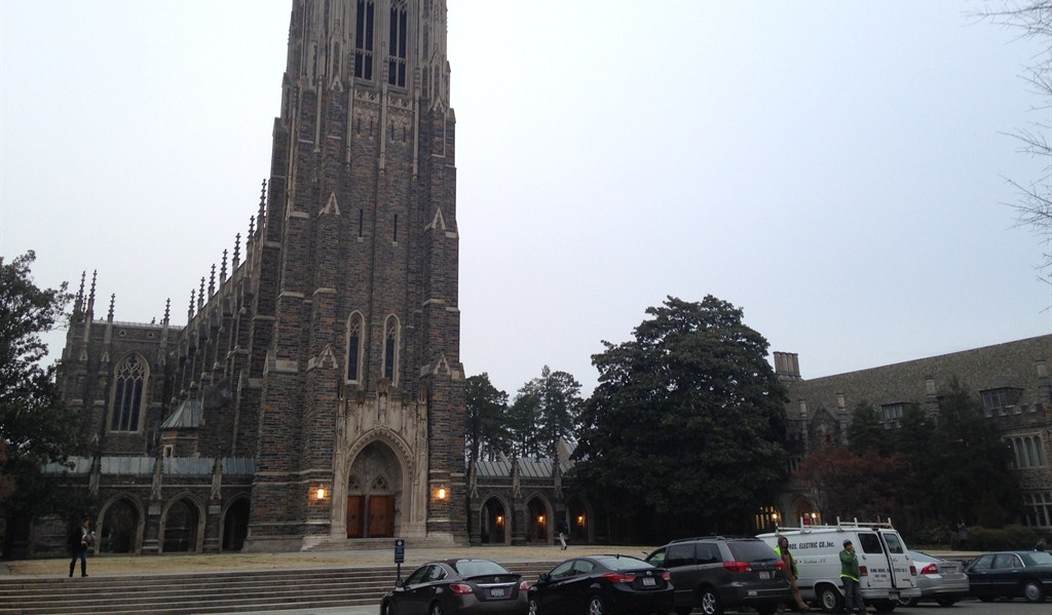
The Supreme Court ruled in 2023 that universities could no longer decide who gets admitted based on skin color. Duke University apparently treated that as a drafting problem.
As a Carolina grad, I would love to say this comes as a shock. Of course, because it is Duke, it does not.
The Justice Department's Civil Rights Division (CRT) announced Thursday that it found Duke University School of Law intentionally discriminated based on race when selecting its incoming classes of 2023, 2024, and 2025. According to the DOJ, Duke used applicant essays, review tags, and background characteristics associated with race to preserve racial preferences after the Supreme Court's decision in Students for Fair Admissions v. Harvard.
Assistant Attorney General Harmeet Dhillon did not mince words, writing in a statement in the release linked above:
"Duke Law School doesn’t get a free pass to discriminate against white and Asian students simply because it thinks it has good intentions. Using 'diversity' essay questions to identify preferred races for admission is still illegal discrimination based on race, and this Department is committed to eliminating it everywhere we find it, including in our nation’s law schools."
Duke's published policy claimed admissions reviewers did not see applicants' racial demographic information. Behind the scenes, however, reviewers were instructed to tag short-answer responses related to "Diversity/Services" and flag characteristics such as first-generation status or receipt of a Pell Grant.
Applicants were encouraged to explain how they would further Duke Law’s mission, which included a commitment to “diversity of perspective and experience.” The Justice Department found those supposedly race-neutral factors were used as proxies to advance the school’s racial diversity goals.
Read More: The ABA Thought It Could Force DEI on Law Schools Forever - Then Trump Returned
DOJ: UCLA Med School Caught Using Illegal Race-Based Admissions
Internal emails were even less subtle.
A 2023 email discussed giving preference to applicants who demonstrated a commitment to "advancing the rule of law and the protection of democratic institutions," with the author noting that approach could "possibly" help Duke meet its diversity goals. Other internal communications described diversity, equity, and inclusion as one of the school's "most important values" and pledged to "work even harder" to admit and recruit a racially diverse class.
In a 2025 internal review, Duke's admissions dean suggested that officials could assess the racial makeup of the student body during campus visits without collecting formal statistics.
The paper trail did not leave much room for interpretation. The Justice Department summarized what it found in Duke's records:
"Taken together, the 2021-2022 planning materials, the 2023 committee memoranda and reviewer templates, and the 2024-2025 annual reviews support the inference that Duke Law intended to influence admissions with race or closely related proxies despite formal disclaimers of race-based decision-making."
Then there are the numbers.
In 2024, the admitted median LSAT was 164 for Black applicants, 170 for Hispanic, 172 for white, and 173 for Asian. In 2025: 166, 171, 173, and 173. More damaging, rejected white and Asian applicants posted higher median scores than admitted Black applicants in both years.
DOJ’s analysis went beyond comparing averages,as they said:
"Based on our review of the 2025 applicant-level data, Duke Law’s use of race gave a black applicant a roughly 3.5x higher probability of admission than an equally strong Asian applicant with similar academic credentials. Earlier cycles show even larger preferences, with preferences declining after SFFA but remaining practically and statistically significant."
That finding lines up with warnings issued after the Supreme Court decision. Vijay Jojo Chokal-Ingam, Mindy Kaling's brother, who got into medical school in 1998 by pretending to be Black, predicted schools would resort to "stealthy, complex admissions algorithms" to preserve racial preferences while evading detection.
The department concluded that highly qualified white, Asian, and other applicants were denied admission because of their race. It also said the discrimination appears to be ongoing.
Duke said it was reviewing the letter and maintained that the university is "committed to complying with the law" while pursuing its academic mission. That is the institutional equivalent of a shrug, a non-answer carefully worded to promise nothing.
The DOJ finding is not yet a court judgment, and Duke can still try to negotiate its way out. The department is seeking a voluntary resolution agreement; the same language it used with Yale's medical school, which has been in drawn-out settlement talks while facing faculty pushback. If Duke refuses, DOJ says it is prepared to file suit. In other words, the department is daring Duke to litigate this.
A law school tried to lawyer its way around a Supreme Court ruling. Of course, because it is Duke.
Editor's Note: Do you enjoy RedState's conservative reporting that takes on the radical left and woke media? Support our work so that we can continue to bring you the truth.
Join RedState VIP and use promo code FIGHT to receive 60% off your membership.

Join the Conversation
VIP members get the ability to comment on articles.