






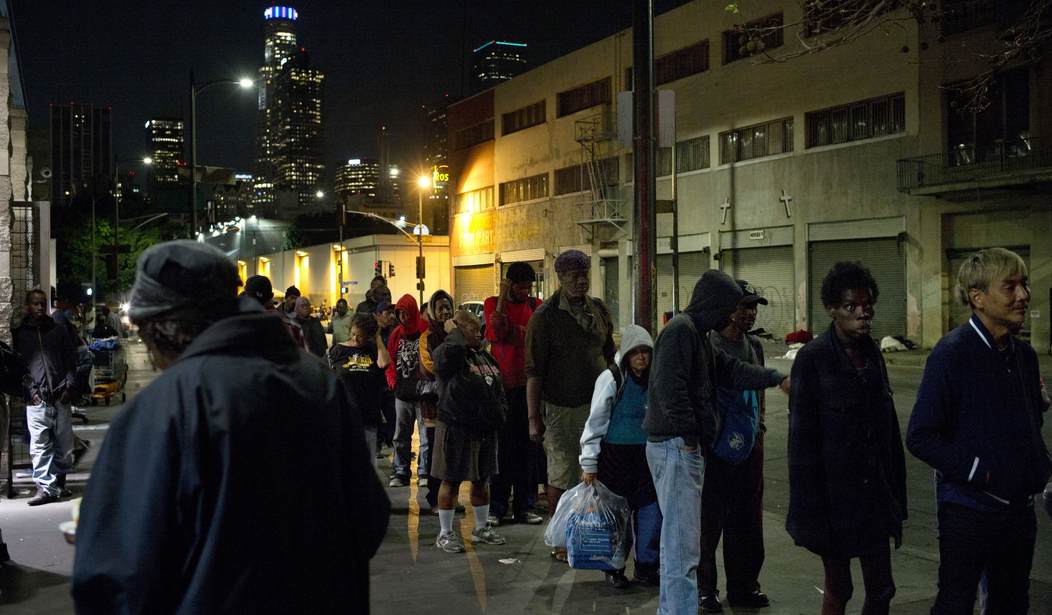
An undercover video recorded in downtown Los Angeles, including Skid Row, shows how easily California’s ballot petition system can be manipulated in plain sight, with signatures bought, names and addresses treated as optional, and the process moving forward anyway.
Foreigner Named in Swiss Criminal Complaints Caught Promoting California Ballot Petition Fraud
— Muckraker (@realmuckraker) March 23, 2026
In Los Angeles, we investigated the company Urban Signers, which specializes in circulating ballot petitions.
The man who owns Urban Signers, Franck Tessemo, was previously named in… pic.twitter.com/iVt3YRXda1
On the sidewalk, it starts quickly and without much effort to hide what is happening. There is no buildup, no real attempt at persuasion, just a transaction that moves from one person to the next:
“You sign it, and then you get money.”
“$2 per signature… No, $1 a signature.”
“I give them $1… any junkie $1.”
Petition circulators are often paid per signature, and qualifying a statewide ballot measure requires hundreds of thousands of valid signatures, creating strong incentives to move quickly and at scale. Some circulators say they are paid $7–$10 per signature and can make more than $1,000 per day.
No one stops to explain what is being signed or why. It moves forward on repetition and volume, with the next signature mattering more than the last, and almost immediately, the conversation turns to what, if anything, has to be real:
“Any LA address… they can make it up. It doesn’t make a difference.”
“As long as they get they pen on that paper… any address.”
When the question turns from address to identity, the answer does not get any cleaner:
“Do I have to give a real name?”
“Oh, just make up some bullshit.”
The problem is not just paid signatures but whether the signatures themselves represent real voters at all. California’s Secretary of State says it is illegal to register a nonexistent person, and if names and addresses are being falsified and still counted toward qualifying a ballot measure, that could violate those protections.
The interaction does not stop there. It adjusts depending on who is being approached, but the exchange stays the same:
“Chips, cigarettes. What you need?”
“You get a cigarette for every page you sign.”
Something of value is offered, the signature follows, and the process keeps moving. California law prohibits offering money or anything of value in exchange for petition signatures.
What the person is told they are signing appears to be whatever it needs to be in the moment:
“Just say… this is to build more homeless shelters…”
“Just make up some bullshit.”
California law forbids circulators from misrepresenting the reason for and contents of a petition, and if the explanation is being invented in the moment, those signatures could be invalid because the signer was never told what they were actually signing.
Read More: Watch: Fraudsters Pay LA Skid Row Residents for Petition Signatures — Then Attack Investigative Team
Newsom’s Hospice Fraud 'Crackdown' Collapses: 197 Agencies Registered to One Address
This video shows a process: incentives first, information treated as flexible, explanations adjusted as needed, and signatures moving through without much friction. Reporting has shown this is not new, with petitioners targeting vulnerable populations in areas like Skid Row for years.
When that same pattern moves off the street and into a more formal setting, the answers do not tighten anything:
“If somebody’s hungry… you give them food.”
“That’s between you and those people.”
“We wouldn’t even know unless you tell us.”
If enforcement depends on someone admitting what they have done, there is little reason to think anyone is checking at all.
Then the conversation stops being about signatures and starts being about the camera:
“It’s the hustle right now, bro.”
“You know, this is, like, not a smart idea…”
“Mikey get took real quick. That’s not smart.”
“If you wanted to do this, you could have just did that on Skid Row. It’s every day.”
The focus shifts away from the signatures themselves and toward stopping them from being recorded. According to RedState reporting, the situation escalated beyond the warnings caught on camera, and the investigative team was allegedly assaulted after pressing further, turning what began as a ballot operation into a physical altercation.
That pressure, to collect signatures quickly, in volume, and with minimal friction, is built into the system.
California’s ballot initiative system begins with signatures. If those signatures are bought, falsified, or secured through misrepresentation, the process is compromised before voters ever see the measure.
If enough of those entries are accepted, what reaches the ballot is not just a reflection of public support.
It reflects what the system allowed through before a single vote was cast.
Editor’s Note: Gavin Newsom, Karen Bass, and the “progressives” are ruining California.
Help RedState to continue bringing you the truth. Join RedState’s VIP and use promo code FIGHT! to get 60% off your membership.



Join the Conversation
VIP members get the ability to comment on articles.