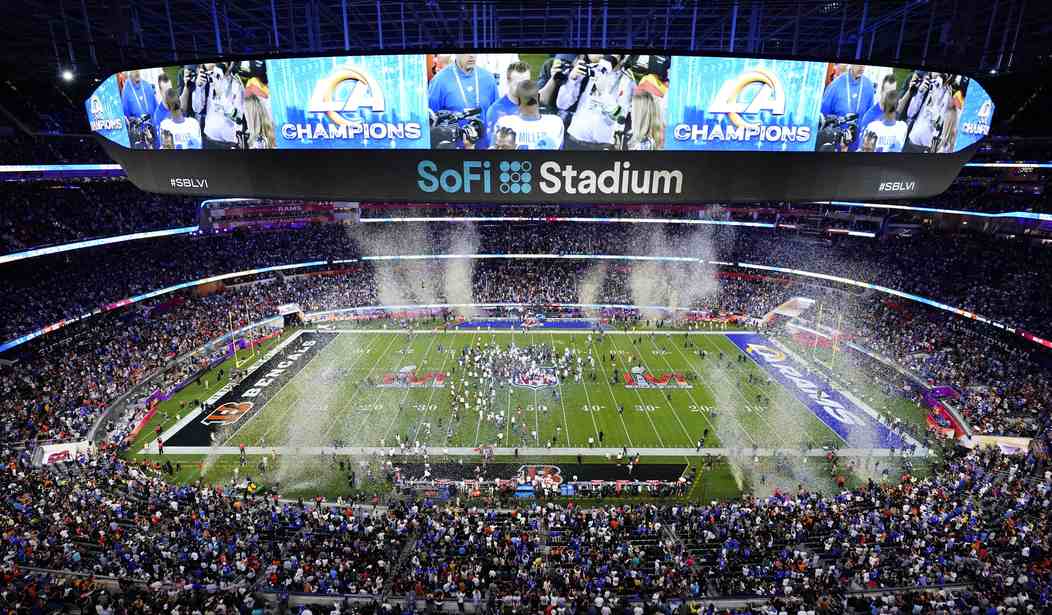

Alright, I get it. Everything these days is Super Bowl.
Big is too small a word for this event every February. It’s an amazing example of American marketing, always. The game itself comes in spurts because of TV timeouts and is sometimes exciting. But it's increasingly hard to live up to all the surrounding weeks of relentless hype.
The buildup is overwhelming if you pay attention to sports. And even if you don’t, it’s hard to avoid. This is a peak season for television sales. Traffic will be lighter almost everywhere.
Grocery stores lay on special displays and sales. Civic cultural events are scheduled, or rescheduled, around game time. Sports bars. Fantasy leagues. Betting outfits. All cashing in.
Pizza places call in every delivery driver. Millions of chickens will lose both wings this weekend.
I’m a sucker for flyovers, which have nothing to do with football, but add a powerful opening spectacle to the National Anthem. This year’s is a rare joint mission by the Air Force and Navy.
The late Duane Thomas, the laid-back Cowboys running back, once asked about the Super Bowl, "If it's the ultimate game, how come they're playing it again next year?"
I $u$pect many of u$ can gue$$ the an$wer.
This year's ticket prices have plummeted from a $6,500 peak to less than $4,000, presumably for Seattle and New England fans who don’t have TV. That seems like an awful lot of money to pay for lines to enter, lines to buy beer, lines for the bathroom, and seats requiring binoculars.
And don't forget the parking. That can set you back another $3,300, unless you're into hiking.
Don't worry about concessions. Many are California-style, meaning plant-based, and the nachos are gluten-free, thank goodness. Oh, a 16-ounce can of beer costs a little more than a dollar an ounce.
This game will have the largest number of TV viewers of anything all year, every year. Watching or at least snacking near a TV tuned to NBC will be an audience equal to more than a third of this country’s entire population of 330 million, not counting Joe Biden’s 10 million illegal immigrants.
Many viewers will even pay attention to the plays and the unfolding football feints and strategies, especially in the second half.
During every commercial break, the nation’s water pressure will plummet as viewers visit the smallest room in the house. Some people will stay riveted for the commercials, which will be refreshingly original for this one day. (Why are ads only this creative and entertaining once a year?)
Each of those sales pitches costs between $233,000 and $333,000 per second.
If anyone was going to attack the Homeland, late afternoon Super Bowl Sunday would be a good time.
Halftime of most football games is typically a time-filler with marching bands getting their big moments on national TV and overpaid football “analysts” opining on mistakes to display their keen grasp of the obvious, filling time between commercials.
This year, to boost fandom among Hispanics — and, who knows, maybe generate a little controversial publicity — the NFL tapped Bad Bunny to do his anti-ICE thing in Spanish. As it happens, I will be unable to watch this halftime show, as I have every year since Janet Jackson’s intentional nip-slip.
Monday will find an unusually large number of workers calling in sick; some claims may be legit. Those who do show up will talk about two things – their favorite commercial or maybe a stunning play or two.
The Super Bowl, which used to be called the NFL Championship, has truly become a most remarkable example of mega-marketing. The yada-yada pregame show, the hype-filled but lucrative hours before anything has actually happened on the playing field, will be nearly as long as the actual game itself. But they provide more time for ads.
My wool hat is off to the league and Commissioner Roger Goodell, son of Charles Goodell, the late Republican member of Congress from New York.
The 66-year-old commissioner makes in excess of $64 million every year. Unlike the 1,696 contracted players in his 32-team league, his income is based largely on performance.
And, let’s acknowledge, Goodell and his team have performed amazingly in terms of marketing and money. Maybe not the actual play. The NFL’s 11-year media-rights deal (2023-2033) brings in more than $111 billion.
However, the league can opt out after the 2029 season, which it will because sports rights have gone up. New negotiations will likely open this year.
Viewership of NFL games was strong this season. Actually, every season. The first Moon Landing aside, of the 20 most-watched TV broadcasts in United States' history, 20 were NFL Super Bowls – almost 128 million viewers just last year.
This explains why Goodell wants to cut pre-season contests to two and boost the regular season schedule by one to 18 games, plus playoffs.
At the moment, the players' union claims it doesn’t like that idea. But like everything else in sports these days, including NCAA football now, it’s not about the actual game. As Cuba Gooding and Tom Cruise shouted 30 years ago, “Show me the money!”
Also, you may have noticed Goodell’s drive for games in foreign countries (eight this year, up from seven, headed for 16). That will create a whole new package available to the highest foreign bidders.
That’s on top of the Sunday night, Monday night, Thursday night, Christmas, and Black Friday rights to sell. And don’t forget team gear. A jersey runs $160 or $80 per sleeve. (The jersey of Philadelphia’s Saquon Barkley is currently the top seller.)
No word yet on Wednesday morning games.
Team values are also climbing. Forbes magazine currently lists the Dallas Cowboys as the most valuable at $13 billion, despite its pathetic record in recent years. The least valuable are the Cincinnati Bengals at “only” $5.25 billion.
Most of us hear mainly about the highest-paid NFL players. Believe it or not, the Cowboys’ Dak Prescott gets $60 million a year for not making the playoffs. That works out to more than $3 million each per regular-season game.
This season’s team salary cap was $279 million, increasing to $300+ million this year. That’s about $5.2 million per rostered player. Numbers are skewed high by quarterbacks and left tackles, who protect their blind side.
But salaries are layered and not totally guaranteed. A No. 1 draft pick will get $8.9 million his first year; the bottom ten picks get a minimum $840,000.
Speaking of money, I interviewed Bronko Nagurski years ago on a blustery winter afternoon in a distant part of northern Minnesota that is almost Canada.
He told me he made $5,000 in his best year playing both ways as the Bears’ fullback and defensive tackle. “George Hallas,” he said, “threw nickels around like manhole covers.”
The Bronk was still 6-2 and close to 265 the day we met, 30 over his playing weight. When he opened the door, his huge hand enveloped mine. His arms looked like logs, which is what he used to cut as a lumberjack in Canada.
Aging knees had shortened his long walks in the woods. He couldn’t stand to watch baseball, but had come to love hockey for its speed and skill. And watched only “interesting football”:
"The games all seem so much alike. Only the faces and numbers change. And, of course, the platoons. We had 18 men on a team and you played 60 minutes, sometimes twice a week."
Even at 63, the Bronk got fan letters daily. He answered each.
Steve Owen, the longtime Giants player and coach, designed the only way to stop Nagurski: “Shoot him before he leaves the clubhouse.”
To supplement his Bears check, Nagurski also wrestled professionally. “I was the good guy or the bad guy,” he said with a shy smile, “whichever I thought would bring in the most people.”
His biggest thrill: Returning after six years of retirement to win the NFL Championship 24 years before it became the Super Bowl.
I confess I came to love football later in childhood. We had a 12-inch screen on our DuMont TV set on the second floor of a Cleveland duplex in a neighborhood that’s been gentrified now.
I knew nothing of football. I thought the referees were eavesdropping on the huddle. But my father liked it, which was good enough for me.
He was an engineer. So, he studied the working parts. With a pencil, he’d point on the screen to each player. “Forget the ball,” he’d say, pointing to the guard. “Watch him, and you’ll know where the play’s going.”
That intrigued me greatly. We watched many Ohio State games that way; they were the only ones on. The Buckeyes had a new coach, Woody Hayes. He came after some guy named Paul Brown, who left to coach a new Cleveland football team named for him.
(The original owner was Arthur McBride, whose local investments included the Yellow Cab Co. He paid Brown’s player reserves to drive cabs until needed, hence the term, taxi squad.)
The Browns entered the NFL in 1950 and – Oh, look! – won the league championship their first year, unlike later NFL additions. Dad and I went to some games, sitting in frigid Municipal Stadium to watch Jim Brown and Otto Graham. Great times!
As NFL fans are no doubt noting, my Brownies have fallen on sad times under recent owners from somewhere else and their appalling choice of managements. My team has become a vanity investment for a visiting billionaire, less a thriving civic symbol beloved by fans as a cherished point of local pride.
That’s probably why my football interests and viewing have drifted away. I tried to watch several NFL games live last fall, but the ads were so intrusive and frequent. The playing time became herky-jerky. Understandably, the Browns no longer make many TV appearances. I have switched to watching taped games and more often college contests.
I realized when pondering this column that what I’m back to doing now is watching the most skilled players in certain positions, regardless of teams. The pulling guards. The linebacker feints. The quarterback’s feet.
Dad’s gone now. My TV screen is much bigger. I don’t need a pencil pointer. And I can rewind to see something again. Like Nagurski, as long as it’s interesting, I’ll do that after the Super Bowl, which is so very super there will be another one next year.
True, I’ll miss the Budweiser Clydesdales live. But something tells me they will be online somewhere.