



Our republic was founded and is based on three co-equal branches of government: The legislative, the executive, and the judicial. In recent years, the judicial branch has had a major impact, sometimes wandering into activism, at other times reining in the excesses of the other branches. Today's Democrat Party, though, isn't enamored of the top court specified in the Constitution, the Supreme Court, which is defined in Article III, Section 1:
The judicial Power of the United States, shall be vested in one supreme Court, and in such inferior Courts as the Congress may from time to time ordain and establish. The Judges, both of the supreme and inferior Courts, shall hold their Offices during good Behaviour, and shall, at stated Times, receive for their Services, a Compensation, which shall not be diminished during their Continuance in Office.
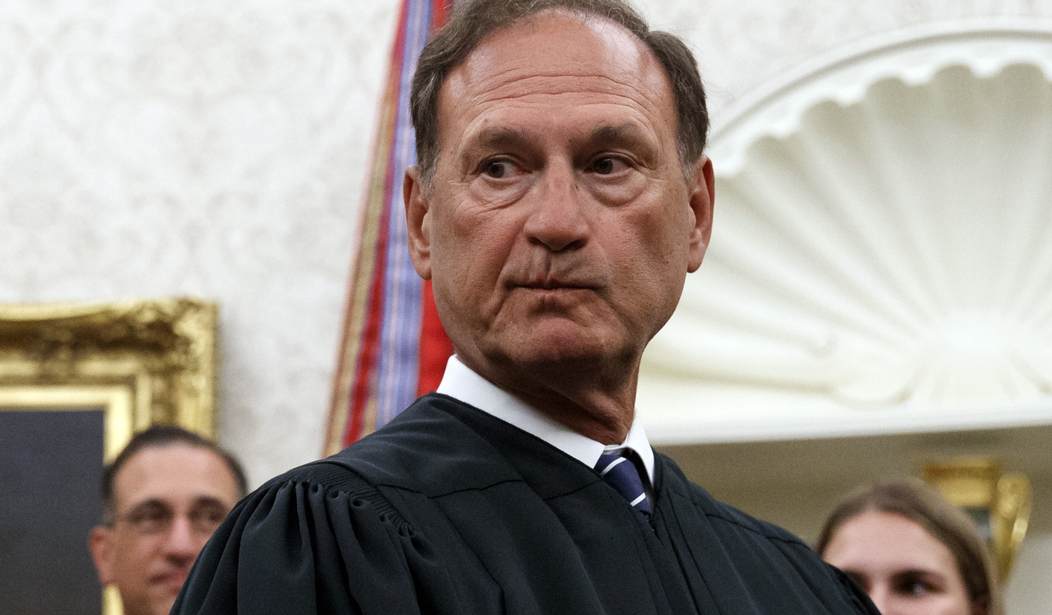
You'll notice that the Constitution provides that judges shall be compensated for their services. But what about just plain keeping the lights on? Might the incoming, Democrat-controlled 120th Congress turn off the lights over at the Supreme Court? Justice Samuel Alito is warning about that possibility, and that's something that should concern all of us.
Supreme Court Justice Samuel Alito Jr. on Thursday warned that Congress could defund the high court, hamstringing its ability to carry out its operations, The Hill reported.
"Congress can turn off the lights at the Supreme Court and stop everything from happening if they want to defund their activities. And there are many, many, many other things that they can do, or at least try to do," Alito said during remarks at the Federalist Society's Antonin Scalia Memorial Dinner, the outlet reported.
"So, it is important to preserve the independence of the judiciary," he reportedly said. "If that is eliminated, then the Constitution as adopted in 1789 will no longer be the same."
Many things the incoming Democrats seem inclined to try, such as making an end run around the Electoral College, seem intended to erase or at least dramatically reduce the Constitution. They also intend to change the Supreme Court by adding four, six, eight, or more new justices, ones who would be spinelessly compliant with the Democrat Party agenda.
This would dramatically change the country as we know it, and Justice Alito has also expressed concern that candidates have already made themselves known by making decisions based on politics, not the law.
Alito indicated that lower-level judges have at times handed down "unjustified" orders obstructing the policies of presidents during recent years, The Hill reported.
"They are dedicated, and they are skillful, but they're not perfect, and they make mistakes," he said, according to the report. "And in some instances, I think they have gone far astray in abuse of their powers."
Of all that, it seems the most alarming one is the notion that Congress may simply yank the Supreme Court's funding. That seems unlikely; it would be a major constitutional upset, wherein the Supreme Court justices would be paid as the Constitution requires, but their staff, their communications, and the utilities of their work spaces would not; they would be, literally and figuratively, working in the dark. That seems a radical move. That, on the surface, seems wildly unlikely.
But Justice Alito is worried about it. And his worries come on the heels of two of his colleagues making an unusual visit to Congress to talk about the high court's funding.
Two of Alito’s colleagues — Justices Elena Kagan and Amy Coney Barrett — made a rare visit to Capitol Hill over the summer to advocate for increasing the judiciary’s budget and increased security funding in the wake of rising threat levels.
Just as with their efforts with regard to the constitutionally-defined method of electing presidents, the new Democrats seem determined to fundamentally change our republic, to ensure that they are never, ever in the minority again. Many of them seem determined to do whatever it takes to reach that goal. And if you want an example of what Democrat supermajority rule is like, just look at California. For the next two years, President Trump still has veto power over budgets, and that's a considerable stick to shake.
But after that?
Editor's Note: Do you enjoy RedState's conservative reporting that takes on the radical Left and woke media? Support our work so that we can continue to bring you the truth.
Join RedState VIP and use promo code FIGHT to receive 60% off your membership.


Join the Conversation
VIP members get the ability to comment on articles.