






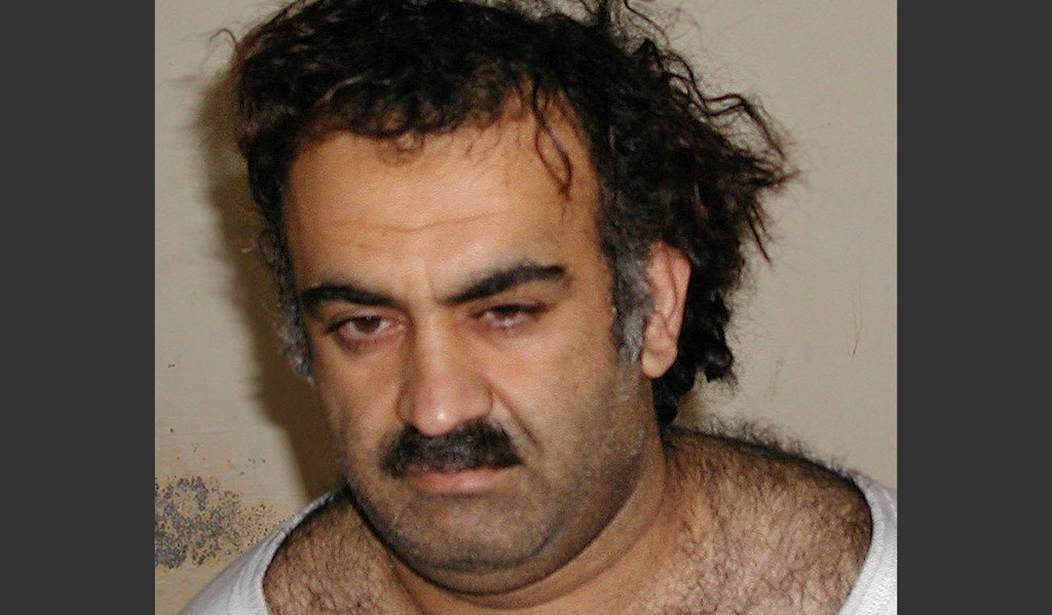
Khalid Sheikh Mohammed, the accused plotter of the infamous September 11, 2001 World Trade Center and Pentagon attacks, has just been handed a small but significant legal victory in his long, drawn-out military trial. Yes, it's been 25 years now that this goblin has been living in Gitmo (Guantanamo Bay) as this all works through.
In the latest, on Friday, a military judge threw KSM's confession out of evidence, blaming coercion on the part of CIA interrogators.
In a major blow to the U.S. case against Khalid Shaikh Mohammed, the man accused of plotting the Sept. 11 attacks, a military judge ruled on Friday that the prisoner’s confessions to F.B.I. agents were not voluntary and cannot be used against him at trial.
Prosecutors have described Mr. Mohammed’s interrogations in 2007 at the U.S. Navy base in Guantánamo Bay, Cuba, as the government’s most crucial evidence in the long-running death-penalty case.
But his confessions have always been challenged because the government used torture to question him in secret C.I.A. prisons years before he was charged.
The ruling, just before the 25th anniversary of the attacks, could further delay the start of a trial if prosecutors decide to appeal to reinstate it. Aging survivors and families of victims have said they worry they may never see a final resolution to the case.
It's been 25 years. It's not at all unlikely that KSM may well die of natural causes in Gitmo before he can be convicted.
Here's more from the judge's 45-page ruling:
...[T]he trial judge, Lt. Col. Michael Schrama, went further, concluding that Mr. Mohammed’s subsequent interrogations in 2007 at Guantánamo were also inadmissible.
...
Colonel Schrama cited several factors, including an “unbroken continuation of the C.I.A.’s psychological conditioning and severe coercion” at the time of Mr. Mohammed’s questioning at Guantánamo in 2007.
He also found that F.B.I. agents intentionally failed to explicitly tell Mr. Mohammed that he had a right to be silent and to consult a lawyer, and that what he told them could be used against him at a trial.
He ended by writing, “The prosecution has failed to prove by a preponderance of the evidence that Mr. Mohammad’s statements to the F.B.I. were voluntarily given.”
The NY Times said the judge's order "was not immediately released to the public but whose unclassified contents were confirmed by several lawyers who had seen it."
Currently, the trial is set to begin in almost two years.
Just this week, the judge set a trial date of June 5, 2028.
Mr. Mohammed is accused of being the mastermind of the hijacking attacks that killed nearly 3,000 people in New York, Pennsylvania and the Pentagon.
He was brutally interrogated by the C.I.A. in the overseas prisons after his capture in 2003 and held incommunicado until his transfer to Guantánamo in 2006. Prosecutors excluded statements from those interrogations, which included 183 rounds of waterboarding, from the case.
But the trial judge, Lt. Col. Michael Schrama, went further, concluding that Mr. Mohammed’s subsequent interrogations in 2007 at Guantánamo were also inadmissible.
“The prosecution has failed to prove by a preponderance of the evidence that Mr. Mohammad’s statements to the F.B.I. were voluntarily given,” Colonel Schrama wrote in the conclusion of his 45-page ruling, which was not immediately released to the public but whose unclassified contents were confirmed by several lawyers who had seen it.
A piece in The New York Post has some reactions from a family member of one of the 9/11 victims.
Victims’ families have long feared that Mohammed and his alleged fellow 9/11 plotters could die behind bars at Guantánamo Bay before being found guilty in a court of law.
“We have been asking for a trial date for 20 years. Hopefully, this time it is for real,” retired NYPD officer Jim Smith, whose wife Moira Smith died responding to the attacks, told The Post earlier this week.
Twenty-five years is a long time to wait for resolution in something like this. The families of the victims are awaiting, at least, a trial. This isn't necessarily a permanent setback for the prosecution, of course; people are convicted without a confession all the time. But while the families wait, the legal wrangling goes on.
The chief U.S. prosecutor, Rear Adm. Aaron C. Rugh, said his team would review the ruling “and will make a decision on whether to appeal in the near future,” the NYTimes reported, adding that "under the rules, prosecutors have five days to decide whether to appeal but can request an additional five days."
Stay tuned.
Editor's Note: Do you enjoy RedState's conservative reporting that takes on the radical Left and woke media? Support our work so that we can continue to bring you the truth.
Join RedState VIP and use promo code FIGHT to receive 60% off your membership.


Join the Conversation
VIP members get the ability to comment on articles.