








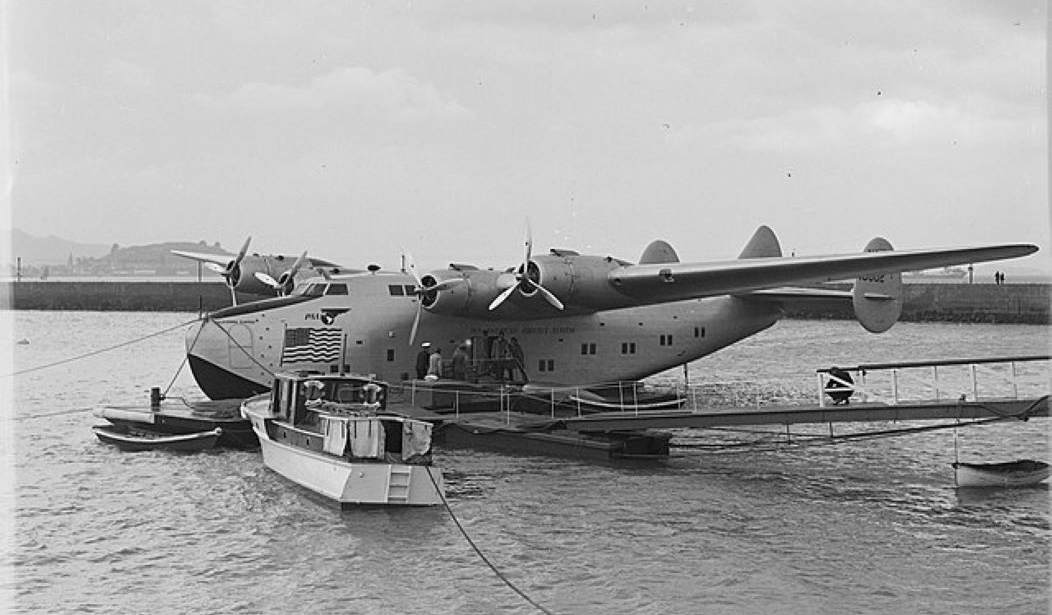
The idea of a plane that can land on and take off again from water isn't a new thing. Landing on water is easy, but it's taking off again that's the trick, which is why flying boats, as they came to be called, were a common thing back before the country was so liberally dotted with airfields. The United States and other countries made heavy use of them, right up through the Cold War. But the idea goes back to the very beginnings of powered flight. There are two basic designs: a small airplane fitted with floats instead of wheeled landing gear, and a larger model where the fuselage itself is, essentially, a boat with wings. Most of these used in military applications are of the latter sort.
In World War II, the U.S. Navy made good use of the Consolidated PBY Catalina and the Martin PBM Mariner. They were ideal for the far-flung Pacific theater, for patrol and reconnaissance, transporting VIPs, and hauling cargo. They were versatile and had good range, but they were slow and vulnerable to enemy fighters. The last flying boat used by the United States Navy was the Martin P5M Marlin, and it was retired in 1967. The Coast Guard continued using the Grumman HU-16 Albatross until 1983.
Which brings up the notion: Would a new, modernized flying boat be useful today? Mind, we wouldn't have to build one. Our Pacific ally Japan already makes one, the ShinMaywa US-2. Task & Purpose's Kyle Gunn recently made the case for the United States Department of War buying some of these.
United States Pacific Command is made up of over one hundred million square miles of territory, which is over half the Earth. The majority of that is water. This puts a premium on land, especially airfields. Despite technological leaps that make crossing thousands of miles faster, and arguably easier, aviators still face some of the same hurdles today as they did back in World War II.
As leaders plan for a potential fight in the region, new doctrine like the Marines’ Expeditionary Advanced Base Operations and the Army’s Multi-Domain Operations all consider the challenge of maintaining logistics for small and dispersed teams in austere conditions, with little infrastructure for traditional cargo aircraft or watercraft.
The situation looks even more dire when you consider that existing airfields and ports would be high-value targets in the opening moments of a conflict, further complicating logistics.
There is an advantage in having a good-sized aircraft that can land on water. But there are some pretty serious cons in this notion. Were the United States facing a near-peer conflict, seaplanes would be very vulnerable indeed in contested airspace, perhaps even more so than in 1941-1945. They are slow and cumbersome. But they can land on a lake, a large river or a lagoon, and perhaps more importantly, they can take back off again. In a theater like the Pacific, a flying boat could be very useful back in the logistics zone. A flying boat would also be a great search and rescue craft for oceanic environs, and indeed the PBY and PBM did a lot of that in both the Atlantic and Pacific in World War II.
The Japanese US-2 has some things going for it as well.
The US-2 is built by ShinMaywa Industries with a design lineage going back to the Albatross the Coast Guard flew. It has a 2,900-mile range, can fly as fast as 330 miles per hour, go as high as 30,000 feet, and only needs about 900 feet of water to take off and about 1,100 to land. The most remarkable trait the US-2 possesses is that it can fly as slowly as 55 miles per hour, thanks to a fifth engine that runs a compressor to blow air over the control surfaces. It can also operate in waves as high as 10 feet, which is a third of the aircraft’s height.
Most importantly, though, it is flown by Japan’s Maritime Self-Defense Force, and U.S. service members have trained alongside the aircraft. A small U.S. fleet would help solve several of the problems that planners are facing in the Pacific theater, and Japan has also started opening up its defense industry to more exports.
That's all good, logistically, especially in the Pacific, where in any major conflagration we may well be fighting alongside Japan.
A seaplane would be sort of the Swiss Army Knife of oceanic aviation. They can land and take off anywhere there is sufficient water, and the US-2 only needs about 1,000 feet of open water. It's not fast, and it's not sleek, but it is versatile and could be useful for a wide range of purposes.
It might be worthwhile for the Department of War to take a good long look at this aircraft. Having at least a few of them around doesn't seem like a bad idea.
You can see Mr. Gunn making his own case for the seaplane here.
Editor's Note: Thanks to President Trump and War Secretary Pete Hegseth's leadership, the warrior ethos is coming back to America's military.
Help us continue to report on Trump and Hegseth's successes as they make our military great again. Join RedState VIP and use promo code FIGHT to receive 60% off your membership.


Join the Conversation
VIP members get the ability to comment on articles.