
How many Americans, especially those in the younger generations, know of the significance of this date: August 14th, 1945?
The day this was written, August 14th, 2026, marks the 81st anniversary of the day the American people were informed of the unconditional surrender of the Empire of Japan, the act that ended World War II. The most destructive war in modern history was over. Millions were dead. Property damage was incalculable. The damage and the loss reached into every corner of the world. This was the first war since 1812 where enemy troops stood on American soil, an event that has not happened since.
On this day in 1945, all of that was officially ended. Like Pearl Harbor, the event that drove the United States to finally enter the war, many Americans who were alive on that day know all too well where they were and what they were doing when they heard the news.
My mother was working in a shoe store in Independence, Iowa. She was 16 years old, and when the announcement came over the radio, the main drag of that town erupted in cheers.
Mom's older brother, a Marine, was on a hospital ship, recovering from sepsis that resulted from his taking a Japanese bayonet through the shoulder on Iwo Jima. Mom's younger brother was in Europe, that war having ended, wondering if he'd be sent to the Pacific. My Dad's older brother was in a hospital with severe head injuries from a German 88mm shell fragment, in a coma, with his survival doubtful; he did survive, although gravely hurt, and he lived until 1995. Dad was in Victorville, California, checking out as a navigator in the B-29 in preparation to be sent to the Pacific, a deployment that never happened.
All around the United States, families breathed a sigh of relief. It was over. All those sons, husbands, fathers, all would be coming home. There was, at last, peace.
The war didn't end on the snap of some fingers. There were still attacks and actions after the official notice of surrender.
Even though Japan’s War Council, urged by Emperor Hirohito, had already submitted a declaration of surrender to the Allies via ambassadors on August 10, fighting continued between the Japanese and the Soviets in Manchuria and between the Japanese and the United States in the South Pacific.
In fact, two days after the Council agreed to surrender, a Japanese submarine attacked the Oak Hill, an American landing ship, and the Thomas F. Nickel, an American destroyer, both east of Okinawa.
The fog of war, perhaps? During the American Civil War, fighting went on for some time after General Lee's formal surrender at Appomattox Court House; of course, Lee was only surrendering the Army of Northern Virginia, and fighting continued in the west for some days after that.
We should note, though, that there were powerful people in Tokyo who opposed the surrender. Some of them were willing to take up arms against their own government to resist the capitulation. In fact, there was even an attempted insurrection in Tokyo, where troops who wanted to continue the fight actually attacked the Imperial Palace.
On the afternoon of August 14, Japanese radio announced that an Imperial Proclamation was soon to be made, accepting the terms of unconditional surrender drawn up at the Potsdam Conference. That proclamation had already been recorded by the emperor.
The news did not go over well in Japan, as more than 1,000 Japanese soldiers stormed the Imperial Palace in an attempt to find the proclamation and prevent its being transmitted to the Allies. Soldiers still loyal to Emperor Hirohito repulsed the attackers.
That evening, General Korechika Anami, the member of the War Council most adamantly against surrender, committed ritualistic suicide by seppuku. His reason: to atone for the Japanese army’s defeat, and to be spared having to hear his emperor speak the words of surrender.
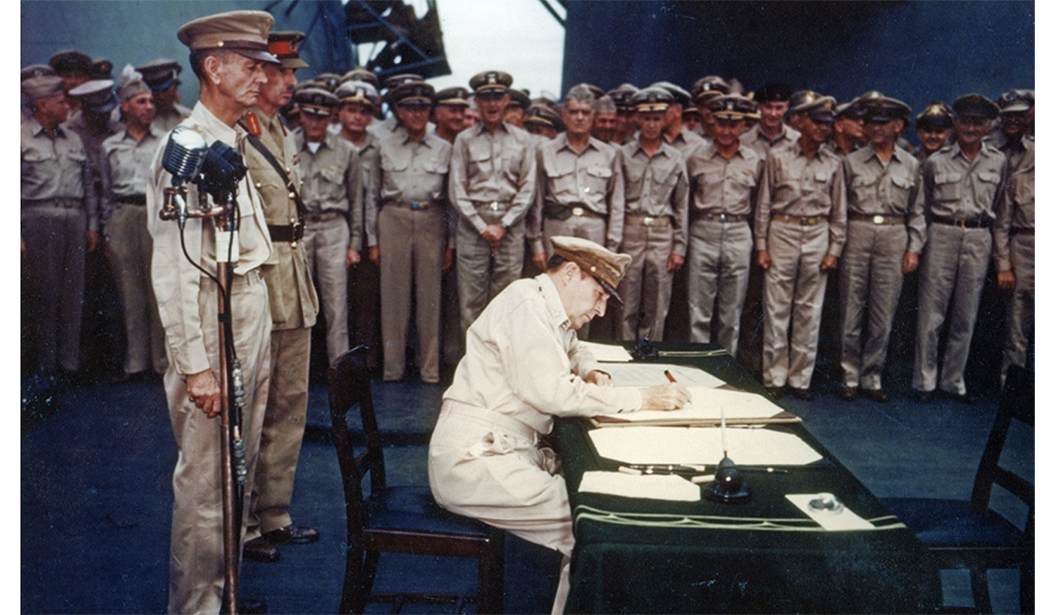
Then, on the 2nd of September, 1945, on the deck of the battleship USS Missouri, in Tokyo Bay, the official surrender was signed.
It was over. The greatest of all modern wars was ended.
There's an old saying that applies: Nations have no permanent friends, only permanent interests. Japan, in the post-war years, did one of the most amazing turnabouts in modern history, turning from a heavily militarized culture to a much more pacifistic one. Limited to only a self-defense force, for many years Japan enjoyed a peace protected under treaty by the United States. In that time, the Land of the Rising Sun became a new nation: A manufacturing and high-tech powerhouse, and America's best friend in the northern Pacific. What's more, due to the increasing bellicosity of North Korea and China, Japan is also remembering that they have a great martial tradition, and they are starting to dial their military back in. That's not a bad thing; modern Japan is nothing like the Japan of 1941, and there's no chance of them suddenly going on a conquest spree again. But should China or North Korea set their sights on Japan, they may find Japan to be a tough nut to crack.
I've spent a fair amount of time in modern Japan myself, and while we couldn't live there for good, my wife and I have grown very fond of Japan. Even so, even with Japan's turnabout after the war, bad feelings persisted; my uncle, the Marine I described above, would until he died refer to the Japanese only as the "G.D. Japs." And, honestly, the behavior of the old Japan, the militaristic Empire of Japan, warranted that epithet.
That war ended, and the American people learned of it 81 years ago today. But as we have seen since, George Santayana's caution, then as now, applies: "Only the dead have seen the end of war."