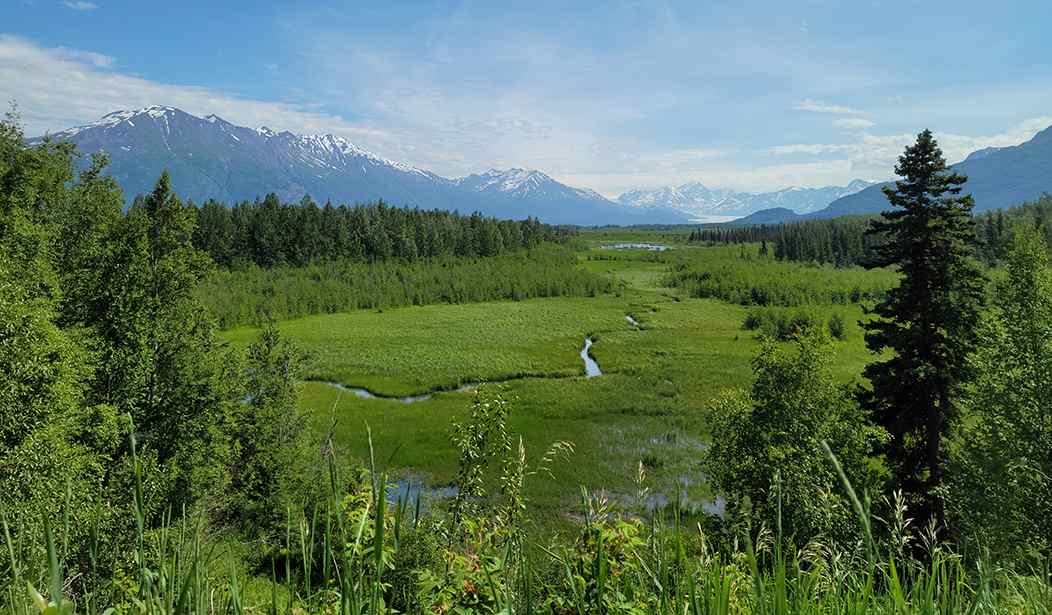

Most folks love trees. Trees give us oxygen; they beautify our surroundings; they give us timber for our homes and furniture and firewood to keep us warm. Living as I do on the edge of that great circumpolar forest, the taiga, known as the Great North Woods, I have a particular affection for the poplar, birch, and spruce that surround our home. I spend a fair amount of time wandering around in those woods. Oh, I call it "hunting" or "fishing" to lend the rhetorical appearance of purpose to my woods-bumming, but mostly I just like being out in the woods. In this I find I have a lot of company.
But there's a big difference between liking trees, enjoying the woods, and even passing laws regulating our take of trees so there will be trees remaining for future generations, in an act called "forestry," and the lunatic notion that trees can have "rights." Trees, like non-human animals, don't have rights; they can't have rights. The very notion is nonsensical.
And yet that's precisely what a town in Quebec is trying to do.
Terrasse-Vaudreuil, a town of about 2,000 people just west of Montreal, adopted a resolution on June 9 to sign the Universal Declaration of Tree Rights.
The declaration was launched in 2018 in response to worldwide deforestation and the perception of trees as nothing more than objects and a resource to be extracted by humans.
Its stated goal is to 'recognize the Tree as a sentient living being, a source of Life and a common good of humanity.'
A 2019 petition in support of the declaration had garnered just shy of 88,000 signatures, and Terrasse-Vaudreuil's adoption of its principles marks the first public entity in North America to sign on as well.
And the last, if there's any sense left in Canada and the rest of the known world.
Rights are, after all, not something that can be granted by any government at any level. They are inherent. Every living human on the planet has certain inalienable rights, although some governments illegitimately deny those rights. Our natural rights represent something which governments, comprised of humans, cannot (or should not) interfere with.
But all of the moral claims and actions required to exercise those rights can only be made by, and can only apply to, humans. Trees cannot exercise any such claim; only humans can make those claims.
Read More: Disastrous Oregon Animal Rights Measure Fails to Make Ballot
Gun Rights Victory: New Jersey Assault Rifle and Magazine Ban Declared Unconstitutional
Here's the problem. While this town in Quebec may claim that its local trees may benefit from the extension of some variation of the human concept of rights, the fact remains that the only results will affect humans. Only human behavior will be affected. Only humans will be able to bring any claims against anyone perceived to be violating those "rights."
Any policy changes made will only affect human society; the consequences imposed for infractions will only affect human behavior. A tree cannot make a moral or legal claim against a man wielding a chainsaw. This lunatic resolution places no obligations on trees, nor does it open up any recourse trees may take against humans. That onus of responsibility is placed only on humans.
One good definition of a "right" is derived from Immanuel Kant's emphasis on the universal human possession of a uniquely moral will and the autonomy the use of such will entails. (Kant, one might note, was a strong advocate of constitutional republics as the governing system best suited to peace and prosperity.) Humans and only humans confront purely moral choices. Humans and only humans lay down moral laws, for others and for themselves. Humans and only humans are self-legislative and morally autonomous. That in and of itself entails moral agency. What humans possess as a matter of human nature, no tree can be said to have at all.
That's the huge, glaring flaw in what the people of Terrasse-Vaudreuil are trying to do here.
Terrasse-Vaudreuil has promised to abide by the three fundamental principles of the Universal Declaration of Tree Rights. The first principle states: 'The Tree, a sentient living being and source of Life, is a common good of humanity.'
The second principle states: 'Life on Earth depends upon the existence of the Tree.'
And the third states: 'Human beings, endowed with reason and conscience, must act with the Tree in a spirit of fraternity and solidarity.'
Let's pick that apart, piece by piece:
The first principle is essentially content-free. It's a massive example of belaboring the obvious, with one exception: Trees are living beings but there is no evidence they are in any way sentient or self-aware. That's the first glaring flaw.
The second principle also falls under belaboring the obvious, although to attain any biological accuracy, one would have to substitute "plant" for tree. Yes, the food webs require producers. Again, this is essentially a content-free statement.
It's that third statement that really founders on the rock of reality. Note the wording: All of the onus is placed on humans. They acknowledge that only humans have reason and conscience. Only humans have moral agency. Only humans have a moral claim to natural rights. And, saving the worst for last, trees cannot act. They cannot adhere to any "spirit of fraternity and solidarity." This is one of the greatest outpourings of downright poppycock I have ever seen; and I spent years debating animal rights nuts, in person and in writing. This town in Quebec has sunk to new lows of nitwittery that, until now, I wouldn't have thought possible.
In the end, this action by this small Quebecois town of Terrasse-Vaudreuil is, as Shakespeare would have it, a tale told by an idiot, full of sound and fury, signifying nothing.