








I've been writing and talking about what I call the Great Sorting for some time now. This is pulling the nation into two opposing camps: Business-friendly, prosperous, free, conservative, and business-hostile, floundering, restricted, and "progressive," or increasingly (I'm looking at you, New York City) outright communist. This has economic and political implications, and it's largely the latter driving the former.
It's affecting red states and blue states. On Saturday, I wrote about how California is losing the Great Sorting, and badly. That failure may be laid squarely at the feet of their political leadership.
Read More: California Fail: Why the Once-Golden State Is Losing the Great Sorting
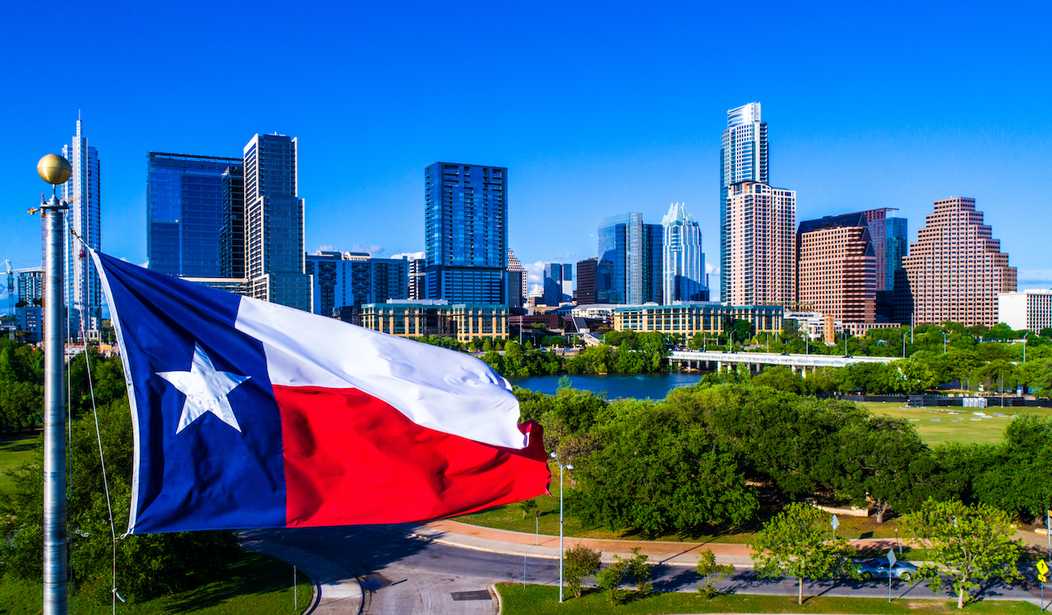
Now, here's the other side of that coin: Texas, which is becoming the land of boom-towns.
The race to become America's next economic heavyweight may already have a frontrunner.
The latest Internal Revenue Service (IRS) migration data show billions of dollars in taxpayer wealth flowing into Texas, while Census figures show the state's largest metropolitan areas continue to outpace much of the country in population growth, strengthening a decades-long shift in America's economic center of gravity.
What's more, Texas isn't relying on a single boomtown. Dallas-Fort Worth added more residents than any metropolitan area in the country over the past year, while Houston, Austin and San Antonio also ranked among the nation's fastest-growing metros.
That unusual breadth gives Texas multiple engines of economic growth, providing businesses with larger labor pools, diversified industries and a broader customer base than states anchored by a single dominant city.
There's a key term in there: Economic center of gravity. Dallas/Ft. Worth, Houston, Austin and San Antonio are replacing Los Angeles, San Francisco, Chicago, New York and their blue-state brethren in being that center of gravity, and that's only going to continue. There's a lesson in that for anyone paying attention.
"Capital follows where there is confidence," Texas Association of Business Chief Policy Officer Gabriela von zur Muehlen previously told Fox News Digital. "And right now there is a tremendous amount of confidence in Texas."
Von zur Muehlen said Texas' tax structure and predictable regulatory environment continue to attract businesses and investment from other states, helping reinforce the state's economic momentum.
It's not often one can honestly say, "...and it was as simple as that."
Read More: True Value Leaving Chicago After 78 Years, Blaming Illinois
Red States Crush Blue States: Incomes Now Up 40 Percent Faster Since 2000
The theory is simple, that is. Lower taxes. Lower, sensible regulations. Reward success, not failure. The application is a little more difficult, and the question is, can the blue cities reverse course now, at this late stage? Texas and Florida have already stolen a long march on the blue states. The Great Sorting sure looks to be accelerating. Sooner or later, things are going to have to change.
That, of course, is up to the voters. There are still conservative voters in California; some of them are my friends and colleagues. It's the middle of the road, the independents, who have to be convinced, and California's Democratic super-majority in the state legislature seems determined to continue operating under the old notion of continuing the beatings until morale improves.
To encourage enterprise, job creation, and prosperity, the best thing the government, any government, can do is to stay out of the way, to the greatest degree possible. Texas seems to have figured that out. California politicians could do a lot worse than to study their example.
Editor's Note: Do you enjoy RedState's conservative reporting that takes on the radical Left and woke media? Support our work so that we can continue to bring you the truth.
Join RedState VIP and use promo code FIGHT to receive 60% off your membership.

Join the Conversation
VIP members get the ability to comment on articles.