
In 1968, I was just a little kid, but I was raised in an outdoor tradition. My parents were involved in our local Audubon Society, back when the Audubon Society was about birds and not climate activism. We did nesting and migrating bird counts every spring and fall, and I was raised to take pride in our efforts to help further our understanding of wild birds, as well as all the critters we shared our environment with.
In that year, I remember my parents both read Paul Ehrlich's famous, later notorious book, The Population Bomb. I remember them talking about it at the time - vaguely - but in later years, I remember both of them expressing a great deal of skepticism. Ten years after the publication of Ehrlich's work, it was already becoming apparent that he had overblown his predictions - that is, the ones that were not just flat wrong.
Now, to be simply human for a moment: This recollection was prompted because, on Friday, Paul Ehrlich passed away at age 93. Whether or not we agree with his work and his (mostly wrong) conclusions, he was a human being with a family who loved him, and we extend our sincere condolences to them in this time of their grief.
But science, the scrupulous examination of data and of concluding that data, prompts a new look at Paul Ehrlich's predictions and how they have held up over time. Dave Burton, writing at one of my favorite climate/environment sites, Watts Up With That, has some interesting observations.
First, on the primary topic: Population and famine.
When Ehrlich wrote his book, in 1968, the world’s human population was between 3.5 and 3.6 billion people. Today it is over 8 billion. Yet famine deaths, which were common when Ehrlich wrote his book, have become rare, as population and CO2 levels have risen:
Here's the chart:
— Ward Clark (@TheGreatLander) March 17, 2026
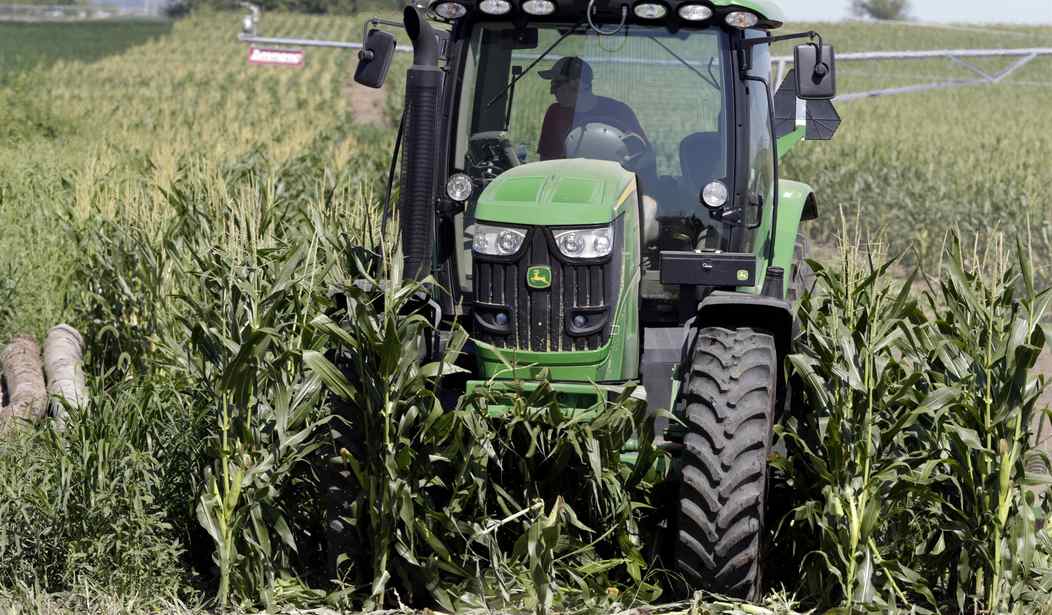
It’s mainly because crop yields have risen even faster than population:
And here's that chart.
— Ward Clark (@TheGreatLander) March 17, 2026
What is helping this sudden increase in crop yields? Several things, one of which is, yes, a slight increase in carbon dioxide - CO2 - which increases plant growth and crop yields. But there's more. As I'm continually pointing out, we solve today's problems with tomorrow's technology, and agricultural practices and tech have come a long way even since Ehrlich published his work in 1968.
Read More: Will the Population Bomb Turn Out As a Dud?
Major Legacy Media Outlet Dumps Climate Doom Squad: End of the Alarmist Era
And it turns out that CO2 has more effects on plant growth other than photosynthesis, as many studies have shown:
Elevated CO2 not only benefits crops by CO2 fertilization, it also improves water use efficiency & drought resilience of crops, through reduced stomatal conductance. Here are some papers about it:
De Souza, A.P. et al. (2015). “Changes in Whole-Plant Metabolism during the Grain-Filling Stage in Sorghum Grown under Elevated CO2 and Drought.” Plant Physiology, 169(3), Nov 2015, 1755–1765. https://doi.org/10.1104/pp.15.01054
Fitzgerald GJ, et al. (2016). “Elevated atmospheric [CO2] can dramatically increase wheat yields in semi-arid environments and buffer against heat waves.” Glob Chang Biol. 22(6), 2269-84. https://doi.org/10.1111/gcb.13263
Chun, J.A. et al. (2021). “Effect of elevated carbon dioxide and water stress on gas exchange and water use efficiency in corn.” Agricultural and Forest Meteorology, 151(3), 378–384, ISSN 0168-1923. https://doi.org/10.1016/j.agrformet.2010.11.015
Yep, those are all peer-reviewed scientific studies. The climate scolds and doomcryers insist on peer-reviewed studies, yes? Here they are.
It gets better. There are, broadly, two photosynthetic processes, known to botanists as C3 and C4 photosynthesis. Corn and sorghum use the C4 process, but most human food crops are C3 plants, and those actually fare even better in an atmosphere with more CO2. Trees, too, are C3 plants, and they, too, are contributing to the greening of the world. Here's another peer-reviewed study demonstrating that:
Idso & Kimball (1994). “Effects of atmospheric CO2 enrichment on biomass accumulation and distribution in Eldarica pine trees.” Journal of experimental botany. 1994 Nov., v. 45, no. 280 p.1669-1672. (preprint here)
But, dire predictions of climate scolds aside, it's fossil fuels that have made the greatest difference. Synthetic nitrogen fertilizers, made from natural gas, have super-charged crop yields. There's more; our use of fossil fuels has enabled the mechanization of agriculture, making every process, from planting to harvesting, more efficient and more conducive to increasing scale. Pesticides also increase yield, reducing losses ranging from insect/nematode losses in the field to rodents and other pests in storage. Pesticides, too, are largely produced from petrochemical precursors.
All of these things proved Paul Ehrlich and his early work, simply, wrong. There have been no horrendous global famines, as he predicted. His conclusions were wrong. He was wrong.
Environmental extremists, most of whom have little experience with the environment, as well as climate scolds all still cling to Paul Ehrlich's work. That's not surprising; he was one of the founding fathers of the environmental/climate movement, a movement which, in 1968, had some legitimate points where things like industrial pollution and air quality were concerned, not to mention just plain ordinary litter. But those problems have been addressed. Our air, land, and water in the United States are cleaner than they have been since before the Industrial Revolution. Agriculture is more efficient and productive than ever. Not only is nobody starving, but the biggest health problem among poor people in the Western world is obesity.
Science requires a scrupulous examination of facts, and when new facts, new data, arise, then conclusions often change. Ehrlich and his cohort weren't able to do that. Fortunately, facts always win through in the end.