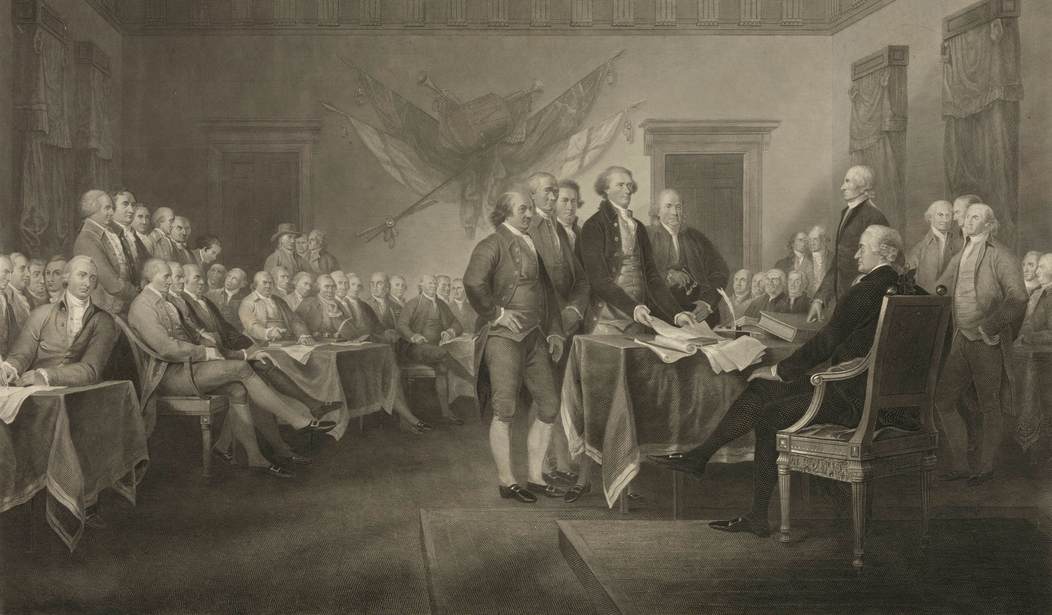

This year, we Americans celebrate our semiquincentennial, the 250th anniversary of the Declaration of Independence, in which we announced our intention to break away from the iron grip of the most powerful empire in human history at that time. The King demanded we return to the fold. The American people told him where to head in, and after a grueling war for independence, the United States of America was born. We have now taken the British Empire’s place as the most powerful nation on the planet, the most powerful nation in human history.
As we near the 4th of July, the date on which the Declaration of Independence was signed in 1776, we’ll be looking at and reading about the events that led up to that day, and what happened afterwards. We’ll be remembering the people involved: American heroes, like George Washington, John Adams, Thomas Jefferson, Benjamin Franklin, Paul Revere, Sam Adams, and more. But I’d like to take a look at some of the lesser-known but no less committed figures who contributed to our fight for freedom.
Read More: Unsung Heroes of the Revolution I: Thomas McKean
One of those, a signatory of the Declaration of Independence, carries a name that is still famous in Maryland today, a name that’s found in my wife’s family tree, coming all the way from that notable from 1776, Charles Carroll.
Charles Carroll was born in September of 1737, in Annapolis, Maryland, to Charles Carroll and Elizabeth Brooks. He was the only surviving son of the Carrolls, a wealthy couple who were heads of one of Maryland’s most prominent Catholic families. Charles would go on, in fact, to be the only Catholic signatory of the Declaration of Independence. At the time, Catholics in the colonies were restricted in some surprising ways, including in college admissions, so young Charles went to France to study at Jesuit schools. He read law there, earning a law degree and learning to speak several languages. He spent time in London, and there saw for himself the attitudes of the British towards the distant colonies, which were, at that time, less than complimentary. Charles returned home at 28 years of age; he found the increasing alienation reciprocated by the colonists.
“Gentlemen, set fire to the vessel and burn her, with her cargo, to the water’s edge.”
Read More: It's OK to Love Our Exceptional Country: Reagan Library's Powerful 'America 250' Exhibit Says It All
In 1776, he found his Catholicism no longer mattered in the eyes of his fellow men, and he was elected to the Continental Congress. He actually signed the Declaration of Independence after the fact, as he didn’t reach Philadelphia until well after July 4th. He would remain in the Continental Congress until 1778.
Here’s the interesting thing: Charles Carroll, of Carrollton, Maryland, was one of, if not the, wealthiest men involved in the founding of our republic. As such, he perhaps had the most to lose, should the revolution fail; he would not only have lost his property and his fortune, but also likely his life. Nevertheless, he tirelessly supported the cause, sinking much of his fortune and much of his time and energy to the effort. In 1776, he was part of a delegation sent by the Continental Congress to Quebec, where he tried (unsuccessfully) to enlist the aid of the French Canadians in the war with Britain. During his second term in the Continental Congress, he served on the board of war.
An interesting side note: on documents from the Revolution, Charles Carroll always signed “Charles Carroll of Carrollton,” as his father, Charles Carroll of Homewood, was still alive. That was a time when a case of mistaken identity could have been very bad.
After the Revolution was fought and won, Charles Carroll served as a United States Senator from Maryland from 1789 to 1792, under the new Constitution. He also served in the Maryland State Senate from 1781 to 1800. In 1800, he lost re-election and retired from politics, but he didn’t slow down any.
He broke down a lot of barriers, including many unfairly levied on his fellow Catholics. He invested heavily in the infrastructure of the new nation he helped create, in his later years sinking much of his considerable fortune in railroads, canals, and banks. He invested heavily in the creation of Georgetown University. And his lineage eventually led to my mother-in-law, and hence my wife.
Charles Carroll lived a long, long life, dying in 1832 at age 95. He outlived most of the other signatories of the Declaration of Independence. He outlived four of the first five United States presidents. He is immortalized, not only in the name of Carrollton, but also in Carroll County, and in one stanza of the Maryland state anthem, Maryland, My Maryland:
Maryland, My Maryland
Thou wilt not cover in the dust
Maryland! My Maryland!
Thy beaming sword shall never rust
Maryland! My Maryland!
Remember Carroll’s sacred trust
Good words. We should remember Charles Carroll, as we remember all the Founders, in this 250th year of the republic.