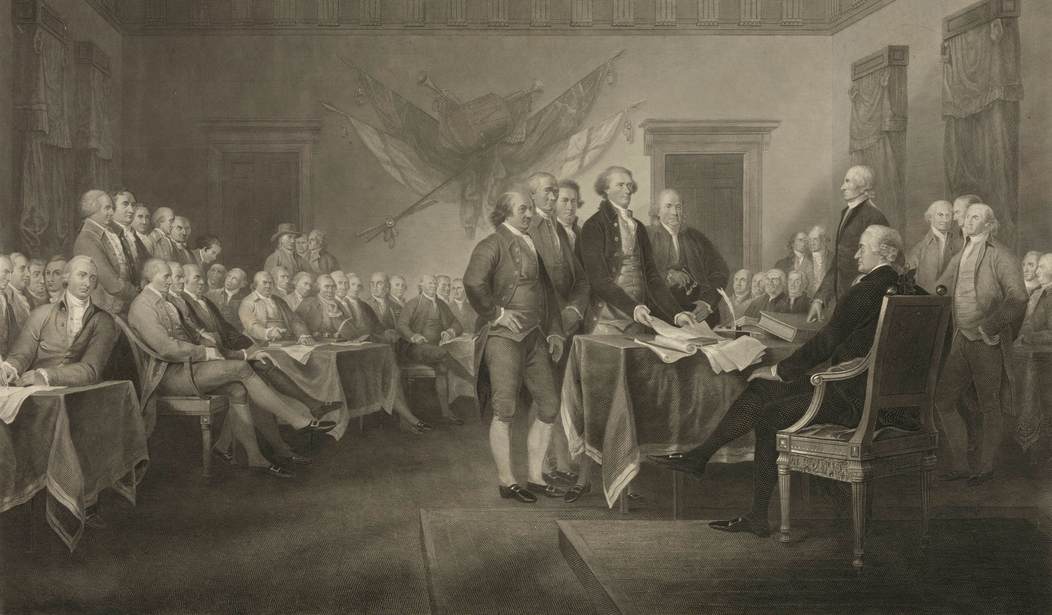

This year, we Americans celebrate our semiquincentennial, the 250th anniversary of the Declaration of Independence, in which we announced our intention to break away from the iron grip of the most powerful empire in human history at that time. The King demanded we return to the fold. The American people told him where to head in, and after a grueling war for independence, the United States of America was born. We have now taken the British Empire’s place as the most powerful nation on the planet, the most powerful nation in human history.
As we near the 4th of July, the date on which the Declaration of Independence was signed in 1776, we’ll be looking at and reading about the events that led up to that day, and what happened afterwards. We’ll be remembering the people involved: American heroes, like George Washington, John Adams, Thomas Jefferson, Benjamin Franklin, Paul Revere, Sam Adams, and more. But I’d like to take a look at some of the lesser-known but no less committed figures who contributed to our fight for freedom.
For this first installment, I’d like to introduce you to an ancestor of mine, one of the lesser-known signatories of the Declaration of Independence: Thomas McKean. This was a man who played several roles, not just in the Revolution but throughout his life. He was a colonel in the Continental Army, a delegate from Delaware to the Continental Congress, and a signatory not only of the Declaration of Independence but also of the Continental Association and the original Articles of Confederation. He was a president, in a way, before George Washington, being the second President of the Continental Congress in 1781 – in fact, he served in that role during the British surrender at Yorktown.
Read More: It's OK to Love Our Exceptional Country: Reagan Library's Powerful 'America 250' Exhibit Says It All
Thomas McKean was born in March of 1734, to William McKean and Letitia Finney. Thomas’s father was a farmer and innkeeper. He studied law in Delaware in a time when one didn’t do that formally; he learned the law by working with his cousin in Delaware. He was admitted to the bar in 1754, then went to London for more formal education, after which he returned to Delaware and started what would become a substantial practice.
He married twice. His first wife, Mary Borden, bore Thomas six children (!) before she died in 1773. Thomas then married Sarah Armitage, with whom he had five more children.
But it was during the Revolution that Thomas McKean made a name for himself, literally; McKean County, Pennsylvania is named for him. So am I, in fact; his last name is my middle name.
Thomas McKean had one interesting distinction: He managed to lead a sort of political double life, being simultaneously the representative of Delaware in the Continental Congress and the Chief Justice of the Supreme Court of Pennsylvania. Mind you, this was in the days when traveling between the two was a considerable journey on horseback, and yet he managed it for five years.
During the war, Thomas McKean was a colonel of Philadelphia’s Fourth Battalion of Associators and for a time, served directly under George Washington, although not much seems to be known now about the nature of that service, other than that at the time of the British surrender, he was back in Philadelphia. During the war, he also relocated his extensive family at least five times, stating at one point that he was “hunted like a fox by the enemy.” That wasn’t an uncommon fear among the Founders, who, had they lost, would very likely have been hanged for treason.
After the Declaration was signed – there are reports that Thomas McKean signed late, possibly as late as 1781, due to his army service - Thomas returned to his busy, two-forked political career.
It was in the realm of defining the shape the various states and the new nation would take that he played a larger role. He was an early proponent of a strong judiciary and was a key figure in developing the state constitutions of both Delaware and Pennsylvania. He didn’t attend the 1787 Constitutional Convention, but he worked with James Wilson to draft the Constitution, and it was Wilson and McKean who were in on the push to get the new Constitution ratified in Pennsylvania.
Read More: Reality Check: We Are a Republic, Not a Democracy
Finally, in 1799, he was elected Governor of Pennsylvania. There was some controversy over his having served two different states in two different functions before the war, and those tensions may have led to his abandoning the Federalist Party, although he returned to the Federalists when he needed their support to run for a third term as governor in 1805. And, like a certain political figure we know today, he managed to get past at least one impeachment attempt before retiring in 1808.
Thomas McKean died in 1817, aged 83, at the time only one of five remaining signatories of the Declaration of Independence, which we recognize now, on the 250th anniversary of that famous document.
Thomas McKean wasn’t a war hero. He was a self-taught man of ambition, one who skated close to the edge at times. But he was an American, and what is America known for, but for being ambitious people, people willing to risk big to win big? When the call for freedom came, Thomas McKean did what he was best equipped to do. And because of him and others like him, 250 years later, America is still here.