
Ted Turner's Legacy
"Therefore by their fruits you will know them." That's a pretty good reminder. We judge people by who they are, but also by what they do, what they leave behind. Medial moguls are no exception.
On Thursday, my friend and colleague Jennifer Oliver O'Connell brought us the news of the passing of Ted Turner, the founder of the Cable News Network (CNN), and the pioneer of cable news. CNN isn't what it was when Turner was running the show, but I remember watching it back in the day, when they still made a pretense of unbiased coverage. So, we remember Turner for changing the face of how we get our news, and that's a considerable accomplishment all on its own.
Read More: Ted Turner, the 'Mouth of the South' and CNN Pioneer, Dead at 87
But that's not the part of Turner's legacy that I'll remember. What I choose to remember is the two massive, sweeping American Civil War epics he produced: "Gettysburg" (1993) and "Gods and Generals" (2003). These are massive films, both over four hours long, and remarkable for several reasons, including the casting, the equipment and uniforms, the locations, and the overall tone of the movies.
Casting
The casting was mostly good. In "Gettysburg," with one notable exception, the casting was near perfect. Tom Berenger (despite a rather alarming fake beard) turned in a great performance as the Confederate General James "Dutch" Longstreet, perhaps second only to Jeff Daniels' excellent portrayal of one of my personal heroes, Union General Joshua Chamberlain. Stephen Lang was great as the flamboyant George Pickett, and Sam Elliot turned in a great performance in the first hour of the film as the Union cavalry commander, General John Buford. The only rather jarring casting decision was, from what I understand, a last-minute decision to cast Martin Sheen as General Robert E. Lee, and while his portrayal was adequate, he kept slipping in and out of Lee's Virginia accent throughout.
The casting in "Gods and Generals" was a little more mixed. Stephen Lang, in the second film, turned in a typically great performance as General "Stonewall" Jackson, but some of the other casting was only adequate. Jeff Daniels again turned in a solid performance as General (then Colonel) Chamberlain, although he was clearly heavier than in the first film. Bruce Boxleitner replaced Tom Berenger as Longstreet, and he was... OK. Ditto for replacing Lang with Billy Campbell as Pickett. But the great casting win in the second movie, aside from Stephen Lang as Jackson, was bringing in Robert Duvall to play General Lee.
Equipment and Uniforms
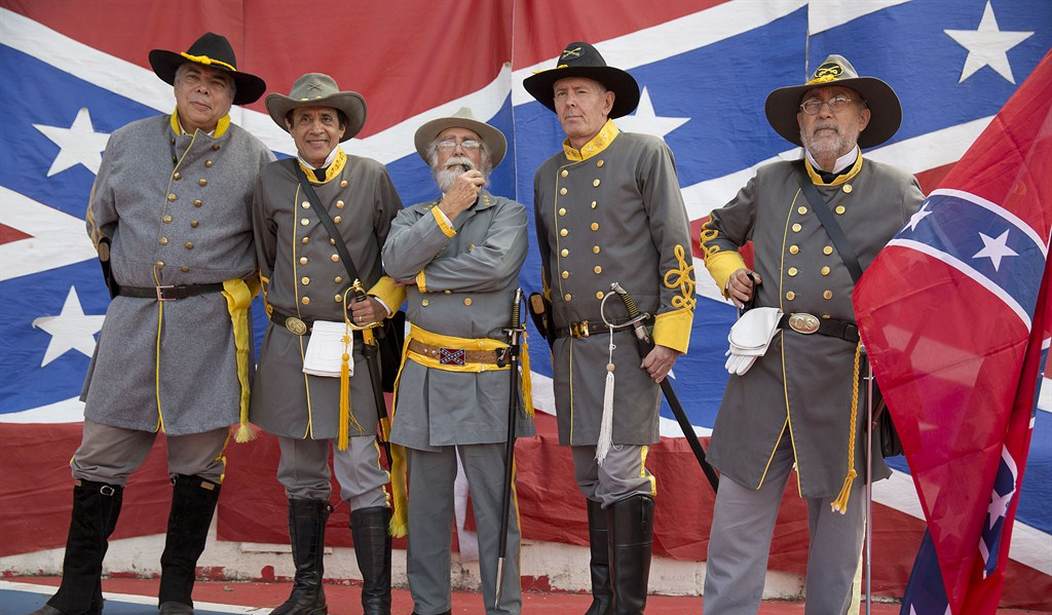
Here, Turner had a good idea: In staging the great battles, especially the last day's charge at Gettysburg, he relied heavily on re-enactment groups, who are notoriously fussy about the accuracy of their uniforms and equipment. One of the great scenes in Gettysburg was that famous charge, known often as "Pickett's Charge" even though Pickett commanded only one division of three, making the charge, and the charge was ordered by General Lee - over the vociferous and repeated objection of General Longstreet, who reportedly at one point pointed out, "No 12,000 men ever born could take that hill." He was proven tragically correct. But when Turner filmed the charge, he not only filmed the initial part of the charge on the actual ground, he actually assembled thousands of re-enactors to shoot what has to be one of the most epic, sweeping scenes in the history of cinema.
The second movie was a little more mixed. The uniforms and equipment were, again, accurate, but there weren't any such sweeping, epic scenes as in "Gettysburg."Locations
To the extent possible, Turner filmed on the original locations. Trouble is, those locations are, in large part, under the control of the National Park Service, and are today (rightly) populated with monuments to the history. Turner did manage some great location shots: The initial charge on the final day, "Pickett's Charge," in "Gettysburg" was filmed on the actual ground, although the close-in battle scenes were filmed elsewhere. The battle of Manassas, though, in "Gods and Generals," was filmed in the Shenandoah Valley, as the original ground now has placed monuments and so forth, making it unsuitable. Likewise, for the excellent portrayal of the Battle of Little Round Top in "Gettysburg," which at the National Park Service's request was filmed on similar ground some ways to the west.
Presentation: The Characters
This may be the best part of Turner's epic Civil War films. The characters, particularly the Confederate officers and men, were not comic-opera villains or cardboard cutouts, but men, and by the standards of their time, good men. General Lee was regarded at the time as a man of great honor and character, and he is portrayed as such. At the end of the first film, he is acknowledged, at present, to still be one of America's most beloved generals. Chamberlain is portrayed as a man of letters, with no military background, who went to war to fight for his country, and as in real life, he proved more than up to the task, going from college professor to regimental commander in a year. The issue of slavery comes up, but only in passing; Turner's emphasis is on the men, the armies, and the battles.
These are great films, well worth the investment in time - remember, both are over four hours long. And, sadly, they probably couldn't be made today, if for no other reason than that Turner didn't present the Confederates as comic-opera villains.
We look back on this time in American history right now with a mixture of wonder and apprehension. Our nation is again going through a difficult time; the population is self-segregating, tensions in these United States may well be higher than at any point since 1860.
Have we simply forgotten the lessons of our Civil War?
Read More: Fort Sumter? Tim Walz Flirts With Civil War Rhetoric to Deflect ICE Chaos
Let's hope not. What comes out of such an event will never be the same nation.