
It's an accepted fact in economics that if a product or service is economically viable, it shouldn't require government subsidies to stay in business. Now, governments at all levels use tax incentives to attract businesses, and while that's not an ideal practice, asking less in taxes from a company is at least marginally different than having the government guaranteeing massive loans, or just providing direct subsidies.
And yet, that's what has been happening with the various "green" energy boondoggles, most notably, wind and solar power. Now, it might not be so bad if these loans and/or subsidies had enabled any particular enterprise to break through with some radically new technology, but that's not what's happening. These "green" energy boondoggles are failing right and left, and too often, the taxpayers are stuck with the check.
What do you know, it's happened again, this time with California's Ivanpah solar plant, which got its subsidized start during the Obama presidency.
Federal taxpayers helped build a $2.2 billion solar plant — now electricity customers are on the hook to keep it running.
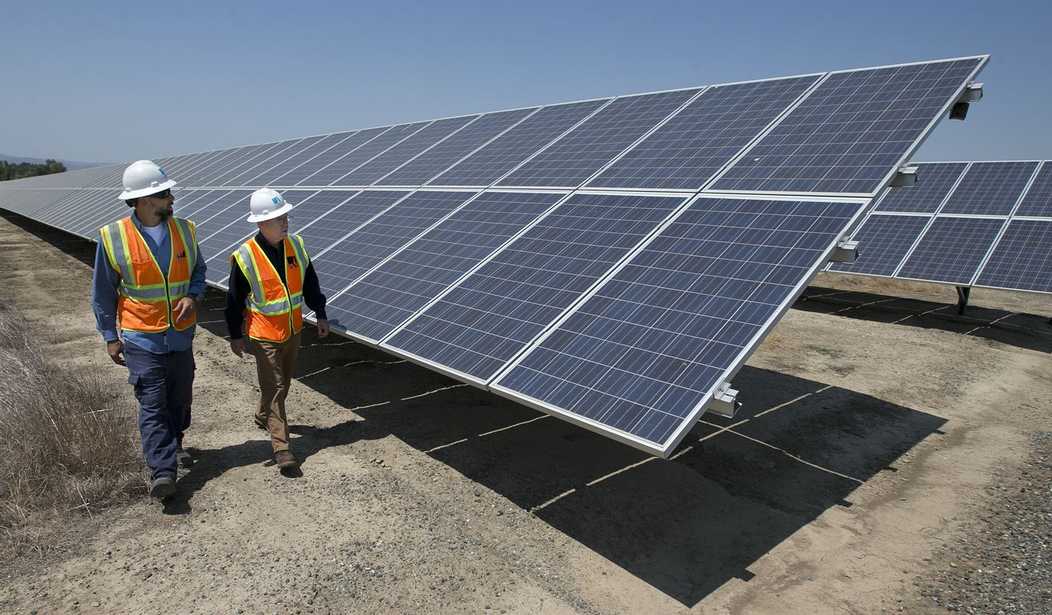
The Ivanpah Solar Power Plant, a sprawling facility near the California-Nevada border built with billions in federal support during the Obama-era economic stimulus program, is stuck in a costly dilemma.
Both the Trump and Biden administrations — along with the utility company that buys its power — have sought to shut it down, saying it underperforms, produces expensive electricity and has been overtaken by cheaper energy sources. But California regulators have refused to allow it to close, warning that closing the plant could strain the power grid.
The result is a costly standoff rooted in years of government decisions: shutting it down could leave taxpayers responsible for hundreds of millions of dollars tied to a $1.6 billion federal loan, while keeping it open means higher electricity costs for consumers.
There's really no decision to be made here, is there? The California legislators are (what a surprise) ill-informed, overcome by climate-change dogma, or both; they aren't capable of comprehending that California's energy woes go far beyond one failing solar farm, or that sometimes the best option is to cut one's losses and let the Ivanpah plant take its rightful place in the ash heap of American energy history.
At least one energy export is calling for just that:
"This project makes no economic sense to keep afloat, and the market itself has shown that," Daniel Turner, founder of the energy advocacy group Power The Future, told Fox News Digital.
"This is a boondoggle, like most of California's large projects are a boondoggle," he said, arguing it is being kept alive for political reasons, with costs ultimately passed on to customers.
To the customers, and to the taxpayers.
Read More: Weak Tornado, Strong Message: Solar Panels Shredded in Indiana
Autopsy of a Subsidy Zombie: How Sunnova Burned Billions and Collapsed
It always seems to end up this way, doesn't it? This is far from the first time something like this has happened; in 2020, Nevada's Crescent Dunes solar plant similarly failed, leaving taxpayers with a $737 million check in the form of Department of Energy (DOE) loan guarantees.
The owner of a big Nevada solar-thermal power plant that received $737 million in loans from the U.S. Department of Energy filed for bankruptcy on Thursday, according to a court filing, potentially leaving U.S. taxpayers with a whopping bill.
The project's failure is a blow to the DOE renewable energy loan program, which had already been criticized by Republicans as a waste of money after it backed failed solar panel maker Solyndra during the Obama administration.
Tonopah Solar Energy LLC still owes $425 million on its DOE loan, but reached a settlement under which the department will recover at least $200 million, it said in court documents filed in U.S. Bankruptcy Court in Delaware.
There are others, through the gamut of the solar-panel scheme, from failed, Obama-backed panel maker Solyndra, to Abound Solar, and many more; all failed, all broke, all proven to be an utter waste of time and money - and all sold to politicians and the public in the name of climate change. If these schemes were economically viable, one would think that at least some of them would have become a commercial success, or at least one of them would have lived up to the hype of clean, "green," inexpensive, and reliable energy.
They can't. As I am continually pointing out, you cannot have reliable, constant energy from an unreliable, intermittent, low-density source. That is the failure of both wind and solar schemes, to go along with the environmental damages, which are considerable, and anything but "green." The American people can't keep pouring money down these grid-scaled ratholes. Enough is enough.
Look, these technologies aren't completely useless. Solar panels, in particular, can be useful in niche applications. We use small ones right here on our property to keep the batteries in our trail cameras topped up. People we know who live off-grid do very well with solar power in summer, with southern Alaska's 20+ hours of daylight, although they require diesel or propane generators in the winter. I can see a use for these in places like Arizona, where the sun shines much of the time, but one would still need a grid hookup.
The point being, this is something that should be a consumer's choice, not a government-supported attempt at a grid-scale solution that won't ever work. When it's the consumer's choice, after all, there's much less chance of the taxpayers getting stuck with the bill.