






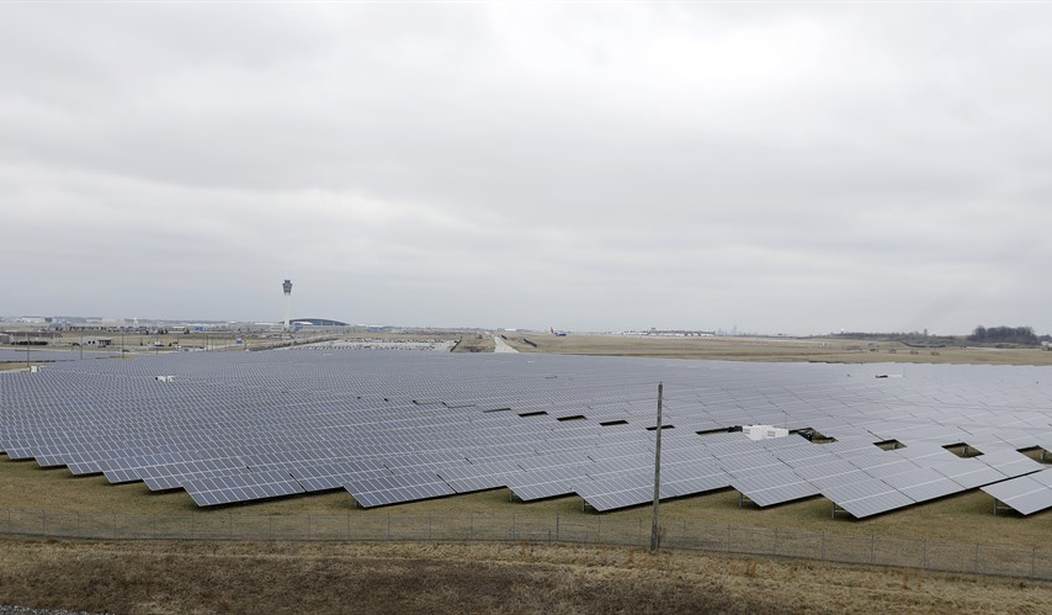
Ever notice how sometimes you stumble across a story where, about one paragraph in, you already know how it will end? Well, here's another; it turns out that building a huge solar panel farm in tornado country, sooner or later, is going to produce perfectly predictable results.
Case in point: A billion-dollar solar farm in Indiana has been wrecked by an EF-1 tornado - not a big one, as tornadoes go, but big enough.
An article from the German climate science critical Report24 reports on a major disaster involving a solar farm in Indiana that was destroyed by a tornado, underlying the fragility of PV systems as a source of energy.
On March 10, an EF-1 tornado (a relatively low-intensity storm) struck Wheatfield, Indiana. It directly hit the “Dunns Bridge I & II” solar projects, destroying a significant portion of the facility. According to Report 24, approximately 2.4 million solar modules were damaged or destroyed. Aerial footage showed rows of panels ripped from the ground and twisted metal frame (sic).
The facility is valued at approximately $1 billion. According to sources, manufacturer warranties often exclude tornado damage, potentially leaving the operator (NIPSCO) or customers with a massive bill for reconstruction, unless the government steps in with a bailout plan.
Warranties notwithstanding, didn't anyone stop to think that, yes, much of the upper Midwest, including Indiana, is tornado country? I grew up in Iowa - trust me, tornadoes are something people know about. We expect them. We build for them - unless we're building billion-dollar solar farms, it seems.
As for the environmental impact:
Report24 highlights the “toxic risks” of the destruction, suggesting that broken panels could leak heavy metals or other hazardous substances into the soil and groundwater.
Solar panels are reliant on various metals like lead and cadmium, although solar panel advocates would have us believe that these metals are contained and cannot leak into groundwater, even if the panel is damaged. But then, solar panel advocates also were in favor of building billion-dollar solar farms in tornado country.
Here's the best part:
The central point of the article is a critique of “green” infrastructure, pointing out that a nearby coal power plant remained unscathed by the storm, showing that traditional energy sources are more resilient and reliable than solar energy.
So now the local folks are getting their electricity from a good old, solid, reliable coal plant.
Read More: Lessons From Spain and Portugal About Solar Power
America’s Real Waste Problem: Wind and Solar Waste Is Piling Up
Report24 is a German publication that is sharply critical of the climate scold agenda - you can see the original article, auf Deutsch, here. While neither German nor American climate scolds seems interested in listening, this Indiana incident sure presents a stunning example of their short-sightedness.
I mean, who didn't know there are tornadoes in Indiana?
As I have said and written for years, there is a place for solar and wind power. Here in Alaska, we know off-grid people - you don't have to be very far off the highway to be off-grid here - that rely on solar and battery in summer, along with a diesel or propane generator in winter. It works for a household. Some of the installations can even be taken down and stored in winter, when we don't get much sunlight, to avoid damage from winter weather.
But on the grid scale? No. No low-density, intermittent, unreliable energy source will ever replace high-density, steady, reliable sources, like the coal plant in Indiana mentioned above, that just kept chugging along.
I'd like to think the green energy advocates would learn something from this incident. I'm guessing, however, that they won't.
Editor’s Note: Hollywood, academia, and liberal elites are out of touch with the average American.
Help us continue to report the truth about what 77 million patriots voted for by joining RedState VIP and using promo code FIGHT to receive 60% off your membership.



Join the Conversation
VIP members get the ability to comment on articles.